Uber’s in-app roadside assistance, run through a partner called Urgently, covers jump starts, towing, lockouts, flat tires, and fuel delivery, but it is not built to add range to a fully depleted EV battery pack.
Uber drivers who qualify for the higher Uber Pro Rewards tiers get free access to roadside help through Urgently, and drivers outside that tier can add coverage for a small monthly fee. That is a real benefit, and it is worth having in the app. But the service list Urgently advertises, jump starts, towing, lockout help, flat tire changes, fuel delivery, is the same list that has worked for gas cars for decades. A dead EV brings a different problem, and it is worth knowing exactly where the in-app option ends and where a dedicated mobile charging service picks up.
What Uber’s roadside partner actually offers
Uber’s roadside assistance runs through Urgently, a third-party provider available to drivers through Uber Pro Rewards. Drivers who reach Gold, Platinum, or Diamond status get a set number of free services each year, and drivers who have not hit those tiers can typically add coverage for less than a dollar a month. The services on offer are the standard roadside menu: towing, lockout assistance, fuel delivery, flat tire changes, and jump starts.
That jump start service is the part drivers most often assume covers a dead EV. It is worth understanding what “jump start” usually means in that context before you count on it during a real shift.
Why a jump start does not fix an empty EV pack
A jump start restores power to a car’s 12V system, the small battery that runs the computer, the locks, the lights, and the ignition electronics. In a gas car, that is usually the whole problem: dead 12V, dead car. In an EV, the 12V battery and the main high-voltage pack that actually powers the drive motor are two separate systems. A jump can bring a dead 12V EV back to life in minutes. It does nothing for a main pack that has run down to zero.
If your EV coasted to a stop because you simply ran out of range, a standard roadside jump start will not get you moving again. At that point, the typical path through a generic roadside provider is a tow, either to a charging station or to your home, because towing is the tool most roadside networks are actually equipped to offer. That is a slower, more disruptive fix for a problem a mobile charging truck solves by adding range on the spot instead of hauling the car somewhere else to get it.
The Burien-specific angle
Burien sits in the South King County corridor, between Seattle and SeaTac, and the housing stock tilts heavily toward pre-1980 buildings. Roughly 68.6 percent of Burien housing predates 1980. A typical older apartment along Ambaum Boulevard or 8th Street South has one outlet in the lot or none at all. A rideshare driver who lives in that building relies on public Level 2 chargers near Burien Town Square and the Highline Medical Center area.
The cycle goes like this. The driver plugs in overnight at a public stall, returns in the morning at 90 percent, and runs the SEA airport loop. A long queue at the airport plus a slow return trip to Capitol Hill drains the pack. The driver pulls into a parking lot with 4 percent battery and reaches for the Uber app. The app connects to Urgently. Urgently dispatches a tow truck. The driver waits two hours for a flatbed, gets dropped at a charger in SeaTac, and sits through a 40 minute Level 2 session. That is a half-shift gone.
The local failure mode is not “the app does not work.” It is “the app does what it was designed to do, and what it was designed to do is not what this EV needs.” A 12V jump would not help. A fuel delivery would not help. A tow is the only service on Urgently’s list that physically moves the car, and that is what gets dispatched.
When mobile charging is the faster answer
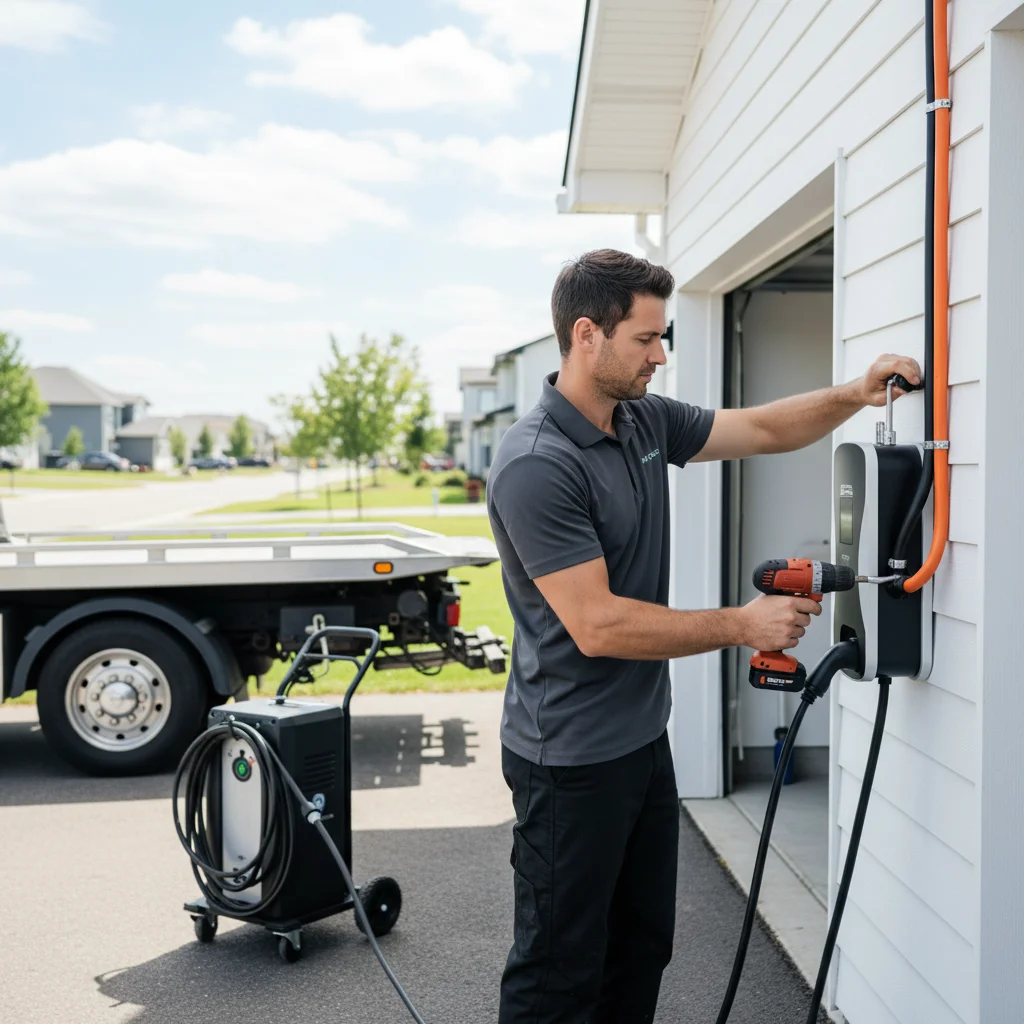
If your EV has an empty main pack and is otherwise mechanically fine, no collision, no warning lights, no fault codes, a mobile charging call almost always beats a tow on both time and hassle. The operator drives to you, adds roughly 10 to 20 miles of range, and you drive yourself to a fast charger or home, all without leaving your parking spot or handing your car to a tow operator. Full detail on how that comparison plays out across different stranding scenarios is in mobile EV charging versus a tow.
Our mobile EV charging and EV roadside assistance services both cover this exact situation across the metro, and the operator who takes the job confirms timing with you directly.
For Burien apartment dwellers in particular, mobile charging is the difference between getting back on the road in 30 minutes and losing half a shift to a tow and a public charging queue. A planned on-site top-up at your lot is even cheaper than an emergency call, and it removes the dependence on a public stall that might be occupied.
When Uber’s roadside option still makes sense
There are situations where the in-app option through Urgently is genuinely the right call. A flat tire, a lockout, or a true 12V-only failure with no range issue are all things that service handles fine, and if you already have free access through your Uber Pro tier, there is no reason not to use it for those specific problems. The gap only shows up when the real issue is an empty battery pack, which is a range problem, not a jump-start problem.
Frequently asked questions
Does Uber’s roadside assistance add range to an EV?
Based on the publicly listed service categories, Urgently’s roadside offering centers on towing, lockout, fuel delivery, flat tire repair, and jump starts, not on-site range charging. Coverage details can change, so confirm the current policy in your Uber app if you are relying on it.
What is the difference between a jump start and a mobile charge?
A jump start restores the 12V system that runs a car’s electronics and ignition. A mobile charge adds usable range to the main high-voltage battery pack. A dead EV can need either one, or both, depending on the failure.
How much does Uber’s in-app roadside cost?
Drivers who reach Gold, Platinum, or Diamond status in Uber Pro Rewards typically get a set number of free services per year. Drivers outside those tiers can usually add coverage for a small monthly fee through the app.
Is calling a local EV charging service instead of Uber’s roadside more expensive?
Not usually, once you weigh the time saved. Mobile charging is often faster than the tow path a generic roadside provider defaults to for an empty EV pack, and faster means less lost shift time. See real pricing in our mobile EV charging breakdown.
Can I use both, Uber’s roadside for some problems and a local EV charging service for others?
Yes. Many drivers keep the in-app option for flat tires and lockouts and call us directly for anything involving range or a dead 12V battery, since that is where the local network is built to move faster.
Whether it is the app’s roadside partner or your own judgment call, knowing what actually fixes an empty EV saves you a wasted wait. Call (206) 202-7018 to reach a local operator.