A stalled Tesla in Auburn doesn’t always need a service appointment. A parked car may need service, but a stranded car usually needs roadside help, a tow, a 12V jump, or an independent mobile charge. Check the Tesla app for current eligibility and coverage before choosing.
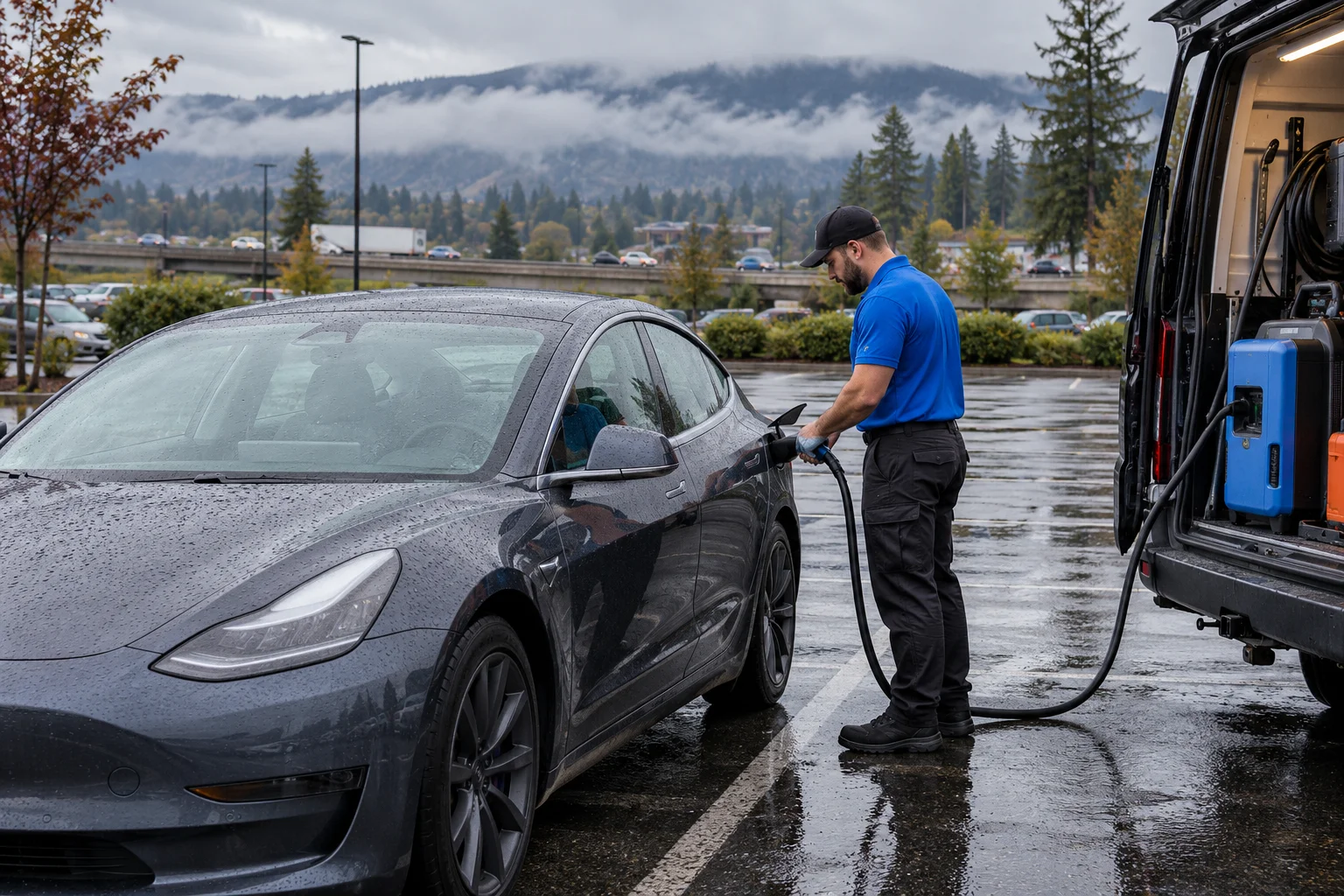
Mobile service and roadside solve different problems
Start with the car’s location and condition. A Tesla sitting at home or parked normally may be suitable for a scheduled service option. A Tesla blocking traffic, stranded beside SR-167, or unable to leave a parking stall needs a roadside decision first.
Current Tesla mobile-service eligibility for a specific repair in Auburn couldn’t be confirmed from the approved sources for this page. Available appointments, repair types, and locations can change. Open the Tesla app and enter the vehicle’s symptoms to see the options Tesla currently offers.
Tesla’s published North American roadside policy covers eligible vehicles for four years or 50,000 miles, whichever comes first. Roadside events unrelated to the battery or drive unit become the owner’s responsibility after the applicable New or Pre-Owned Vehicle Limited Warranty period. Your vehicle’s documents and the Tesla app should settle any coverage question.
Tesla says a warrantable breakdown that leaves the vehicle undrivable can include transportation for up to 500 miles to the nearest Service Center. Flat-tire service is listed for up to 50 miles when Tesla directly completes the tire repair or replacement. A depleted high-voltage battery is different. Tesla says it can assist, but that help isn’t financially covered.
Those distinctions make the first decision clearer:
- Choose the Tesla app when the vehicle may qualify for Tesla service or covered roadside help.
- Consider a tow when the car is damaged, unsafe to move, or needs repair elsewhere.
- Consider a 12V jump when the low-voltage system appears dead.
- Consider a mobile charge when the main battery is empty and the car can accept power.
Our guide to Tesla mobile service versus a roadside charge explains that split in more detail. Charge Pro SEA isn’t affiliated with Tesla. We connect drivers with licensed, independent local operators.
SR-167, SR-18, and Auburn parking stalls
Auburn’s location changes the roadside decision. SR-167, SR-18, Auburn Way, downtown lots, and the valley floor create different places to stop. The useful question isn’t simply whether the Tesla needs service. It’s whether the car can remain where it is while you arrange the next step.
If the Tesla stalls in an active travel lane or another dangerous position, prioritize people over diagnosis. Call 911 for roadway help. The WSDOT Incident Response Team responds to incidents on state highways. Its published materials cover situations ranging from disabled vehicles to major collisions, though they don’t specifically promise EV charging.
Washington law recognizes that a disabled vehicle may have no choice but to stop. It also requires the driver to arrange prompt removal. That can make towing the right first move when a Tesla stalls on SR-167 or SR-18, even if the underlying problem might later prove simple.
A Tesla in a downtown lot or marked parking stall allows a different assessment. Note whether the touchscreen works, doors unlock, exterior lights respond, and the charge port opens. Check the displayed battery level if the screen is available. Those observations help separate an empty traction battery from a low-voltage failure.
Don’t assume a nearby outlet or charging plug can solve every stall. The car must be able to communicate with the charging equipment and begin a session. A dead low-voltage system may prevent that process even when the main pack still holds energy.
Auburn had 3,422 registered EVs in the Washington Department of Licensing file updated in September 2026. For local roadside choices beyond Tesla-specific help, see our Auburn EV roadside assistance guide.
How to separate a dead 12V from an empty pack
A Tesla has a high-voltage traction battery and a separate low-voltage battery. Either system can leave the car unable to continue, but the symptoms and remedies differ.
An empty main pack usually follows a low displayed state of charge and declining available range. The screen may still work because the low-voltage system remains active. If the pack is depleted, Tesla says assistance may be available, but it isn’t financially covered under its published roadside terms. An independent mobile Level 2 charge may be another option.
The rescue equipment described by Charge Pro SEA uses a 240-volt, 9.6 kW source with a NACS connection. A typical rescue connection of 15 to 30 minutes adds roughly 10 to 20 miles of range. That’s the size of the charge, not an arrival promise or a guarantee of driving range. Conditions and the vehicle affect the result.
A low-voltage failure can look different. The doors, screen, locks, or charge controls may stop responding. The main pack may still contain energy, yet the car can’t activate the systems needed to drive or charge.
Tesla documents different low-voltage battery types by factory and production period. Some vehicles use lead-acid batteries, while later vehicles may use lithium-ion low-voltage batteries. Don’t choose a replacement from the model name alone. Confirm the vehicle’s model year, build information, and battery type before work begins.
A matched operator can jump and load-test the low-voltage battery on site. The operator can also replace a failed AGM lead-acid or lithium battery when appropriate for the model year. Stock and availability vary, so the operator should confirm the option and quote it before starting. The driver contracts with and pays that operator directly.
Tesla also warns owners not to use their Tesla to jump-start another vehicle. The instruction appears across Tesla model documentation. If your symptoms point toward the low-voltage system, review our Tesla 12V battery jump service before requesting help.
When to request a local rescue operator
Request a local rescue operator when the Tesla is in a workable location and the likely problem fits an on-site service. The clearest examples are an empty main pack that can accept Level 2 power or a dead low-voltage battery that needs testing and a jump.
Before calling, collect a few details. Share the Tesla model, model year, exact location, displayed battery level, warning messages, and whether the screen or locks respond. Say whether the vehicle is on SR-167, SR-18, Auburn Way, the valley floor, or inside a parking facility. Also mention clearance restrictions, locked gates, and the precise stall location.
These details help the operator decide whether mobile charging or low-voltage service fits. They don’t guarantee that the car can be restored on site. Collision damage, wheel damage, a high-voltage fault, or an unsafe roadway position may still require towing or Tesla service.
For an empty pack, confirm that the charge port is accessible. The operator’s NACS connection is intended for Tesla vehicles. The available mobile Level 2 output is 240 volts at 9.6 kW. A short charge aims to provide enough energy for the next practical move, not to refill the entire battery.
For a suspected low-voltage failure, don’t request a replacement battery until the vehicle details are checked. Tesla’s battery chemistry changed across production periods. A matched operator can identify the appropriate service, test the battery, and quote any replacement before starting.
Price and arrival timing must come from the operator. Charge Pro SEA doesn’t set rates, promise an ETA, perform repairs, or own rescue vehicles. We connect Auburn drivers with licensed, independent local professionals. The customer contracts with the professional directly.
Use the Tesla app first when you want Tesla to determine service eligibility or roadside coverage. If Tesla’s available option doesn’t fit an empty-pack or low-voltage situation, an independent operator may offer another path. Our Tesla roadside rescue service covers the information to prepare before that call.
When to call us
Call when your Tesla is stranded in Auburn and may need an on-site charge or low-voltage battery help from an independent operator. Move away from active traffic and call 911 first if the vehicle creates a roadway hazard.
Call us at (206) 202-7018 and we’ll connect you with a local EV rescue operator.