It is a moment many new Tesla owners in the Puget Sound experience. You are exploring the settings, checking the frunk, and then it dawns on you: there is no spare tire. This often leads to the next logical question. If there is no spare, surely the car must have run-flat tires, right. It is a reasonable assumption, but it is one that does not match the reality of Tesla’s design philosophy.
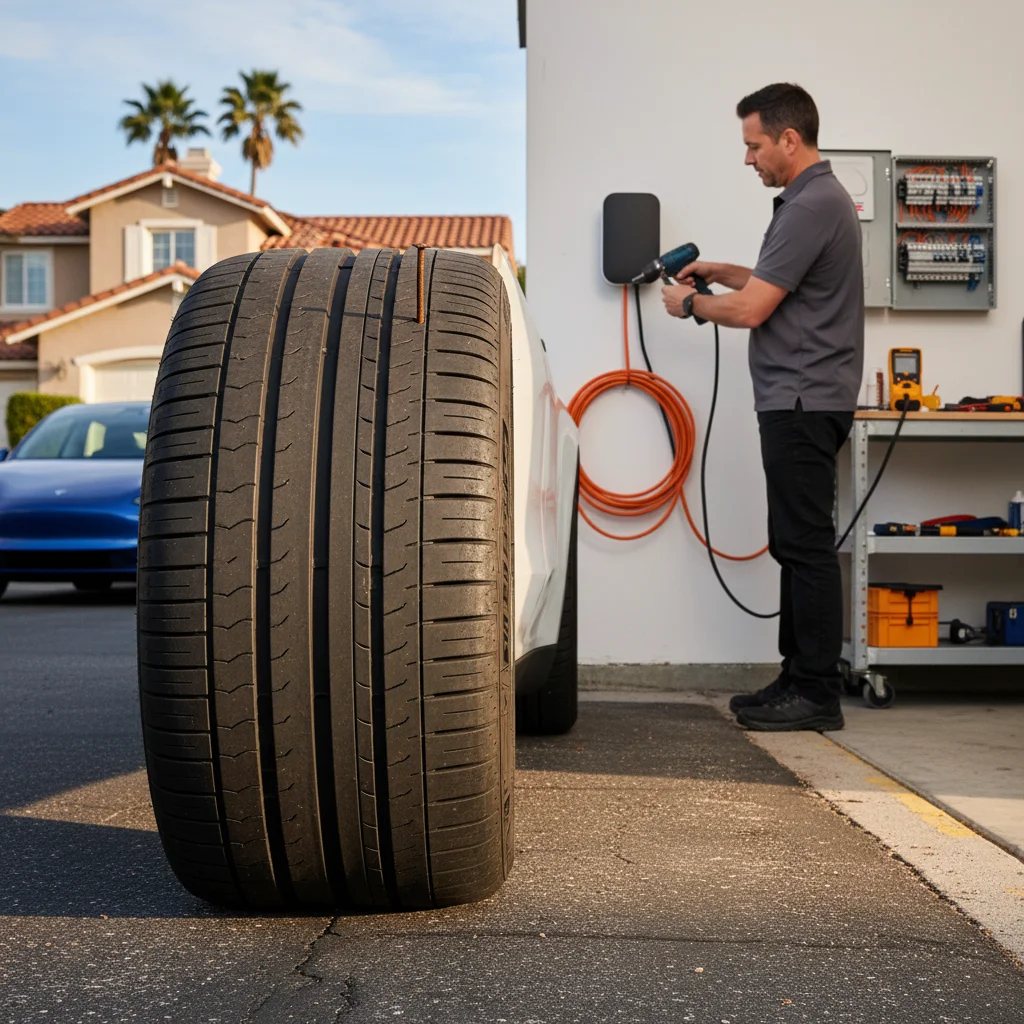
The short answer: no, and why Tesla chose foam-lined tires instead
Let us get right to it: no, Teslas do not come equipped with run-flat tires from the factory. While it seems like a missed opportunity for a car without a spare, Tesla made a very deliberate engineering choice to prioritize other factors: range, performance, and cabin quietness.
First, what are run-flat tires. They have heavily reinforced sidewalls that can support the vehicle’s weight even with a complete loss of air pressure. This allows you to continue driving for a limited distance, typically up to 50 miles at a reduced speed, to get to a service center. The convenience is obvious, but it comes with trade-offs. Run-flats are heavier, stiffer, and create more road noise. They are also more expensive to replace and, in many cases, cannot be repaired after a puncture.
For an electric vehicle, those downsides are deal-breakers. The extra weight and higher rolling resistance of run-flats would directly reduce the vehicle’s driving range. The stiffer ride would compromise the smooth, premium feel Tesla aims for. Instead, Tesla opted for something different: acoustic foam-lined tires. Many original equipment Tesla tires from manufacturers like Michelin and Pirelli come with a layer of polyurethane foam bonded to the inside surface. This foam’s only job is to absorb tire cavity noise and vibrations, making for a quieter ride. In an EV without engine noise to mask other sounds, road and tire noise become much more prominent. The acoustic foam is a comfort feature, not a flat-tire safety net.
What run-flats would and would not fix here
It is worth being clear about what a run-flat tire actually does for a stranded driver in the metro.
A run-flat would let you drive the 12 miles from the I-5 express lanes near Lynnwood to a tire shop after a slow leak. It would not change the fact that your 12V is dead at the Bellevue Park-and-Ride on a wet February morning. It would not replace the traction gear WSDOT requires on Snoqualmie or Stevens Pass during a winter storm. It would not put charge into a battery that ran down on the climb up to North Bend.
The acoustic foam lining on Tesla OEM tires does one thing: it makes the cabin quieter on I-405 commute pavement. It does not address the most common reasons a Tesla gets stranded here.
What happens when you get a flat in a Tesla
So, if you do not have run-flats and you do not have a spare, what are you supposed to do. That nail you picked up on the I-5 express lanes near Shoreline is not going to fix itself. The first thing that will happen is a notification from your car’s Tire Pressure Monitoring System. You will see a warning on your main screen, showing which tire is low and its current pressure.
Your immediate first step is to pull over to a safe location as soon as you can. Driving on a severely underinflated tire can quickly destroy the tire’s sidewall, making a simple repair impossible. Worse, it can damage the expensive alloy wheel itself.
Tesla’s official solution is a Tire Repair Kit. This small kit, sometimes included with the vehicle or sold as an accessory, contains a bottle of sealant and a small 12V air compressor that plugs into your car’s power outlet. The process involves screwing the sealant bottle to the tire valve, connecting the compressor, and injecting the thick sealant into the tire. The sealant is designed to coat the inside of the tire and plug small punctures in the tread area as the tire rotates. After injecting the sealant, you use the compressor to re-inflate the tire to its recommended pressure.
This kit is a temporary fix, designed to get you to the nearest tire shop. It has serious limitations. It will not work on large punctures, sidewall damage, or blowouts. Furthermore, many tire shops dislike dealing with sealant-filled tires. The gooey mess has to be cleaned out, and it can damage the TPMS sensor inside the tire, adding to your repair bill. Most shops will tell you a tire that has had sealant used in it cannot be properly patched.
Why a spare is not an option on Model 3, Y, S, or X
The absence of a spare tire in a Tesla is not an oversight. It is a core part of the vehicle’s design. There are three main reasons why you will not find a spare in any current Tesla model.
First and foremost is weight. A spare tire, plus the accompanying jack and lug wrench, can easily add 40 to 50 pounds to a vehicle. In an electric car, every single pound matters. Extra weight requires more energy to move, which directly reduces your driving range. By eliminating the spare, Tesla maximizes the vehicle’s EPA-rated range, a key selling point.
Second is space. Tesla’s “skateboard” architecture, with the battery pack forming the floor of the car, does not leave a natural, deep well for a spare tire like you would find in a traditional gas car’s trunk. Including one would mean creating a bulge that would compromise the flat load floor, reduce overall cargo capacity in the trunk or frunk, or even interfere with the battery pack or rear motor placement. The clean, spacious design is a hallmark of the brand, and a spare tire simply does not fit.
Finally, Tesla is following a broader industry trend. Many automakers, from BMW to Hyundai, have been phasing out spare tires for years in favor of inflator kits to save weight, space, and cost. While it can feel unnerving, the data suggests that debilitating flat tires are relatively rare, and for most minor punctures, the inflator kit or roadside assistance is considered a sufficient solution.
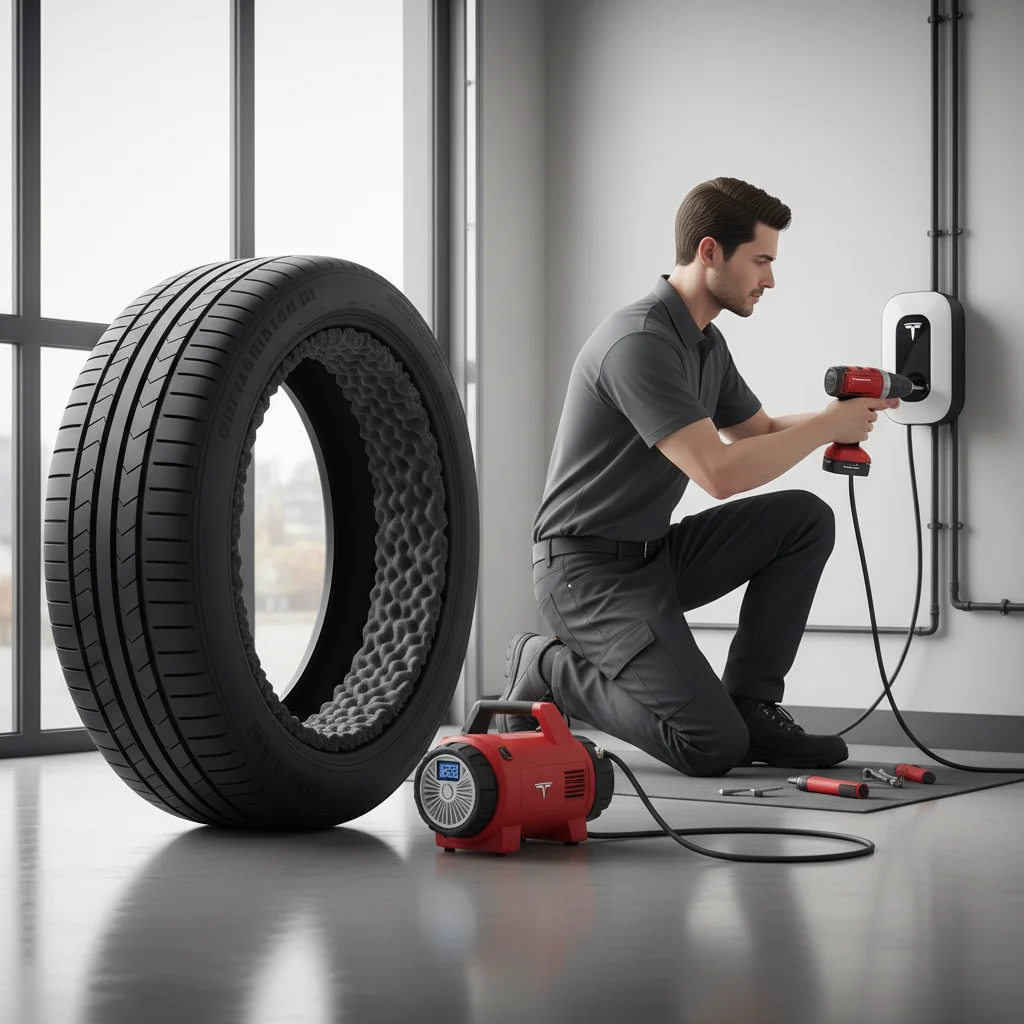
Roadside tire repair vs tow: what actually works here
When the tire repair kit is not enough, you have two primary professional solutions: calling for a mobile tire repair or getting a tow. Each has its pros and cons, and the best choice depends on your specific situation.
A mobile tire service can be convenient. They come to your location, whether you are at home in Kirkland or on the side of the road in SeaTac, and handle the problem on-site. If it is a simple nail or screw in the main tread of the tire, they may be able to plug or patch it right there. More commonly, they will bring a replacement tire and use their mobile equipment to mount and balance it on your wheel. The major advantage is getting back on the road quickly without needing a tow. The challenge, however, is tire availability. Teslas use specific sizes and types of tires, especially the acoustic foam models, and a mobile service might not have your exact tire in stock.
A tow is often the only option for more severe damage, like a sidewall gash or a complete blowout. Tesla’s own roadside assistance will typically arrange for a tow to the nearest Tesla Service Center or an approved tire shop. It is crucial that the tow operator uses a flatbed truck and knows the correct procedure for towing an EV, including putting the car in Tow Mode. While this ensures you get to a facility with the right equipment and a better chance of having the correct tire, it almost always involves more waiting time and the logistical hassle of getting yourself from the drop-off location.
What to do when you get a flat in the metro
Knowing when to abandon the DIY kit and call for professional help is key. If you get a flat anywhere in the metro, here is a simple framework for making the call.
First, assess your safety. If you are stopped in a dangerous location, like the narrow shoulder of SR 520 or a busy downtown street, do not risk your safety trying to use the repair kit. Your priority is to get yourself and your vehicle out of harm’s way. Call for help immediately.
Second, assess the damage. If you can see a large gash, an object sticking out of the sidewall, or if the tire is completely off the rim, the sealant kit will be useless. It is designed for small, clean punctures in the tread only. In these cases, you need a new tire, which means calling for a tow or a mobile tire service.
Third, if you attempt to use the tire repair kit and it fails to inflate the tire or the tire will not hold air, it is time to stop. Forcing more sealant in will not help and will only make a bigger mess. This indicates the puncture is too large for the sealant to handle.
When you do decide to call, you have options. Tesla’s own Roadside Assistance is built into the app and is the default for most owners. They will coordinate a tow or other service for you. However, wait times can be long, and the dispatched provider may not be an EV specialist. For metro drivers who need a more comprehensive or faster response, specialized services exist. While the focus here is on mobile charging and 12V battery issues, Tesla roadside rescue coverage means our EV-expert technicians are already on the road across the metro. If your flat tire incident becomes more complex, perhaps your 12V battery dies while you are waiting for help, the network is uniquely equipped to handle multiple EV-specific problems in a single visit.
When to call
A flat tire is a frustrating event, but it is rarely an emergency we handle directly. The specialty is the electric system. If you are stranded because you are out of charge, your 12V battery has died, or you are facing any other power-related issue with your EV, we are the team to call.
Call (206) 202-7018 to reach a local operator.