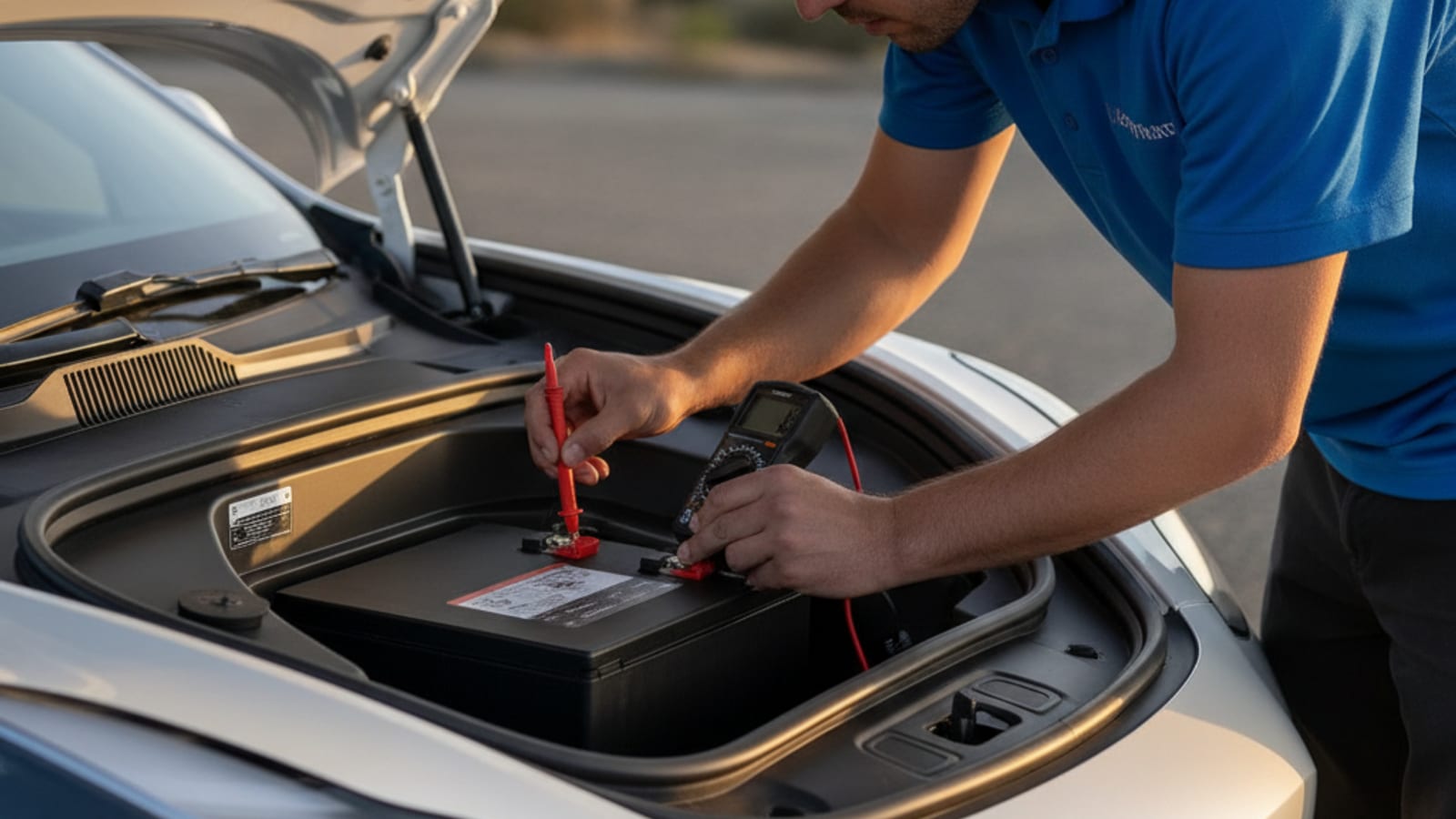
The 12V battery failure is one of the most misunderstood EV breakdowns because the symptom, a completely unresponsive car, looks like a catastrophic high-voltage battery failure. It is not. It is a small part that causes a major headache, and the local failure pattern in the Puget Sound is shaped by the climate.
What the 12V battery does in a Tesla
In a conventional car, the 12V battery starts the engine. In a Tesla, there is no engine, but the 12V system is still doing critical work:
- Powers the door handle actuators, especially the motorized pop-out handles on Model S
- Powers the trunk and frunk electronic latches
- Powers the main display and all network modules
- Powers the Battery Management System relay that enables the high-voltage pack to discharge to the drive motors
That last item is the critical one. If the 12V is dead, the BMS relay stays open. The high-voltage battery can be at 80%, fully charged, and the car will not move, open, or respond to the app.
When local Teslas see 12V failures
Owner forum data and dispatch patterns show a consistent timing story in the metro.
After extended parking without a charge source. Tesla’s 12V charges from the high-voltage pack through a DC-DC converter. When the car is parked and off, it cannot do this continuously, especially in older firmware versions. 12V batteries in 2018 to 2020 Model 3s that were parked for 5 or more days without charger access showed the highest failure rates in warranty claim data. Sea-Tac week-long parkers fall straight into this pattern.
In cold, wet weather. Lead-acid batteries lose capacity below 40F. The lowlands here sit in 35 to 45F for months, and the rain bands keep humidity high. The drain is heater and defrost load, not a hard freeze. Owners who park in unheated garages in Bellevue, Kirkland, or Edmonds see the worst of it.
After system updates. Several Tesla owner communities have documented 12V failures following over-the-air firmware updates that kept the car awake longer than normal during download and installation, draining the 12V.
On older batteries past their cycle life. Lead-acid 12V batteries in standard passenger vehicle service have a 3 to 5 year service life. Owners who do not know to replace them hit failures predictably at years 4 to 5.
What happens during a 12V failure
The failure typically presents one of two ways.
Gradual warning (if you catch it). The Tesla app shows a “12V battery low” notification. The car may still start but shows the warning in the instrument cluster. If you see this, schedule service within 1 to 2 days. The battery is within 24 to 72 hours of complete failure.
Sudden complete failure. You approach the car and nothing responds. Door handles do not pop out, the display does not light up, the key fob or phone key does not unlock. The car is completely unresponsive.
In the sudden failure case, many owners assume the worst, a high-voltage battery problem or major electronics failure. Usually it is the 12V.
How to diagnose and fix it on-site
Tesla provides a manual 12V jump port on most models:
- Model S: under the front frunk, near the firewall
- Model 3 and Y: under the hood, front right corner
- Model X: similar to Model S, accessed through the manual frunk release behind the front bumper tow-eye cover
Jumping the 12V port with a standard automotive jump starter or a portable lithium jump pack will typically wake the car up. The display comes on, doors unlock, the system becomes responsive. This is a diagnostic step, not a fix. If the 12V battery failed, it will fail again within hours of removing the jump source.
After jumping, the car needs a 12V battery replacement. This is a 30 to 45 minute repair, with sourcing the correct battery for the model, removing the old unit, installing the new one, and resetting the BMS through the Tesla Service app or an OBD-II reader that supports Tesla BMS reset.
The 12V vs high-voltage confusion
One common question: how do you know if the failure is the 12V or the high-voltage pack?
If the car is completely dark, no display, no door response, no response to the app, it is almost certainly the 12V. The high-voltage battery does not control any of those systems directly. High-voltage failures typically present differently: the car shows error codes, range drops, or the car enters limp mode but still powers on.
If you jump the 12V and the car wakes up showing 60% or higher charge in the high-voltage pack, your 12V failed and the HV pack is fine.
What this means in the Puget Sound
The local 12V failure pattern is partly climate and partly travel. Bellevue and Kirkland drivers who commute across the I-90 floating bridge or up I-405 spend extended periods in cold-soaked traffic. Sea-Tac week-long parkers leave cars in unheated garages where the 12V drains quietly. Edmonds and Lynnwood owners on the I-5 corridor park outside and let the rain settle into every connector. None of these are unusual conditions, but together they make 12V replacement a more common event than the metro’s mild reputation suggests.
The repair itself is not exotic. The tricky part is recognizing the symptoms and not blaming the high-voltage pack for a problem the small battery is causing. Our Tesla 12V battery jump service connects you with operators across the metro who confirm the access point for your model before doing anything.
Frequently asked questions
How do I know if my Tesla’s 12V battery is going bad?
The Tesla app sends a push notification for “12V battery low.” You may also see it in the instrument cluster. If you have owned the car 3 or more years and have a lead-acid 12V, consider proactive replacement before the failure catches you somewhere inconvenient.
Can I jump a Tesla with another car?
Yes, but use the Tesla’s 12V jump port, not the high-voltage charging port. Use a standard automotive jump cable or jump pack connected to the 12V terminals. Never attempt to jump from another vehicle’s traction battery.
How long does mobile 12V work take in the metro?
A mobile replacement runs roughly 35 to 50 minutes of on-site work once the operator is set up. Operators carry common Tesla 12V battery specs with them. If the exact spec is not on board, the operator tells you what sourcing it involves before you commit.
If your Tesla is completely unresponsive, call (206) 202-7018 and we will work it out on the phone whether it is the 12V or something else, and connect you with a local operator.