You came to Point Defiance for the gardens, the Owen Beach loop, or the ferry to Vashon Island. You parked at the main lot off Pearl Street, walked the trails, came back to a cold silent car, and the pack or the 12V has given up. Being stranded in a busy tourist area with a non-responsive EV can feel like a major roadblock to the rest of your day.
Why running out of charge happens here
Point Defiance draws visitors from across the metro, including a lot of drivers from Tacoma, Lakewood, University Place, and Gig Harbor who pull in for the day. Constantly monitoring the EV battery level takes a backseat when there is a zoo, a rose garden, and a ferry ride to think about. Many drivers are unfamiliar with the charging infrastructure around the park, or they miscalculate their range. The slow drive through the park and back, plus cabin climate on a humid day, can deplete the battery faster than anticipated. Before you know it, that green bar disappears.
The ferry holding lane adds a separate hazard. Drivers waiting for the Point Defiance to Tahlequah run sometimes sit in line for 40 minutes or more with cabin heat or A/C running. A driver who left home with 30 percent and arrives at the dock with 12 percent may find the wait pushes the pack below the level needed to drive out of the holding lane when the ferry loads. That is a separate problem from the main park lots, and it ends in a different spot.
Are the public chargers at Point Defiance reliable
The park itself does not host a fast-charging cluster. Most visitors rely on the chargers at nearby stops, the Pearl Street retail area, the 6th Avenue corridor in Tacoma, or the cluster near the Tacoma Narrows Bridge. During peak tourist seasons, weekends, and any major holiday, those spots are highly coveted and frequently occupied. It is not uncommon to circle lots for extended periods, only to find stations in use or out of service.
Imagine the frustration of navigating the park’s one-way loop with a critically low battery, only to discover a charger is broken or inaccessible. If you are already at zero, those public options are not a practical solution. You need immediate power, not a hopeful wait.
First steps: finding a safe place to pull over
When your EV’s battery warning turns into a full shutdown, your immediate concern must be safety. Panicking only makes it worse. Your first step is to calmly find the safest possible location to pull over. At Point Defiance, this often means carefully maneuvering into an unoccupied parking spot, the far end of a parking aisle, or a wide shoulder on a less congested road like Pearl Street or the road into the ferry terminal. Engage your hazard lights immediately. Never block active traffic lanes, fire lanes, or emergency access.
Once safely situated, pinpoint your exact location. Note specific landmarks, the entrance you came in, the ferry dock if you are in the holding lane, or the Five Mile Drive loop. Precise location details, including cross streets, will significantly speed up rescue efforts. Even if your EV is completely dead, most models allow you to shift into neutral, potentially letting you push it a short distance out of an active traffic flow. Once secure, focus on getting power.
Why a tow truck can be a bad idea in a crowded park lot
Your first thought might be to call a traditional tow truck service. While towing is necessary for some EV issues, it is often a poor choice for a dead battery in a crowded area like Point Defiance. The logistics of getting a large tow truck into a packed parking lot, navigating tight turns, and safely loading an EV with a dead 12V battery can be a nightmare. It creates traffic jams, blocks other vehicles, and wastes time.
Improper towing can also damage your EV, especially if the operator is not experienced with electric vehicles’ specific requirements. Many standard tow services are not equipped for EVs, which often have unique towing needs. A tow truck can only take you to a charging station, which might be miles away, or to a repair shop, prolonging your ordeal. For an out-of-charge EV recovery, you need power, not a complicated time-consuming tow.
How mobile charging gets you back on the road without a tow
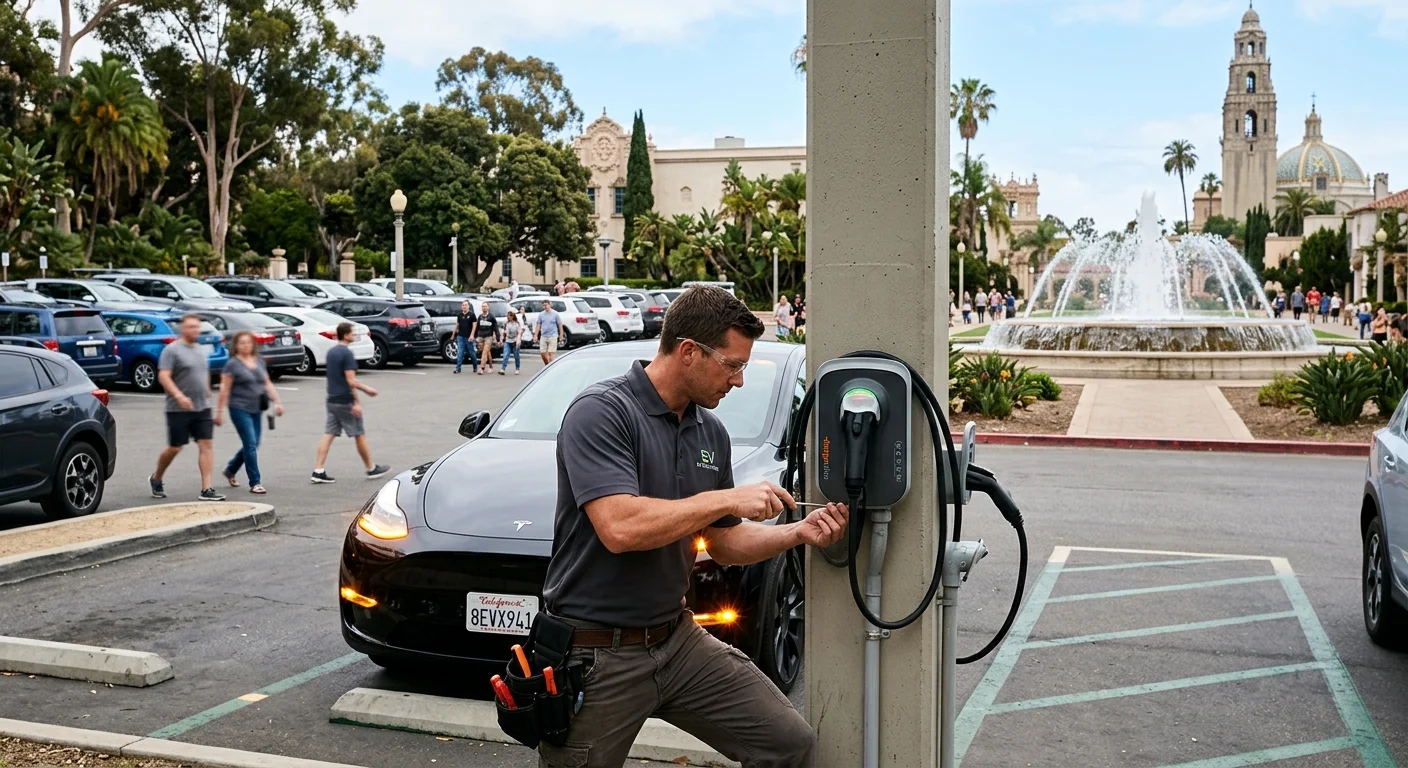
This is where the referral line’s specialized service makes a difference. Instead of waiting for a tow truck, enduring a slow journey to an off-site charger, and then waiting again for your vehicle to charge, our mobile EV charging service brings the solution directly to you. The rescue vehicles the operators we work with drive are compact charging stations on wheels. They carry the equipment needed to deliver a Level 2 charge tailored to your EV’s specific requirements.
Unlike bulky tow trucks, the operator’s mobile units can more easily navigate congested streets and parking lots around Point Defiance and the ferry terminal, meaning a faster arrival. The operators we send are experienced with all EV makes and models, ensuring a safe and efficient charge every time. In most cases, the operator provides sufficient power in 15 to 30 minutes to get you comfortably to the nearest reliable public charger or even back home. It is a precise, efficient solution designed to turn a high-stress situation into a quick manageable one.
Getting help fast: calling for rescue near the ferry
When you find yourself stranded with a dead EV at Point Defiance or in the ferry holding lane, knowing who to call for fast effective help makes all the difference. The referral line connects you with local specialists in out-of-charge EV recovery. We understand the specific nuances of navigating busy tourist areas and the urgent nature of your situation. The detail that matters most is pinpointing your location, whether you are at the main park lot or sitting in the ferry queue.
We gather necessary details and connect you with a mobile EV charging operator who can deploy directly to you. The person who turns up is set up for an EV rather than a gas car. Our goal is to minimize your downtime and turn a stressful incident into a minor blip. Do not let a dead battery cast a shadow over your visit.
If you are stuck in the ferry holding lane, the operator’s vehicle may be able to reach you directly in the queue depending on the ferry operator’s policy and the lane geometry. If not, the operator can advise on the next move, including a tow to the nearest charger if lane access is restricted. Our out-of-charge ferry guide covers the same dynamic for the Mukilteo holding lane, where it is a more common pattern.
When to call us
If your EV battery is dead or critically low at Point Defiance, in the main lot, on Five Mile Drive, or sitting in the ferry holding lane, a mobile EV charging operator is the safest and fastest solution. Avoid the complications of towing and get direct power where you need it, when you need it.
Call (206) 202-7018 to reach a local operator.