Running out of charge on I-5 through Federal Way is one of the more stressful freeway strandings in the South King corridor. The stretch from Tukwila south through Federal Way and on toward Tacoma moves heavy commuter traffic all day, and South King apartment renters without a home plug carry zero margin when the heater is running on a wet winter night. A mobile EV rescue gets 10 to 20 miles of range into your car on the shoulder, no tow needed.
Why the Federal Way corridor drains EV range faster than you expect
I-5 through Federal Way is about 14 miles of stop-and-go commuting between the I-405 interchange in Tukwila and the SR-18 junction at the south end of town. That is not far on its own. The problem is what happens inside those miles on a typical weekday.
South King commuter traffic peaks in the morning and again in the late afternoon. Drivers heading north into Seattle or south toward Tacoma share the freeway with freight from the Port of Tacoma, which means frequent speed changes, heavier braking zones, and longer intervals at low speed. Stop-and-go driving pushes real-world energy consumption well above the EPA highway number.
The grade changes on this stretch matter too. I-5 dips and rises through SeaTac, Des Moines, and Federal Way as it crosses the Green River valley and the surrounding plateau. Those are not steep climbs, but they add up on a car already running low.
Then there is the wet cold factor. Federal Way gets roughly 38 inches of rain a year and overnight temperatures sit in the 30s and low 40s for months. EVs retain less than 80 percent of their range at freezing, and the cabin heater plus defrost draws heavily. A driver who budgeted “just enough” range to reach home in Bellevue often finds the math stops working around South 320th Street.
Charging gaps in Federal Way and South King
Public Level 2 and DC fast charging in South King is thinner than drivers expect, especially if you are coming from the Eastside or from Tacoma where Supercharger coverage is tighter.
| Location | Type | Approximate distance from I-5 shoulder |
|---|---|---|
| Federal Way area retail | Level 2 (ChargePoint, Flo) | Varies, scattered near mall exits |
| The Outlet Collection | Tesla Supercharger (small bank) | ~0.5 miles off I-5 exit 143 |
| Redondo area | Level 2 (workplace/retail) | Varies |
| SeaTac city | Sparse Level 2 | Varies |
The practical problem: if you are stranded on I-5 between the South 320th Street exits and the SR-18 interchange, there is no Supercharger you can roll to without leaving the freeway. A car in low-power limp mode with degraded traction output should not be navigating cross-street traffic in that state.
If you do not make it to the exit, you are calling for help from the shoulder. That is exactly when mobile EV charging is the right call instead of a tow.
Safe-shoulder protocol on a busy interstate
The Federal Way section of I-5 sees heavy truck and commercial vehicle volume. Northbound freight from Tacoma stacks up through Federal Way. The right shoulder between exits is often narrow, and in some stretches there is no shoulder at all through active construction zones.
If your EV is losing power on this stretch, these steps keep you safer:
- Signal right and begin moving toward the shoulder the moment the range drops below 5 miles, not at zero.
- Flip hazards on immediately, even before you have committed to pulling over.
- On I-5 through Federal Way, the right shoulder is your only option. The center divider is concrete barrier with no walkable clearance.
- Once stopped, stay in the car with your seatbelt on. The Federal Way section is not a stretch where you want to stand outside on the right.
- If you have stopped in a construction zone or where the shoulder has active lane closures, call 911 first. Washington State Patrol will alert traffic management before you call us.
- Pop your hood or put a visible marker in the rear window. A running vehicle on the shoulder looks like a parked truck to distracted drivers at freeway speed.
We need your direction of travel, the nearest freeway exit or mile marker, and your car’s make and model when you call.
How mobile rescue works on I-5 through Federal Way
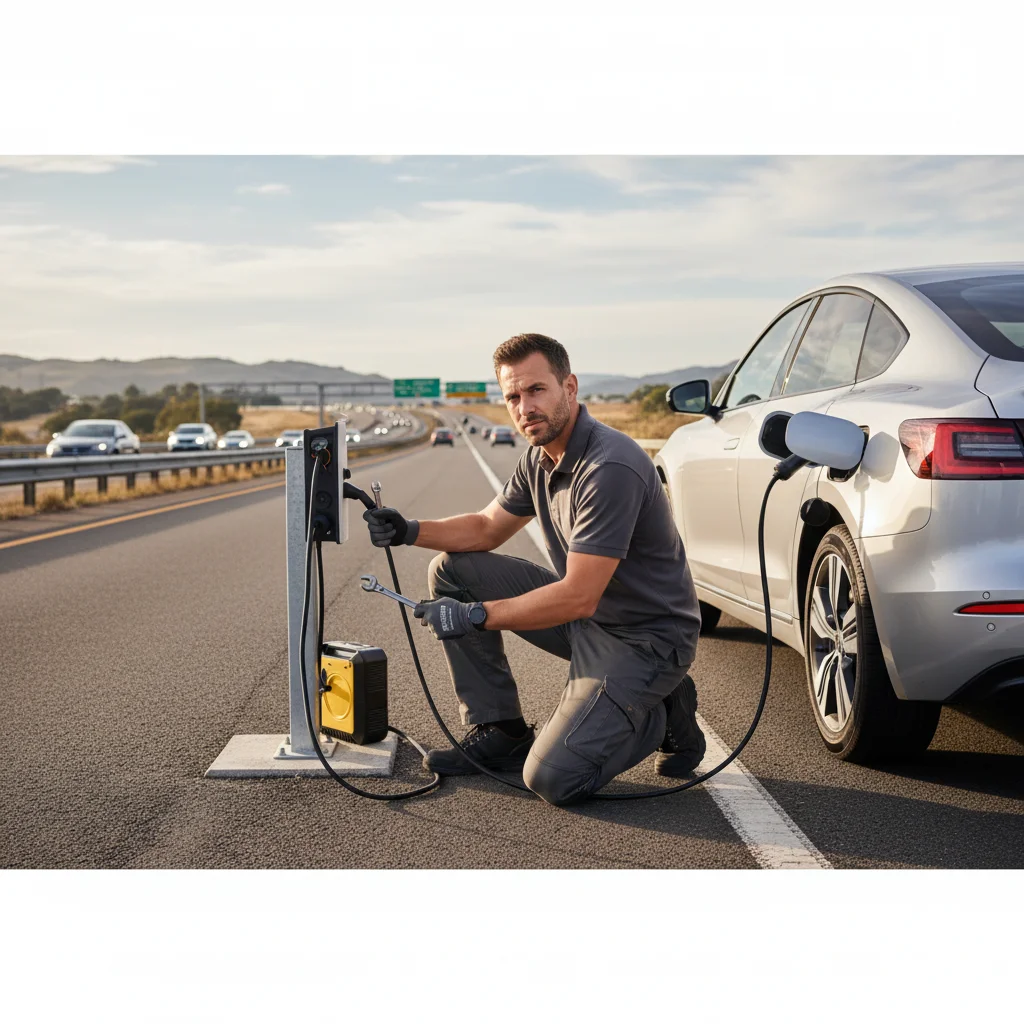
The mobile rescue vehicles in our network carry a 240V Level 2 source, a NACS plug, and a CCS adapter. The operator pulls onto the shoulder behind you, sets reflective safety cones at the rear approach, and plugs in with a long cable that reaches without blocking the travel lane.
In 20 to 30 minutes on-site the operator adds 10 to 20 miles of range. That is enough to reach the Federal Way Supercharger near The Outlet Collection, to roll home to a working Level 2 charger, or to clear the corridor to the next working public charger.
If your 12V battery has also failed, the operator carries jump equipment. A dead 12V is different from a depleted traction pack but both leave you immobile. Our out-of-charge recovery and emergency EV roadside assistance pages cover the full scope.
We cover Federal Way directly, along with SeaTac, Des Moines, Auburn, Kent, and Tukwila. The Federal Way landing page at EV charging Seattle WA lists the typical response window for a freeway shoulder call.
When a tow is the right call instead
A tow is the right answer when the EV is showing red dashboard warnings about powertrain failure, high-voltage battery error, or 12V system fault. Those messages indicate a real mechanical or electrical problem that mobile charging will not fix. In that case, a flatbed to a service center is the only safe move.
But for the far more common “ran out of range on the freeway” scenario, a mobile charge gets you moving under your own power, and the bill is smaller than a tow plus a charging session at the destination.
When to call us
If you are stranded on I-5 through Federal Way with no charge, an operator can reach the shoulder with a Level 2 source and get you enough range to clear the corridor. We confirm the right approach for your situation on the phone, give you a real ETA, and dispatch.
Call (206) 202-7018 to reach a local operator.
Frequently asked questions
Does mobile EV rescue cover I-5 through Federal Way at night?
Yes. The I-5 corridor through Federal Way moves freight and shift workers around the clock, so early-morning and late-night strandings are common. The operator confirms their arrival window on the call.
Can a stranded EV block traffic on I-5 near Federal Way?
It can if you lose power in an active lane, which is why pulling over early matters more on this stretch than anywhere in the metro. Shoulder width is limited between some exits. If you are stopped and partially in a travel lane, call 911 first.
Why does cold rain drain my EV battery so fast in Federal Way?
Cabin heat and defrost draw heavily from the traction pack on a wet cold night, and the rolling grades through the corridor add their own load. Drivers who calibrated habits to summer numbers often find the math fails in January.
What if the nearest Supercharger isn’t within rolling distance?
That is exactly when mobile rescue makes sense. The operator brings energy to your shoulder, no flatbed needed. You can make it to the Federal Way Supercharger or to the next working public charger.
Can the operator help a non-Tesla EV on I-5 Federal Way?
Yes. Operators carry a CCS adapter and serve most non-Tesla EVs: Hyundai Ioniq 5 and 6, Kia EV6, Rivian, Ford F-150 Lightning, Chevy Bolt, Volkswagen ID.4, and others. Our non-Tesla EV rescue service is built for this.
Call (206) 202-7018 to reach a local operator.