The sinking feeling of watching your EV’s range drop to zero is real. It is worse when you are miles from the nearest charging station, maybe stuck on I-5 near Arlington or navigating a long Everett Snohomish commute in cold rain. The Puget Sound has one of the highest EV densities in the country, with King County alone at 144,257 registered EVs, but even here running out of charge happens. When it does, you need a quick reliable solution right where you are. That is what mobile EV charging is for. A referral line matches you with a licensed independent operator who brings 240V to your car, and the operator quotes before any work starts.
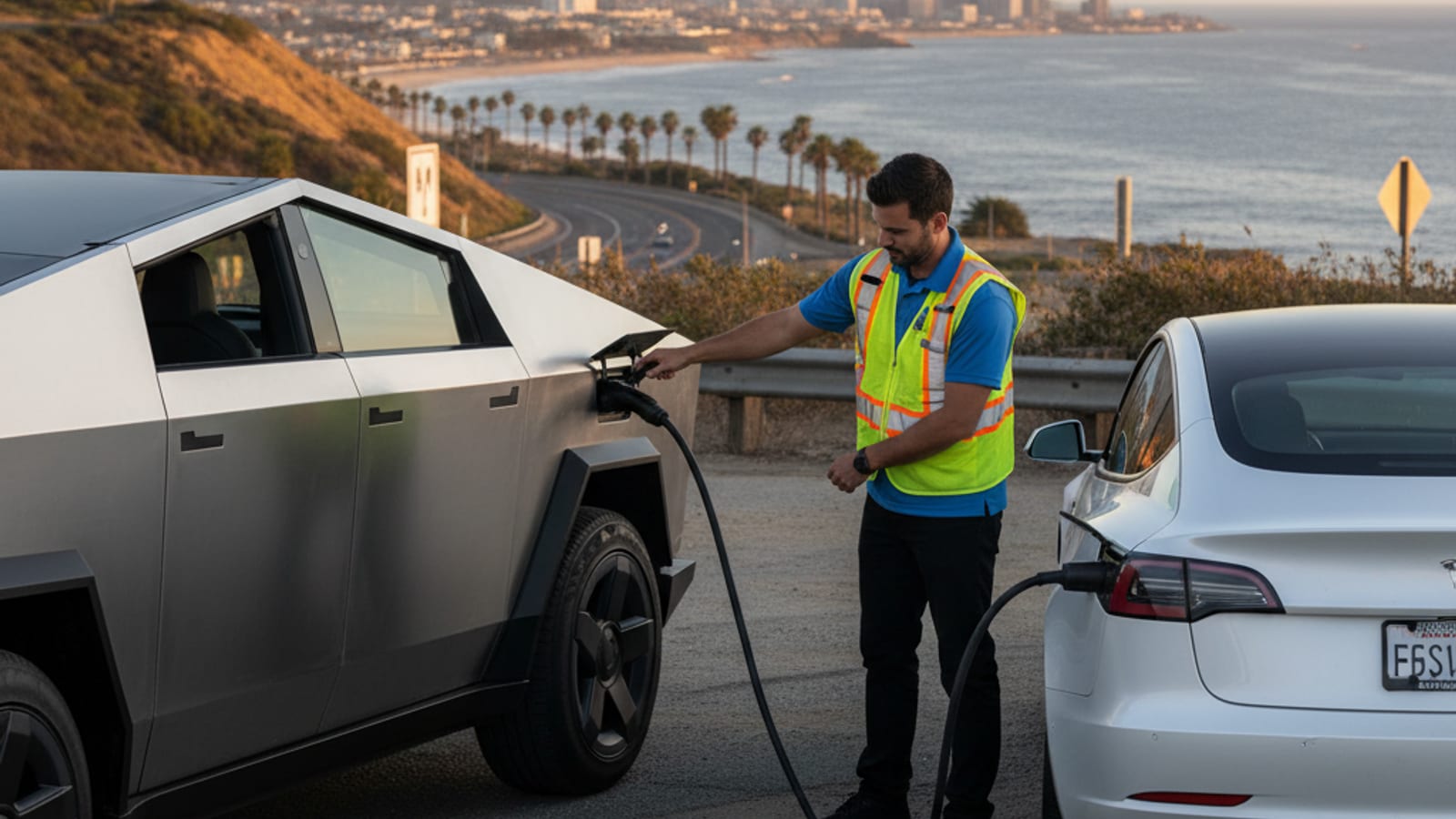
Why mobile EV charging matters in the Puget Sound
The metro has a fast-growing public charging network, with thousands of Level 2 and DC fast chargers across King, Snohomish, and Pierce counties. Yet coverage is uneven. Bellevue, Kirkland, Redmond, and Sammamish have a high density of Teslas and associated charging infrastructure. Drive north past Everett or east past North Bend, and the charger density drops. Range anxiety is real for drivers on the long corridors.
Several factors unique to this metro can leave EV drivers stranded:
- Geographic charging deserts. The US 2 corridor from Monroe through Gold Bar has long stretches with no public fast chargers. A miscalculation there can easily lead to a roadside stop.
- Elevation changes. The I-90 climb from North Bend to Snoqualmie Pass gains roughly 1,500 feet of elevation, and the westbound descent does not always recoup what the climb took. The SR 18 climb from Auburn toward Hobart does the same thing on a smaller scale.
- Cold rain impacts. The metro lives in the 35 to 45F band for months of the year. Industry data from Recurrent Auto shows about 78 percent of rated range at 32F, and AAA testing has measured cabin heat loss of roughly 40 percent at 20F. Cold-soaked packs at a Bellevue park and ride or a Marysville trailhead will not deliver their rated range.
- Unexpected detours or traffic. A sudden I-5 closure in South King County, a stall on I-405 near Renton, or a chain requirement on Snoqualmie Pass can extend travel times and deplete the battery faster than anticipated.
These situations highlight the need for a service that does not just tow your car, but actually brings the charge to you.
How the referral line delivers mobile EV charging
When you call our number, the first person on the line is a referral coordinator. We are not the operator. We connect you with one. The coordinator confirms your vehicle, your location, and the kind of help you need, then matches you with a licensed independent operator in our network who carries the right gear. The operator calls you back with a quote and an ETA before any work starts.
The operator vehicle
The mobile EV charging unit is housed inside an operator vehicle. This is not just for show. The operator vehicle’s capabilities make it an ideal rescue vehicle. It carries a 240V outlet that is powerful enough to deliver a meaningful charge quickly. Operators carry both a NACS plug for Tesla vehicles and a CCS adapter for all other EV makes and models. This setup ensures compatibility with virtually any electric vehicle on the road today, whether you drive a Tesla, Rivian, Ford F-150 Lightning, Hyundai Ioniq, or any other EV.
The charging process on-site
Once the operator vehicle arrives at your location, the technician will safely connect to your EV’s charge port. Safety matters, especially on busy I-5, I-405, or I-90 shoulders, or on remote roads past North Bend. The goal is to provide enough charge to get you moving again. Typically, the operator gives you enough range to comfortably reach the nearest public charging station, your home, or another safe destination. This is not a full charge, but a critical boost to get you out of a bind.
We serve the whole metro, from the dense urban centers of Seattle and Bellevue to the small towns along US 2 and the edge of Pierce County. Whether you are stranded on I-90 near North Bend, or in a coastal neighborhood like Edmonds, we connect you with an operator who covers your area.
Getting roadside help fast: what to do when you are out of charge
Finding yourself with a dead EV battery can be stressful, but knowing what to do next can make all the difference.
Step 1: Safely pull over
If you notice your EV’s range getting critically low, try to pull over to the safest possible location. This might be the shoulder of a freeway, a parking lot, or a quiet side street. Turn on your hazard lights. For safety tips when stranded on a busy road, the Washington State Patrol offers roadside safety guidance on its website.
Step 2: Call the referral line
Call (206) 202-7018 to reach a local operator. When you call, be ready to provide:
- Your exact location (cross streets, freeway mile marker, or GPS coordinates).
- The make, model, and year of your electric vehicle.
- A brief description of your situation.
We confirm your details and match you with an operator who can reach you. We cover the whole metro, and the operator is straight with you about timing and the scope of the work.
Step 3: Wait safely for assistance
While you wait, stay inside your vehicle if it is safe to do so. If you need to exit, do so on the side away from traffic. The operators we work with will keep you updated on their estimated arrival. For more detailed advice on handling this situation, read our blog post: Out of charge on the freeway: what to do.
Mobile charging versus traditional towing: a clear advantage
When your EV battery dies, towing is often the first thought. However, mobile EV charging offers significant advantages, especially for electric vehicles.
| Feature | Mobile EV charging | Traditional towing |
|---|---|---|
| Service provided | On-site battery boost, enough range to get to a charger or home | Vehicle transport to a charging station or service center |
| Time to resolution | Typically faster, immediate charge delivery | Involves loading, transport, unloading, then charging |
| Vehicle handling | No heavy lifting or risk of damage from towing | Risk of damage if not towed correctly, flatbed required |
| Convenience | Get back on the road from your current location | Requires transfer to another location before charging |
| Cost efficiency | Often more direct than a full tow | Towing fees can vary widely, plus charging costs |
| Safety | Minimized roadside time, quick resolution | Extended roadside time during loading and unloading |
Towing an EV requires specific equipment, usually a flatbed truck, to avoid damage to the electric motors or battery pack. Not all tow truck operators are equipped or trained for EV-specific towing. With mobile charging, your vehicle stays on the ground, eliminating these risks. Our service focuses purely on providing power, a specialized solution for a specialized vehicle.
For a deeper look into the pros and cons, check out our comparison: Mobile EV charging vs. a tow.
Preventing future EV stranding incidents in the Puget Sound
While our referral line is here when you need us, prevention is always better. Understanding your EV’s range and the local charging infrastructure can save you from a roadside emergency.
Plan your routes and charging stops
Always check your route on a charging network app or your in-car navigation before you leave. These tools show charger locations, availability, and charging speeds. For longer trips from Seattle, such as to Stevens Pass or down to Portland, plan charging stops carefully. The US Department of Energy’s Alternative Fuels Data Center offers resources for planning EV trips.
Understand range reduction factors
- Speed: Higher speeds on freeways like I-5 or I-405 consume battery faster.
- Temperature: The cold damp winters of the Puget Sound can reduce range by 20 percent or more. Pre-conditioning your cabin while plugged in helps.
- Terrain: The I-90 climb to Snoqualmie Pass is a prime example of how elevation gain impacts range. Regenerative braking on the descent helps, but it does not fully recoup the energy used climbing.
- HVAC use: Running the heater or defroster, especially on full blast, uses significant energy in cold rain.
- Tire pressure: Properly inflated tires improve efficiency.
Monitor your 12V battery
Most EVs still rely on a 12V battery for starting up the vehicle’s auxiliary systems, even though a high-voltage battery powers the drivetrain. A dead 12V battery can leave your EV unable to start, even if the main battery has plenty of charge. If your Tesla will not start, it might not be the main battery. Learn more about this common issue: Tesla won’t wake: is it the 12V or the pack?. Our network also offers Tesla 12V battery jump start services.
Take advantage of local utility EV programs
Puget Sound Energy offers Up and Go Electric pricing and Flex EV charging rates designed for EV owners. Seattle City Light offers a residential EV rebate plus a Multifamily EV Charging Program that helps apartment buildings add stalls. Tacoma Power and SnoPUD run their own residential rebate programs. These programs cut home charging costs and reduce the chance you will run out mid-commute.
The Puget Sound EV ecosystem
The metro’s commitment to electric vehicles is evident. We see a growing number of EVs on our roads daily. While public charging infrastructure is expanding, it is a gradual process. Tesla Superchargers are located in key areas like Factoria, Bellevue Square, Redmond Town Center, and the Southcenter mall cluster, but significant gaps remain on the US 2 corridor east of Monroe and on the long stretches of I-5 between Olympia and Centralia for drivers heading south.
The convenience of charging at home, often overnight, is a major benefit for many EV owners. However, for those unexpected moments when you miscalculate your range, or when a planned charging stop is unexpectedly unavailable, knowing there is a reliable mobile EV charging option is invaluable. Our referral line fills that gap.
Frequently asked questions
How long does a mobile charge take?
The operator heading to your location confirms their own window, which depends on traffic and distance. Once on-site, providing enough charge to get you moving usually takes 15 to 30 minutes. The exact time depends on your vehicle’s battery state and your immediate needs.
What types of EVs do you service?
The operator is equipped with both a NACS plug for Tesla vehicles and a CCS adapter, ensuring connection to virtually any EV that needs a charge. This includes non-Tesla EVs like Rivians, Ford Lightnings, Hyundai Ioniqs, and more.
How much does mobile EV charging cost?
Pricing is set by the independent operator in our network. The cost depends on your location within the metro and the specific service needed. The operator quotes you before any work starts and bills you directly, so you know the price before the charge begins.
Is it safe to charge an EV on the side of the road?
Yes, the operators we work with are trained in roadside safety protocols and use appropriate safety equipment, including cones and flashing lights, to secure the area around your vehicle. We recommend you remain in your vehicle if it is safe to do so while they work.
Do you offer other EV roadside rescue services?
Beyond mobile EV charging, the referral line covers Tesla roadside rescue, out-of-charge recovery, Tesla 12V battery jump starts, and non-Tesla EV rescue.
When your EV battery runs empty in the Puget Sound, you do not have to wait for a tow truck or search endlessly for a vacant charger. The referral line brings the power to you. Call (206) 202-7018 to reach a local operator.