Driving an electric vehicle offers many benefits. Yet, the fear of running out of charge, often called range anxiety, remains a real concern for many EV owners. This is especially true in the Puget Sound region, where long commutes on I-5 or I-405 can quickly deplete a battery. Imagine your EV’s battery indicator flashing red on the I-90 climb toward Snoqualmie Pass, or running low on the I-5 stretch through Federal Way where chargers are sparse. This is where a mobile EV rescue truck becomes a game-changer. These specialized vehicles bring emergency power directly to you, getting you back on the road without a tow.
Our referral service connects stranded EV drivers with licensed, independent local operators who run vehicles built for exactly this. The matched operator carries a commercial-grade mobile charging source, designed for emergency roadside charging across the Puget Sound region. This post explains what a mobile EV rescue truck is, how it works, and why it’s an essential service for the growing EV community in King, Pierce, and Snohomish counties.
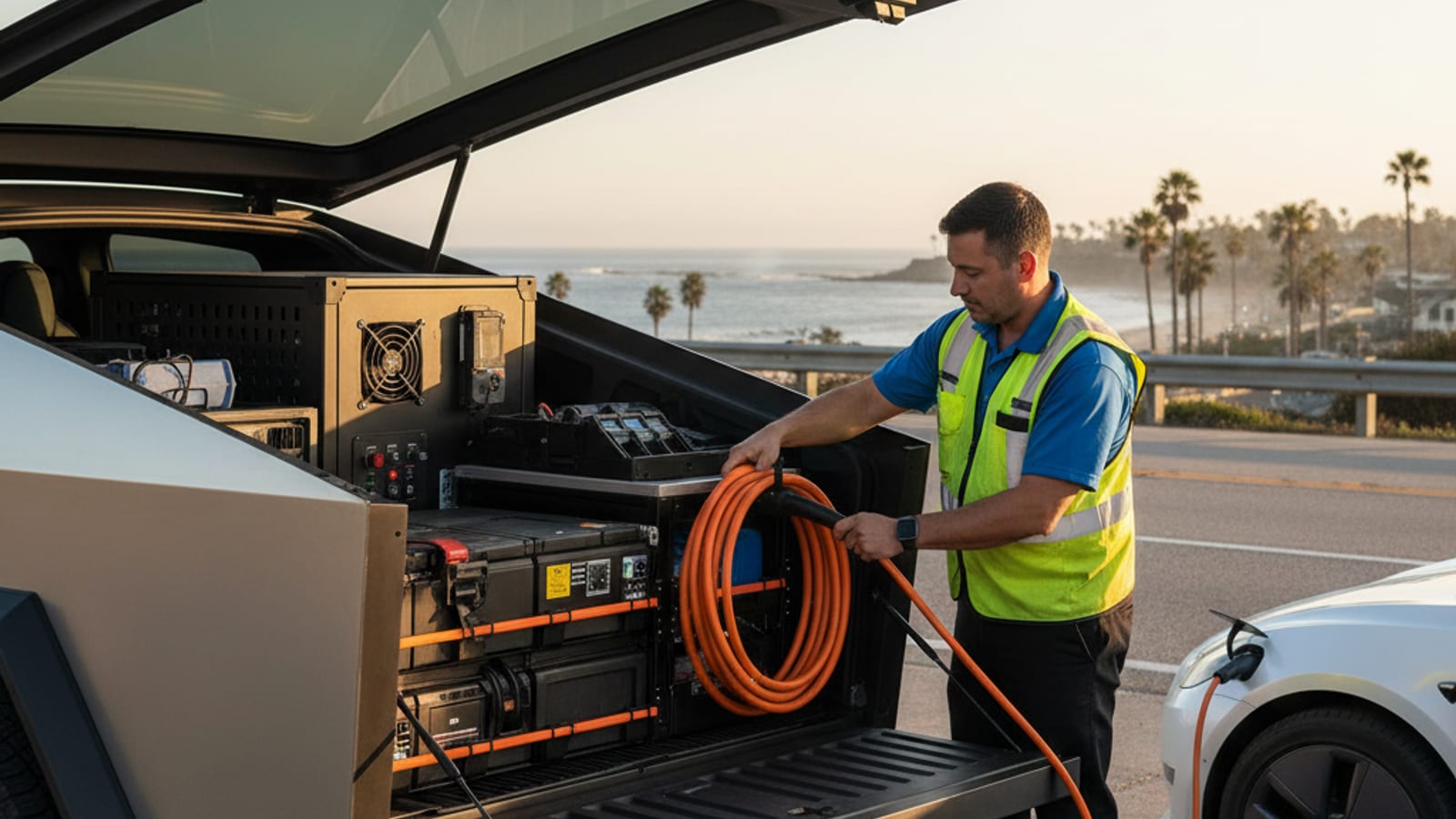
What is a mobile EV rescue truck?
A mobile EV rescue truck is a roadside assistance vehicle specifically designed to deliver emergency electric vehicle charging on-site. Unlike a traditional tow truck, which simply transports a stranded vehicle, a mobile rescue truck provides immediate power. Its primary goal is to give an EV enough charge to reach the nearest charging station or safely get home. This service directly addresses the unique challenges of EV breakdowns, particularly running out of battery far from a charging point.
More than just a tow: on-site power delivery
The core difference between a mobile EV rescue truck and a traditional tow truck lies in its function. When an internal combustion engine vehicle runs out of gas, a service can bring a few gallons of fuel. For an EV, simply bringing a battery isn’t enough; the vehicle needs to charge. A mobile rescue truck essentially brings a charging station to the stranded EV. This eliminates the need for a costly and time-consuming tow to a fixed charging station or a service center.
This on-site power delivery is especially valuable on busy freeways like I-5 or I-405, where a breakdown can cause significant traffic disruptions. Getting a quick boost allows drivers to move their vehicle safely and efficiently.
The technology inside a mobile EV rescue truck
The heart of a mobile EV rescue truck is its power delivery system. These vehicles are equipped with significant battery storage and advanced power inverters. This setup allows them to convert their stored energy into usable electricity for an EV.
The typical matched operator vehicle uses a 240V Level 2 mobile charging source to deliver charging power. This is similar to what you’d find in a powerful home charging station. The truck carries both a NACS plug (for Tesla vehicles) and a CCS adapter (for most other EV brands). This ensures compatibility with nearly every electric vehicle on the road today, from a Tesla Model 3 in Bellevue to a Rivian in Maple Valley. The internal technology manages power flow, monitors safety, and ensures efficient energy transfer to the stranded vehicle.
How a mobile EV rescue truck works
When you call our referral line because your EV is out of charge, here’s how the rescue process typically unfolds. Our goal is to make a stressful situation as smooth and quick as possible.
- The call for help: You contact us, providing your location and EV model. This helps us dispatch the right equipment. Whether you’re stuck on I-405 near Bellevue or in a parking lot in Tacoma, we pinpoint your exact spot.
- Dispatching the matched operator vehicle: The matched operator dispatches to your location. This vehicle is specifically chosen for its power capabilities, durability, and ability to navigate various Puget Sound terrains. It’s built to handle everything from coastal city streets to the mountain roads of the Snoqualmie Valley.
- On-site assessment: Upon arrival, the trained operator assesses the situation. The operator confirms the EV’s state and connects the mobile charging equipment. Safety is the top priority, especially when operating on busy freeway shoulders. The operator follows strict protocols to ensure the safety of both the driver and the operator on scene.
- Power delivery: The operator’s 240V Level 2 mobile charging source begins delivering power to your EV. This Level 2 charging provides a significant boost, typically adding 10 to 20 miles of range in about 15 to 30 minutes. This is usually enough to get you to the nearest fast charger or public Level 2 station. For more details on this service, see our mobile EV charging service page.
- Guidance and departure: Once sufficient charge is delivered, the matched operator helps you plan your route to the nearest reliable charging station. The operator can often suggest specific fast-charge stations in Bellevue, Federal Way, or Lynnwood, or public charging ports across the region.
Safety protocols for roadside EV charging
Safety is paramount during any roadside assistance operation. The operators in our network are trained in EV-specific safety procedures. This includes proper handling of high-voltage cables, managing traffic around the service vehicle, and using appropriate personal protective equipment. The operator’s equipment is regularly inspected and maintained to meet high safety standards. The NHTSA provides general guidelines for roadside safety, and the operators adhere to industry best practices for EV service.
Why mobile EV charging is essential in the Puget Sound region
The Puget Sound region is a hub for electric vehicles, with King County accounting for 144,257 registered EVs and Tesla representing about 44% of that total. This rapid growth, however, comes with unique challenges that mobile EV rescue trucks are perfectly positioned to solve.
The local EV landscape
- High EV density: Cities like Bellevue, Redmond, Seattle, and Kirkland have particularly high Tesla density. While these areas often have good charging infrastructure, unexpected low battery situations still occur.
- Diverse terrain and climate: The Puget Sound’s climate keeps winter temperatures in the 35 to 45 range for months. Cold-soak reduces battery efficiency, and cabin heating is the largest range draw on a typical winter commute.
- Freeway network challenges: The extensive freeway system (I-5, I-405, I-90, SR 167, SR 520) is crucial for daily commutes and road trips.
- The I-90 eastbound climb from Issaquah toward Snoqualmie Pass gains over 3,022 feet of elevation. This significant incline consumes a heavy amount of range, making eastbound trips particularly susceptible to out-of-charge events.
- Popular EV road trips from the Puget Sound, such as to Stevens Pass on US 2 or the Snoqualmie Valley, often involve areas with sparse charging infrastructure.
- The SEA airport garage holds 94 free Level 2 EV stalls. Drivers leaving for a week of business travel often return to a dead 12V battery rather than an empty traction pack.
Addressing range anxiety head-on
Despite the region having public charging ports across King, Pierce, and Snohomish counties, coverage is uneven. The Snoqualmie Valley and the Stevens Pass corridor have fewer chargers, making range anxiety a significant concern for residents and visitors on mountain roads.
A mobile EV rescue truck directly combats this anxiety. Knowing that a referral service can connect you with an operator who brings power to you, even in remote areas or dense freeway traffic, provides immense peace of mind. It transforms a potentially hours-long ordeal into a manageable delay.
Comparing mobile charging to other options
When your EV runs out of power, you have a few recourse options. Understanding the differences highlights the value of a mobile EV rescue truck.
Mobile EV charging versus traditional towing
| Feature | Mobile EV Rescue Truck | Traditional Tow Truck |
|---|---|---|
| Primary service | On-site emergency charging | Vehicle transport |
| Immediate benefit | Adds range to drive away | Relocates vehicle, no power added |
| Convenience | Highest, minimal disruption | Moderate, requires transport to charger |
| Time investment | 15 to 30 minutes for enough range | Varies, includes tow time and charging time |
| Vehicle stress | Low, no physical movement needed | Potential for tow damage |
| Goal | Get you driving again quickly | Get vehicle to a charging point |
As this table shows, mobile charging is often the quickest and most convenient solution. Our mobile EV charging referral connects you with operators who provide this service across the Puget Sound region.
Limitations of public charging networks
While the regional charging infrastructure is growing, it still has gaps. Public Level 2 and DC fast-charge stations can also be occupied, out of service, or require specific apps and payment methods. Finding an available, working charger when you’re already at 0% can be a major challenge.
Individual portable chargers
Some EV owners carry small portable chargers. These are typically low-power Level 1 units and charge very slowly, often adding only 2 to 5 miles of range per hour. They are meant for overnight trickle charging or minor top-offs, not emergency roadside rescue. A mobile EV rescue truck delivers significantly more power, much faster, making it a true emergency solution.
When to call us
Running out of charge in your EV doesn’t have to ruin your day. With a mobile EV rescue truck referral service, you have a reliable solution across King, Pierce, and Snohomish counties. The matched operator’s specialized mobile charging vehicle is ready to deliver emergency power directly to you, getting you back on the road quickly and safely. If you find yourself out of charge, don’t hesitate. Call (206) 202-7018 to reach a local EV rescue operator.