You are coming back across the Narrows Bridge into University Place, gauge dropping faster than the trip planner said, and the nearest working charger is several miles away on a route that does not always have a shoulder. That is the specific, frustrating situation University Place EV drivers face, and it is exactly what mobile EV rescue exists to solve.
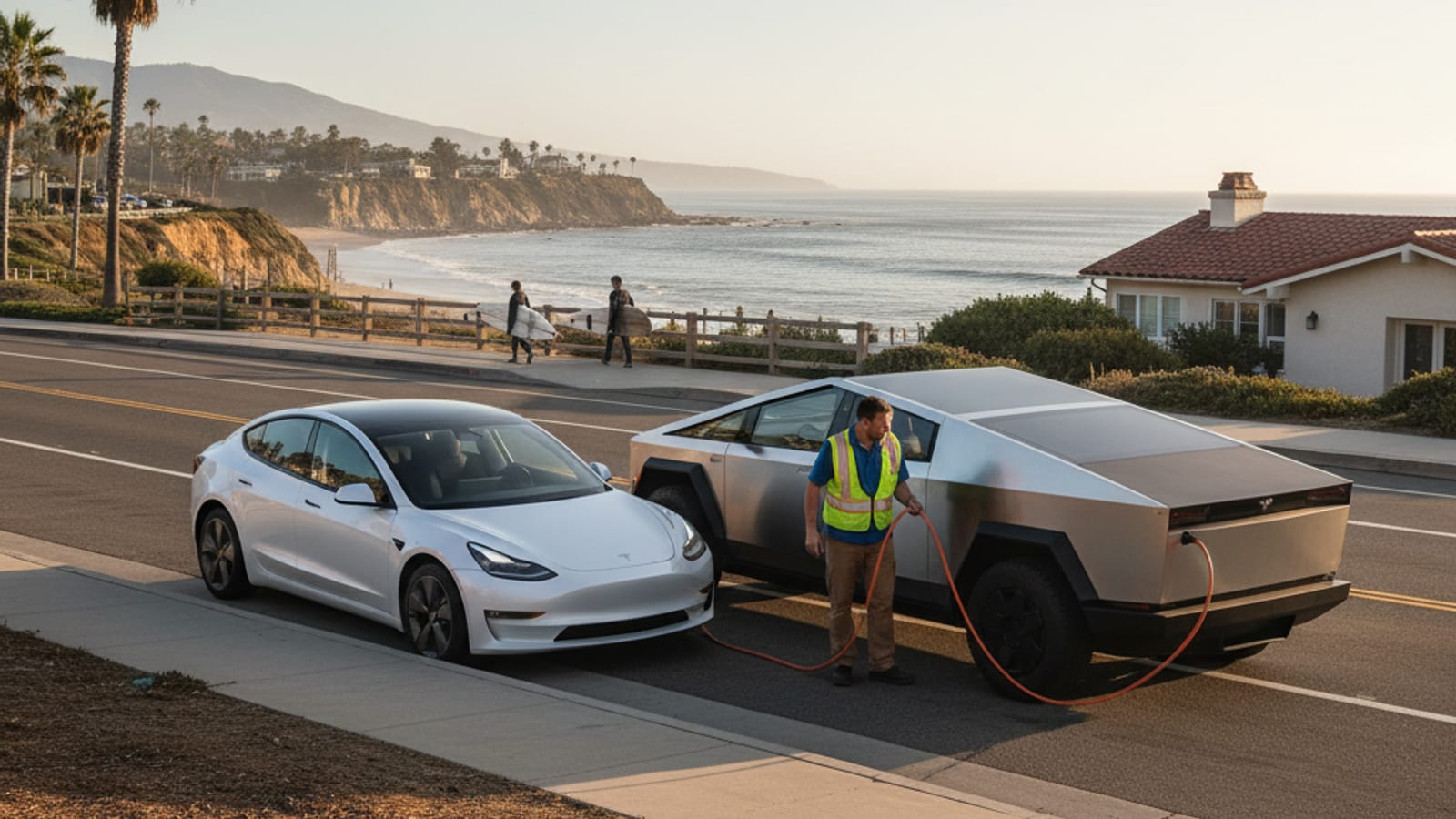
Why University Place drivers run low near the Narrows
University Place sits on the mainland side of the Narrows Bridge, and a lot of residents commute across to Gig Harbor for work, family, or shopping. The 1.4-mile bridge span sits high above the water, which means a climb up and over on every crossing. Drivers coming back from the Kitsap side who started the trip with a marginal charge find that the climb, combined with a winter rain and the heater running, drains the last 10 miles of range faster than the trip planner predicted.
The other pattern is apartment parking. University Place has a significant share of multi-family housing built before 2000, especially along 27th Street, Bridgeport Way, and the Chambers Creek area. Most of those buildings do not have Level 2 charging in every garage. Residents rely on public chargers or a slow Level 1 cord across the driveway, and when a charger is down or occupied for a few days in a row, it is easy to arrive home from work with 9 percent battery and no real plan.
Chambers Creek, Bridgeport Way, and the Narrows crossing
The Narrows Bridge is the single biggest range trap for University Place EV drivers. Whether you are coming back from Gig Harbor or heading out for a weekend on the Olympic Peninsula, the bridge climb eats range fast, and there is no shoulder anywhere on the span. If your car dies on the bridge, you cannot safely wait on the roadway. The right move is to reach the nearest safe pullout at the base of the span and call from there.
Bridgeport Way is the spine through University Place. It carries most of the local commercial traffic, and a few EV owners have ended up on the shoulder between 40th Street and 67th Avenue after misjudging a quick errand. The shoulder is narrower than I-5 but functional, and operators can reach it without difficulty.
Chambers Creek and the waterfront roads add their own wrinkles. The descent into the Chambers Creek basin and the climb back out costs you a few percentage points of range, and the lack of fast chargers along the waterfront means a dead battery there turns into a longer walk to help than drivers expect.
What mobile rescue does when you call
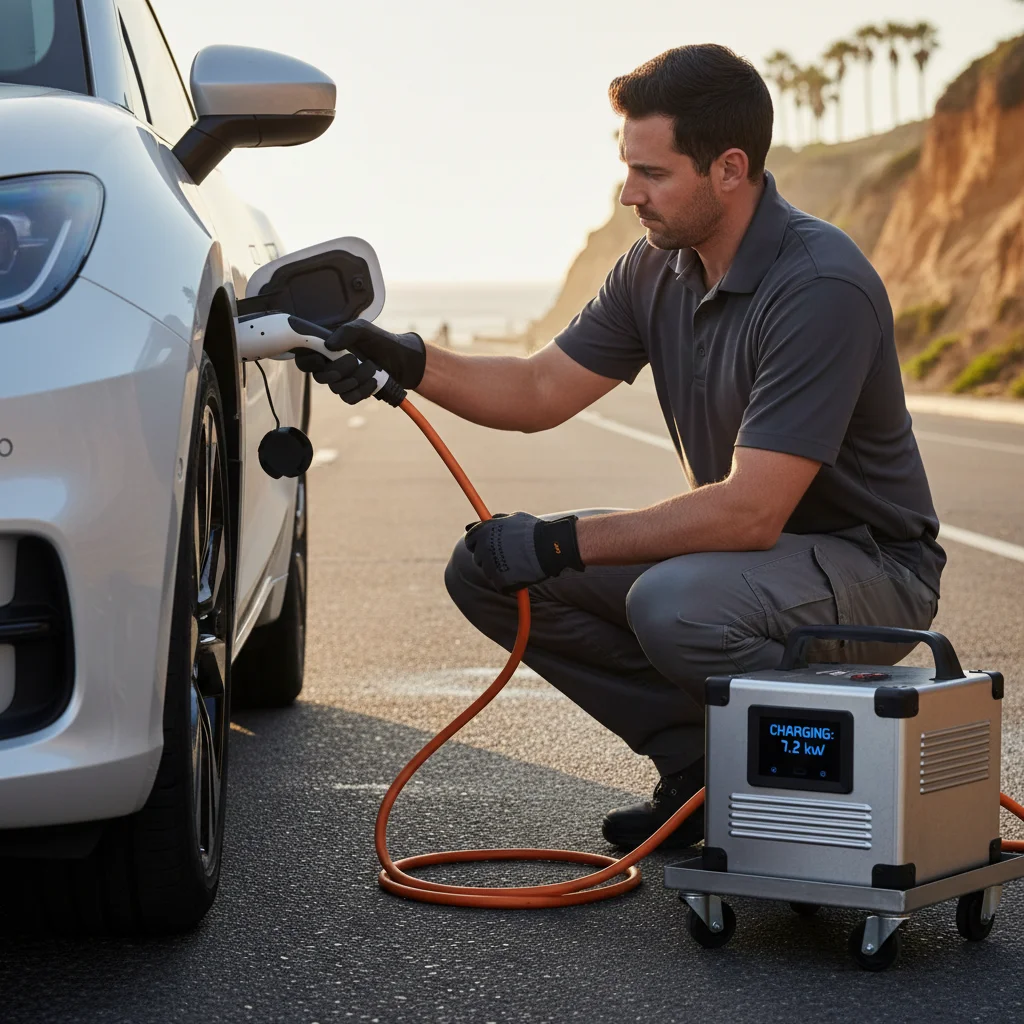
When you call our emergency EV roadside assistance line, dispatch asks for your location and EV model. The operator we connect you with runs a 240V Level 2 source, a NACS plug, and a CCS adapter, and they head to your location, whether that is the bridge approach, the apartment lot on 27th Street, or the shoulder of Bridgeport Way.
A typical session delivers 10 to 20 miles of added range in 20 to 30 minutes. That is enough to get you home to a working Level 2 charger, or to roll to the nearest Supercharger or DC fast charger without sweating the battery gauge.
If your 12V battery has also failed, operators carry jump equipment. A dead 12V is different from a depleted traction pack but both leave you immobile, and the operator can tell which one you actually need on-site.
When a tow is the right call instead
A tow is the right answer when the EV is showing red dashboard warnings about powertrain failure, high-voltage battery error, or 12V system fault. Those messages indicate a real mechanical or electrical problem that mobile charging will not fix. In that case, a flatbed to a service center is the only safe move.
But for the far more common “ran out of range on the freeway” scenario, a mobile charge gets you moving under your own power, and the bill is smaller than a tow plus a charging session at the destination.
Local context: Pierce Power and University Place drivers
Most University Place addresses sit inside Tacoma Power territory. Tacoma Power’s residential Level 2 rebate helps offset the cost of a home charger, which is why a working home plug matters here. When the home charger fails or the apartment garage has no working Level 2 outlet, mobile charging fills the gap while a longer-term fix is arranged.
The Pierce County landing page at EV charging Seattle WA lists University Place and the surrounding Pierce County cities our operators cover, including the typical response window for a Narrows-area call.
When to call us
If your EV is stranded in University Place with no charge, on the Narrows approach, or in an apartment lot without a working home plug, an operator can reach you with a Level 2 source and add enough range to clear the day. The operator quotes you before starting.
Call (206) 202-7018 to reach a local operator.
Frequently asked questions
Does mobile EV rescue cover the Narrows Bridge?
Operators reach University Place and the Gig Harbor side of the bridge routinely. The actual bridge span is not a safe place to wait, so the right move is to get to the nearest safe pullout at the base of the span before you call.
How fast can an operator reach University Place?
The operator confirms their arrival window on the call. Bridgeport Way and the Chambers Creek basin are within the standard response corridor.
Can the operator help a non-Tesla EV in University Place?
Yes. Operators carry a CCS adapter and serve most non-Tesla EVs. Our non-Tesla EV rescue service is built for this.
What if my car is just low on charge, not dead?
A mobile charge adds 10 to 20 miles of range in 20 to 30 minutes, enough to reach a working charger or your home Level 2 outlet if you have one. For longer drives, follow up with a public DC fast charger.
What if my 12V battery is the problem, not the traction pack?
Operators carry jump equipment for most EV brands. A dead 12V will not respond to a charge session, but a proper jump brings the low-voltage side back online so the car can boot and accept a charge. For more on why this happens, see what happens when an EV 12V battery dies.
Call (206) 202-7018 to reach a local operator.