Your EV’s range estimate looked fine when you left the house. Then came the I-405 climb out of Renton, the rain, the AC, and now you are watching the battery tick toward zero somewhere between the Sunset Boulevard off-ramp and the Coal Creek Parkway interchange. It happens to Renton drivers every week, and the geography makes it more likely than you would expect.
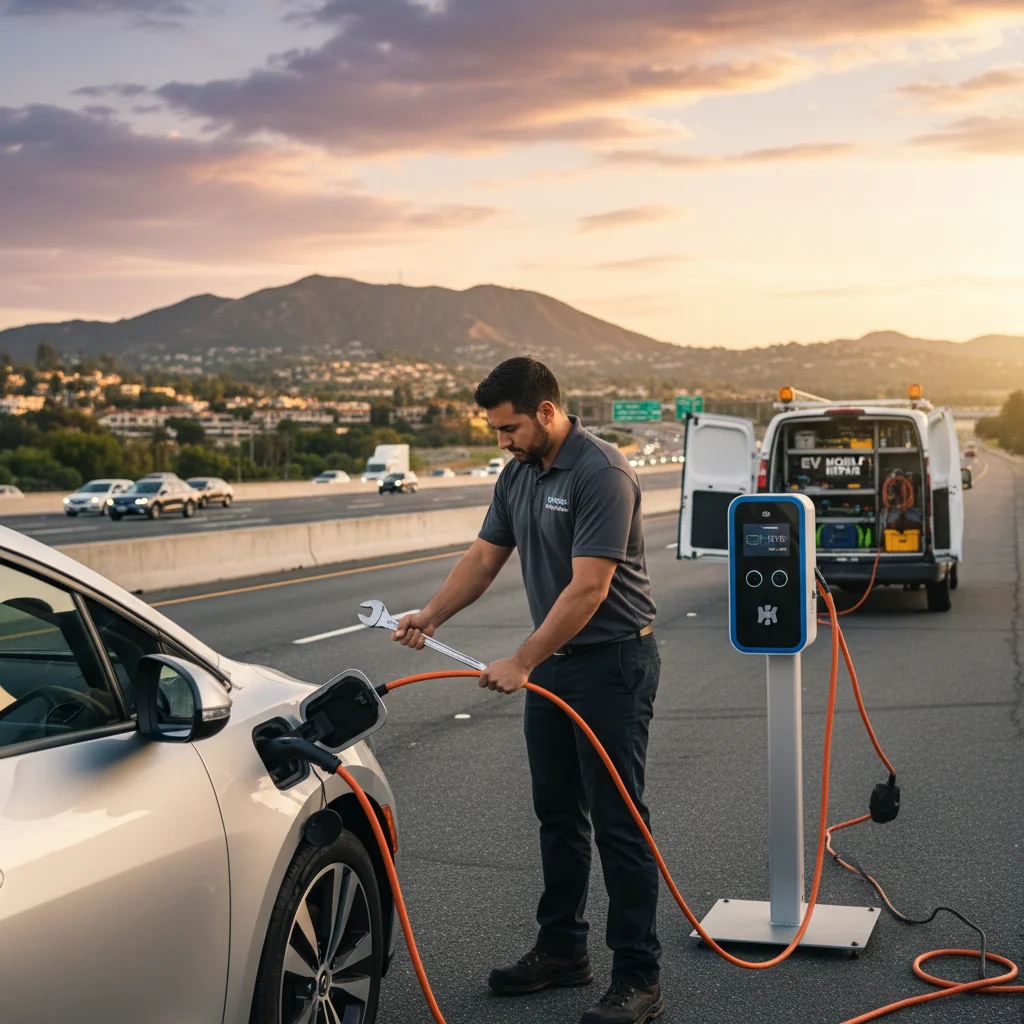
Where Renton EV drivers run out of charge
Renton sits at the hinge between the Eastside plateau and the Green River valley, and that position means a lot of through-traffic: commuters heading home from Bellevue, Boeing workers swinging through the Renton Landing, and residents climbing the residential streets that roll up toward the Kennydale plateau. Each of those patterns creates a distinct way to strand an EV.
The flatland sections around downtown Renton are forgiving. You have surface streets, easy pullouts, and decent public charging near The Landing. But the moment you start climbing toward the Highlands or up the Sunset Boulevard hill, the math changes fast. Cold-soak regeneration is weaker than drivers expect, and the cabin heater plus defrost draws heavily from the traction pack.
The other common trap is deferred charging. Renton has a high density of single-family homes, and a lot of EV owners rely on a Level 1 outlet in their garage. If that outlet has been slow-charging a car that has been driven more than usual, Tuesday night’s commute can leave the battery lower than expected by Wednesday morning. Add a detour, a last-minute errand, and a stop on a hill, and you have a stranded EV before noon.
Our mobile EV charging service covers all of Renton, including the quieter residential pockets that general roadside services sometimes underestimate. We know this city’s topography, and we plan our routes accordingly.
I-405 and SR-167 stranded-EV patterns
I-405 through Renton is one of the busiest EV corridors in the metro. Drivers coming from Bellevue or heading toward Tukwila are often already running lower than they realize by the time they hit the city limits. The uphill grade between the SR-169 interchange and the Coal Creek Parkway split is short but steep, enough to pull an extra 10 to 15 percent from a pack that is already in the red.
SR-167 adds another wrinkle. The stretch between I-405 and the SR-18 junction has limited shoulder space and fast-moving traffic. If you lose propulsion there, you need help that arrives quickly and does not require a flatbed to maneuver in a tight spot. Tow trucks struggle on that corridor. A mobile charging unit does not.
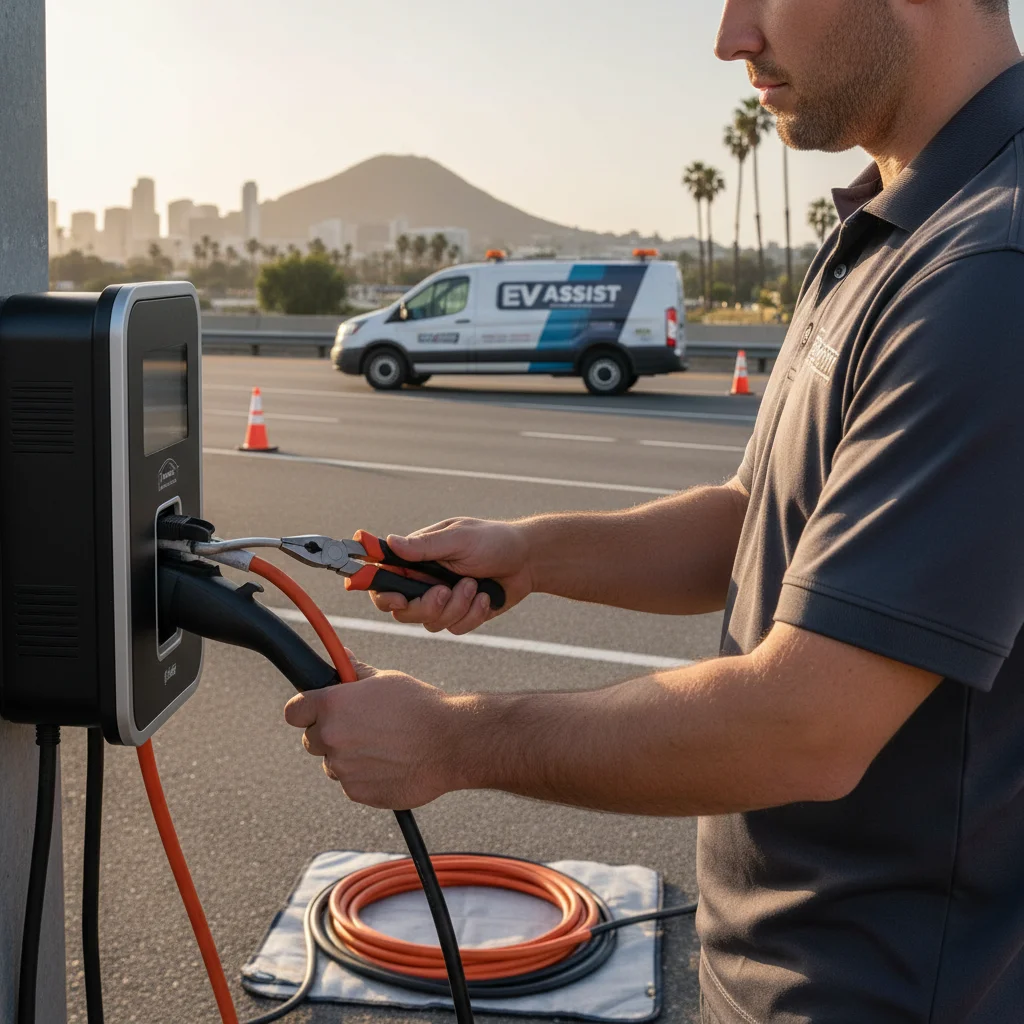
When you are stopped on a freeway shoulder anywhere in Renton, the first call is 911 if you are in a dangerous position, then our EV roadside assistance line. An operator will get your location, confirm which highway and direction, and dispatch from the nearest point. The operator’s truck carries enough stored energy to push most EVs 20 to 40 miles of additional range, enough to reach the nearest DC fast charger or get you home to a working Level 2 charger.
For more on what to do the moment you realize you are running out on a freeway, our guide on running out of charge on a freeway shoulder is worth reading before it happens to you.
Boeing shift changes and cars that sat a week at SEA
Renton has a heavy Boeing workforce, and shift changes at the Renton plant mean thousands of cars pouring onto I-405 and SR-167 at the same moments every day. Drivers who park at SEA long-term for a work trip and come back to a car that will not wake up are a consistent call source. That is the 12V failure mode, not the traction pack: the car sat in the garage for a week, the 12V drained below threshold, and now the car will not respond to anything.
The right move in that scenario is not to plug the car into a charger, it is to bring the 12V back online first so the car can boot. Once it boots, the traction pack charges normally and you drive home.
Our Tesla 12V battery jump and non-Tesla EV rescue services both handle this. The operator carries the right jump equipment for the specific EV brand and confirms the car boots before they leave.
What we bring and how fast the operator arrives
The operator vehicles carry a 240V Level 2 source delivering a meaningful top-up in 20 to 30 minutes depending on your vehicle’s onboard charger. That is enough to get a stranded Tesla, Ford Mach-E, Chevy Blazer EV, Rivian, or Hyundai Ioniq off the shoulder and to a full charging session nearby.
We also carry jump capability for 12V auxiliary battery failures, a separate but common breakdown that can lock you out of your vehicle entirely. If your EV will not power on at all and the high-voltage pack is fine, a dead 12V is usually the culprit. It is one of the most underappreciated failure modes in EVs, and it is not the same as running out of range. The what happens when an EV 12V battery dies post goes deeper if you want to understand what to watch for.
Response times for Renton depend on traffic and time of day. On a typical weekday afternoon, the operator confirms a realistic window on the call. I-405 and SR-167 shoulders during peak hours can run longer if WSDOT has restricted access, but we are in contact with you throughout. You will know when we are coming and when we are close.
We serve all vehicle brands. Tesla drivers have a few model-specific quirks we know well, but we handle Ioniq 5s, Mach-Es, Rivian R1Ts, Chevy Equinox EVs, and anything else running on a lithium pack. If you are not sure whether we can help your vehicle, call us, the answer is almost always yes.
Mobile charge vs tow for Renton drivers
A tow is the right call in specific situations: collision damage, a failed drive unit, a high-voltage pack fault that will not clear. But for the most common Renton breakdown, an empty battery, a tow adds cost and time without solving the underlying problem. You still need to charge the car. A tow just relocates the empty car to a parking lot near a charger, and then you wait anyway.
Mobile charging resolves the situation in place. We drive to you, plug in, and give you enough range to reach a Level 2 or DC fast charger on your own. You are back on the road faster, and the bill is smaller. Most Renton calls do not require a flatbed.
For drivers wondering about costs, our guide on mobile charging vs a tow gives real numbers without the runaround.
Local context: PSE Up & Go Electric and Flex EV rates
Most Renton addresses sit inside Puget Sound Energy territory. PSE’s Up & Go Electric and Flex EV time-of-use rate programs make overnight Level 2 charging genuinely cheap, which is why a working home charger matters here. When the home charger fails or the apartment garage has no working Level 2 outlet, mobile charging fills the gap while a longer-term fix is arranged.
When to call us
If you are stranded in Renton with a dead pack, a 12V failure that has locked you out, or a range emergency on I-405 or SR-167, that is our call to take. We do not do installs; we do rescues, and that is what we are built for. The operator quotes you before starting.
Call (206) 202-7018 to reach a local operator.