An EV that stops in Normandy Park needs the right kind of help. The problem could be an empty traction pack, a dead 12V battery, or a fault that requires towing.
Charge Pro SEA connects drivers with licensed, independent local operators. The operator evaluates the vehicle, quotes the work, and bills you directly.
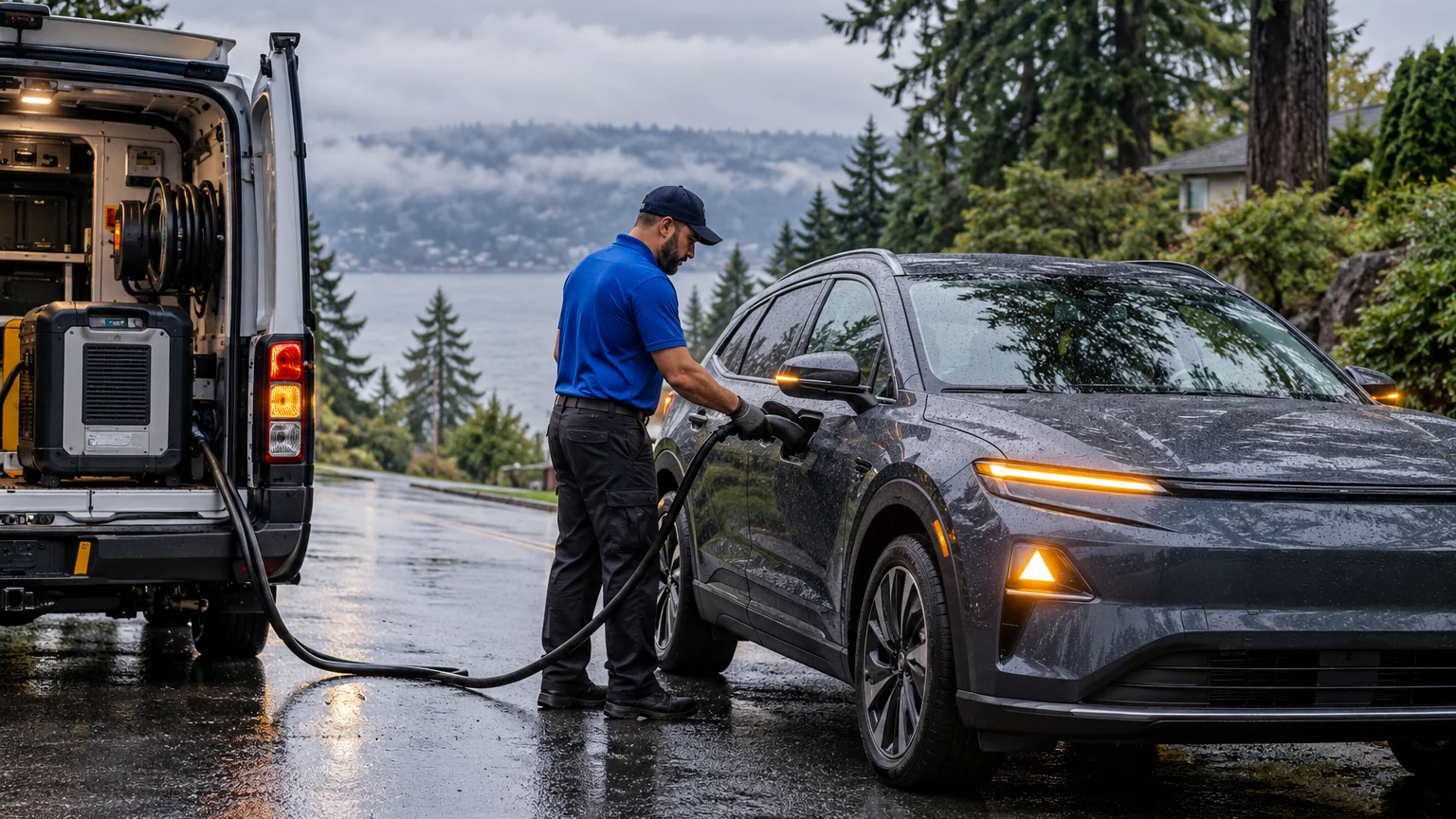
Normandy Park streets and waterfront-area stalls
EV roadside assistance in Normandy Park starts with a precise location. A driver near First Avenue South has different access details than someone stopped along Normandy Road or Marine View Drive. Routes toward SR 509 add another concern because a vague location can place you on the wrong connecting road.
Tell the operator which road you’re on and your direction of travel. Add the nearest cross street, driveway, or visible landmark. A phone location pin can help, but don’t rely on it alone. Confirm the city name because nearby Burien and Des Moines have their own streets and access points.
Normandy Park had 700 registered EVs in the Washington Department of Licensing data read in September 2026. The city had 6,661 residents in the 2024 population estimate. Those figures describe the city, but they don’t show where roadside incidents happen. No verified local breakdown count or call-volume figure was available.
Waterfront-area stops can require extra location details. Say whether the car is on a public street, private driveway, parking area, or another access point. Don’t assume an operator can enter every property or meet at any curb. Current parking, access, and roadside restrictions weren’t confirmed for this page. Follow posted signs and instructions from the authority controlling that location.
If you’re stopped on a state highway or in a live travel lane, the WSDOT Incident Response Team directs drivers to call 911 for roadway help. Charge Pro SEA doesn’t replace emergency services.
Drivers north of Normandy Park can also review the Burien roadside guide. The Des Moines guide covers situations south of the city.
How to separate an empty pack from a dead 12V
An EV has a high-voltage traction pack and a separate low-voltage system. The traction pack moves the vehicle. The 12V battery supports the electronics needed to wake the car and operate many controls.
Start with what the vehicle is doing. A very low displayed charge level, followed by reduced power or a shutdown, points toward an empty traction pack. If the car wakes normally and shows its remaining charge, share that percentage with the operator.
A different pattern appears when the vehicle won’t wake, unlock normally, or illuminate its displays. Those symptoms can point toward the 12V system. They aren’t a final diagnosis, so don’t ask for charging based on one symptom alone. Give the operator the complete sequence.
Try to answer these questions:
- Does the vehicle unlock with the key, fob, phone, or manual method?
- Do the dashboard and center display turn on?
- Does the car show a battery percentage?
- What warning text appears on the screen?
- Can the vehicle shift into drive or neutral?
- Was it charging before the problem started?
- Is a charging connector still attached?
Don’t use one EV to jump-start another vehicle unless the manufacturer permits it. Tesla states that its vehicles can’t be used to jump-start another vehicle because doing so can cause damage.
A matched operator can jump and load-test a dead 12V battery. If testing shows that it has failed, the operator may be able to replace it on site, depending on the vehicle and battery type. The operator explains the available options and quotes them before work starts.
If you want a broader symptom guide, read how EV roadside assistance handles charging, 12V trouble, and other roadside problems. Keep your owner’s manual available because vehicle-specific recovery steps can differ.
When mobile charging works and when towing fits
Mobile charging fits a straightforward out-of-charge situation. The vehicle should be safely accessible, accept a compatible connection, and have no warning that calls for transport or repair. The goal is a limited rescue charge, not a complete battery refill.
A matched operator may bring a Tesla Cybertruck with an integrated 240V, 9.6 kW outlet. The equipment uses a NACS plug with CCS adapter support. Level 2 AC connections include NACS and J1772, so the operator needs the vehicle’s exact year and model before arriving.
A typical rescue connection lasts 15 to 30 minutes and adds roughly 10 to 20 miles of range. That’s the size of the charge, not an arrival estimate or a guaranteed driving distance. Weather, vehicle efficiency, battery condition, road grade, and cabin use can affect the distance you actually get.
That limited charge may fit when the car simply ran out of energy. It doesn’t fix a failed 12V battery, damaged charge port, collision damage, tire problem, or vehicle fault. Charging also isn’t the right answer when the vehicle’s warnings say it shouldn’t be driven.
Towing fits when the car can’t accept power, can’t be made ready to drive, or needs inspection elsewhere. It may also be necessary when roadside access doesn’t allow a safe charging connection. The operator can discuss whether mobile charging or transport matches the symptoms and location.
Don’t choose based only on whether the car looks completely dead. A failed 12V system can prevent the vehicle from waking even when energy remains in the traction pack. Conversely, a working display doesn’t create usable range when the traction pack is empty.
Our out-of-charge recovery service explains how Charge Pro SEA matches drivers with independent operators. Charge Pro SEA doesn’t set the price, perform the charging, provide towing, or promise an arrival time.
What to share when requesting a local operator
Good information helps the matched operator understand the vehicle and access point. Begin with your exact Normandy Park location. Name First Avenue South, Normandy Road, Marine View Drive, or the route toward SR 509 when one applies. Include your direction of travel and nearest cross street.
Next, identify the vehicle. Share its make, model, model year, and displayed battery percentage. Connector standards can vary by model year. For example, the 2025 and later Hyundai IONIQ 5 has a native NACS port. The operator needs the actual vehicle details, not a guess based on the brand.
Describe the failure in order. Explain what happened before the stop, what the dashboard showed, and what the car does now. Mention whether the vehicle unlocks, powers on, shifts, or remains connected to a charger. Read warning messages exactly when possible.
Also share access conditions:
- State whether you’re on a street, shoulder, driveway, or parking area.
- Give any gate, level, entrance, or property-contact details.
- Mention tight access around the vehicle.
- Say whether a charging cable is connected or stuck.
- Keep your phone available for the operator’s questions.
Don’t promise property access on the operator’s behalf. Posted restrictions and current agency instructions control the location. If a rule isn’t clear, check the sign or contact the responsible property owner or public agency.
Charge Pro SEA refers the request to an independent local operator. That operator confirms whether the job fits available equipment, discusses timing, and gives you a quote. You contract with and pay the operator directly. Charge Pro SEA doesn’t own the rescue vehicle, employ the operator, set the price, or warrant the work.
Photos can add context when the operator requests them. A dashboard warning, charge port, or wider location photo may help. Don’t include private documents or unrelated personal information.
When to call us
Call when your EV is out of charge, won’t wake because of a possible 12V problem, or needs an operator to decide whether charging or towing fits. Have your location, vehicle details, battery percentage, and warning messages ready.
Call us at (206) 202-7018 and we’ll connect you with a local EV rescue operator.