Running low on charge in Kent is a different kind of stressful. You’re not near a fast charger on the Eastside, and the nearest public station might already have a line. One wrong turn on the way home from a shift at the warehouses and you’re watching your range estimate collapse on the dash.
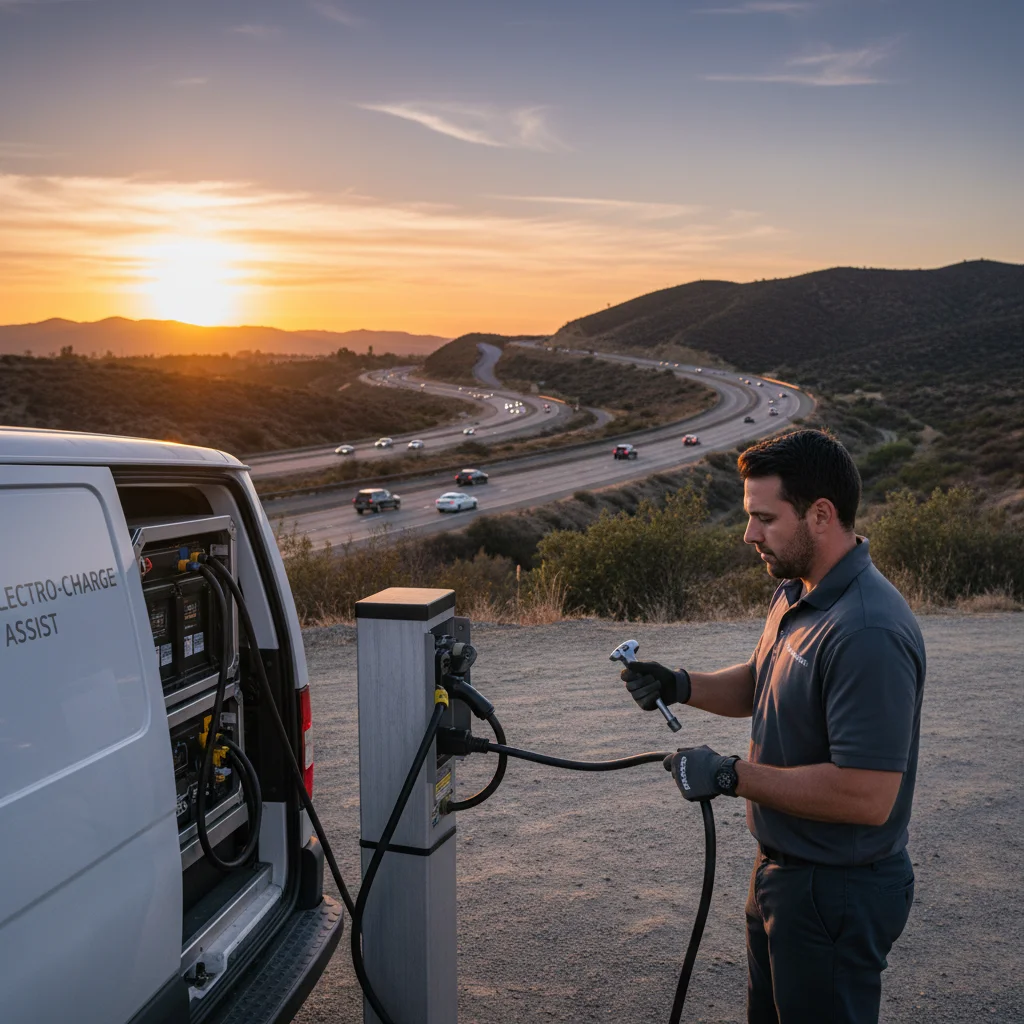
Where Kent EV drivers run out of charge
Kent sits at the heart of South King County’s industrial belt. The Green River Valley warehouse district brings shift workers in from Auburn, Federal Way, and Renton, and the SEA airport cargo area sits just to the north. Public DC fast chargers thin out fast south of Seattle, and the Level 2 stations near the West Valley Highway commercial strip are slow and often occupied.
The city’s geography adds risk. Kent sits in a valley with SR 167 cutting north-south through the middle. The freeway grade from the valley floor toward Renton and the Cedar River crossing pulls measurable energy from the pack. Drivers who leave a workplace charger in Kent with what looks like comfortable range can find themselves short before they’ve crested the hill on the way home.
Then there’s the SEA effect. Workers flying out of SEA for a week leave their EVs in the long-term garage floors. They return, see the pack on the app, and the car still won’t wake. The 12V battery died during the trip, not the traction pack. A mobile rescue call resolves it without a tow.
Our mobile EV charging referral service was built for exactly this pattern: drivers who made reasonable decisions and still ended up short, in a city that doesn’t have a fast charger on every corner.
SR 167 and I-5 stranded-EV hotspots
Two highways define Kent’s EV rescue geography, and they create very different breakdown scenarios.
SR 167 northbound is the bigger problem. The freeway climbs steadily from the Kent valley floor toward Renton, gaining elevation over the Cedar River crossing. That grade pulls hard on any EV, especially when the pack is already warm from a full day’s use. Drivers who check range in Kent and see “plenty” can be caught short on the shoulder before the Renton exit. It’s one of the more common EV breakdown situations in South King.
I-5 through Kent carries the heaviest traffic volume in the city. The freeway interchange at South 272nd Street and the stretch through West Hill bring stop-and-go wear on the pack. A driver who sits in I-5 traffic for 90 minutes with the cabin heat running can arrive at the Kent exit with significantly less range than the dashboard showed when they merged onto the freeway.
The common thread: drivers who last charged in Seattle or Bellevue, drove south, and didn’t account for the elevation penalty or the stop-and-go cost of South King traffic.
What we connect you with
Our referral service matches Kent drivers with licensed, independent local EV rescue operators based in South King. That matters for response time, but it also means the matched operator knows this terrain.
Every call gets an operator vehicle carrying a commercial-grade mobile Level 2 source. The unit supports NACS, CCS, and J1772, so whether you’re in a Tesla, a Chevy Equinox EV, a Hyundai Ioniq 5, or a Ford F-150 Lightning, the matched operator has the connector. Tesla vehicles on the North American Charging Standard port are covered directly.
Our goal on a rescue call isn’t to fully charge your vehicle, it’s to get you enough range to drive safely to a permanent charger or home. For most Kent scenarios, that means delivering 10 to 20 miles of range in 15 to 30 minutes. That’s enough to get you off the SR 167 shoulder, over the grade, and to a fast charger in Renton or back to a home charger in the valley.
We also carry a jump kit for 12V battery failures. On many EVs, Tesla models in particular, a dead 12V auxiliary battery can prevent the car from powering on even when the traction pack is full. If your EV won’t wake up and won’t charge, there’s a real chance it’s the 12V, not the main battery. The matched operator can diagnose and address that on-site.
We don’t do charger installation. We’re not electricians, and we’re not going to pull permits. Charge Pro SEA is a referral service that connects you with operators who handle the roadside rescue, the dead 12V, and the empty pack.
Response times in South King
Kent is a close-in part of the Puget Sound region, and the matched operator factors in traffic on SR 167 or I-5 when they quote you a window.
For calls on the I-5 shoulder through Kent, we coordinate with WSDOT when needed. If you’re on an active freeway shoulder, stay in your vehicle with hazards on. Call our referral line first, then text your location, we’ll track you and give you an ETA as an operator comes out.
City streets within Kent, around West Valley Highway, Meeker Street, or the residential areas near East Hill, tend to run closer to 20 to 30 minutes for the matched operator to arrive.
SR 167 calls north of the South 180th Street interchange are the longest, especially if you’re past the Cedar River crossing into Renton. The operator tells you an honest ETA when they take the call, no inflated promises.
Mobile charge versus tow for South King drivers
A tow in Kent isn’t a fast or cheap option. Most tow companies serving South King will quote 45 to 90 minutes depending on dispatch availability, and flatbed towing of an EV to a charging-capable destination adds cost before you factor in the destination’s charging time.
Mobile charging is usually faster and almost always cheaper for a straightforward range-depletion rescue. You get charged on-site, you drive yourself to the next destination, and you’re back on your schedule. If your EV has a mechanical issue beyond a dead battery or 12V failure, that’s when a tow makes sense, and the matched operator will tell you honestly on the phone if what you’re describing sounds like a tow situation rather than a rescue call.
For South King specifically, the elevation and freeway exposure make a fast mobile rescue more valuable than the regional average. Sitting on an SR 167 shoulder while freight trucks blow past at 60 mph isn’t a situation you want to extend by an extra hour waiting for a flatbed.
Our emergency EV roadside assistance referral covers Kent, Auburn, Federal Way, and the SR 167 corridor up to Renton. If you’re not sure whether your location is in our network, call and ask, we’ll tell you straight.
When to call
If your EV is stranded on SR 167 or I-5, sitting dead in a strip mall parking lot, or refusing to power on in your Kent driveway, that’s our call to take. We handle range-depletion rescues, 12V battery failures that leave your car unresponsive, and range emergencies where you need enough charge to get somewhere safe. Call (206) 202-7018 to reach a local operator.