A stalled electric car in Brier may need mobile charging, 12V help, or a tow. The right choice depends on what the vehicle still does. Charge Pro SEA connects stranded drivers with licensed, independent local operators.
Brier Road and neighborhood stalls
Brier sits between larger service areas around Lynnwood and Mountlake Terrace. That matters when you request EV roadside assistance in Brier, WA. Giving only a nearby city can send an operator toward the wrong side of the boundary.
Start with your exact location. Say whether you’re on Brier Road, a neighborhood street, or headed toward I-5. Include the nearest cross street when you can see it. A dropped map pin can help when street numbers aren’t visible from the road.
Tell the operator where the vehicle can be reached. A car in a driveway presents a different access problem than one stopped at a curb. Mention narrow street access, a blocked side of the car, a gate, or another parked vehicle. The charging port’s position also matters because rescue equipment must reach it.
Don’t assume the rules from Lynnwood or Mountlake Terrace apply inside Brier. A specific Brier parking or roadside restriction couldn’t be confirmed from the approved research for this page. Follow posted signs and check current City of Brier guidance when parking rules affect your next step.
If the vehicle is creating an immediate roadway danger, call 911. The WSDOT Incident Response Team responds to incidents on state highways. Its published materials don’t specifically promise mobile charging for an out-of-charge EV.
Brier had 700 registered EVs in the Washington DOL file read in September 2026. That figure comes from the state’s EV population data. It doesn’t describe roadside demand or predict how often local drivers become stranded.
For nearby context, our guides cover EV roadside help in Lynnwood and EV roadside help in Mountlake Terrace. Those pages address their own streets and boundaries. For a Brier stall, keep the location details centered on Brier.
Empty pack versus a dead 12V
An EV can appear dead for two different reasons. The high-voltage traction pack may be empty, or the smaller 12V battery may have failed. Those problems call for different equipment.
An empty traction pack often follows a clear drop in displayed range. The vehicle may show low-charge warnings before it stops. If the screens still work and the car reports an empty battery, request out-of-charge EV recovery. Share the displayed charge level and every warning message you can read.
A dead 12V battery can look different. The doors, screens, controls, or charge-port release may stop responding. The traction pack may still contain energy, but the vehicle’s low-voltage systems can’t wake normally. Don’t tell the operator only that the “battery is dead.” Say which battery you suspect and describe what still works.
A matched operator can jump a dead 12V battery on site and load-test it. The operator may also replace a failed AGM lead-acid or lithium 12V battery when the correct option is available for that model year. Stock and scheduling vary, so confirm both with the operator. The operator quotes the options before starting and bills you directly.
Vehicle details prevent avoidable confusion. Give the year, make, model, and trim if known. Some model years use different low-voltage battery types or charging connectors. A photo of the dashboard warning can help describe the problem.
Tesla’s manuals state that its vehicles can’t be used to jump-start another vehicle. A qualified operator can follow the correct access and connection procedure for the stranded EV.
If you’re unsure which battery failed, describe symptoms instead of guessing. That gives the operator better information for selecting equipment.
Charging on site versus towing toward Lynnwood
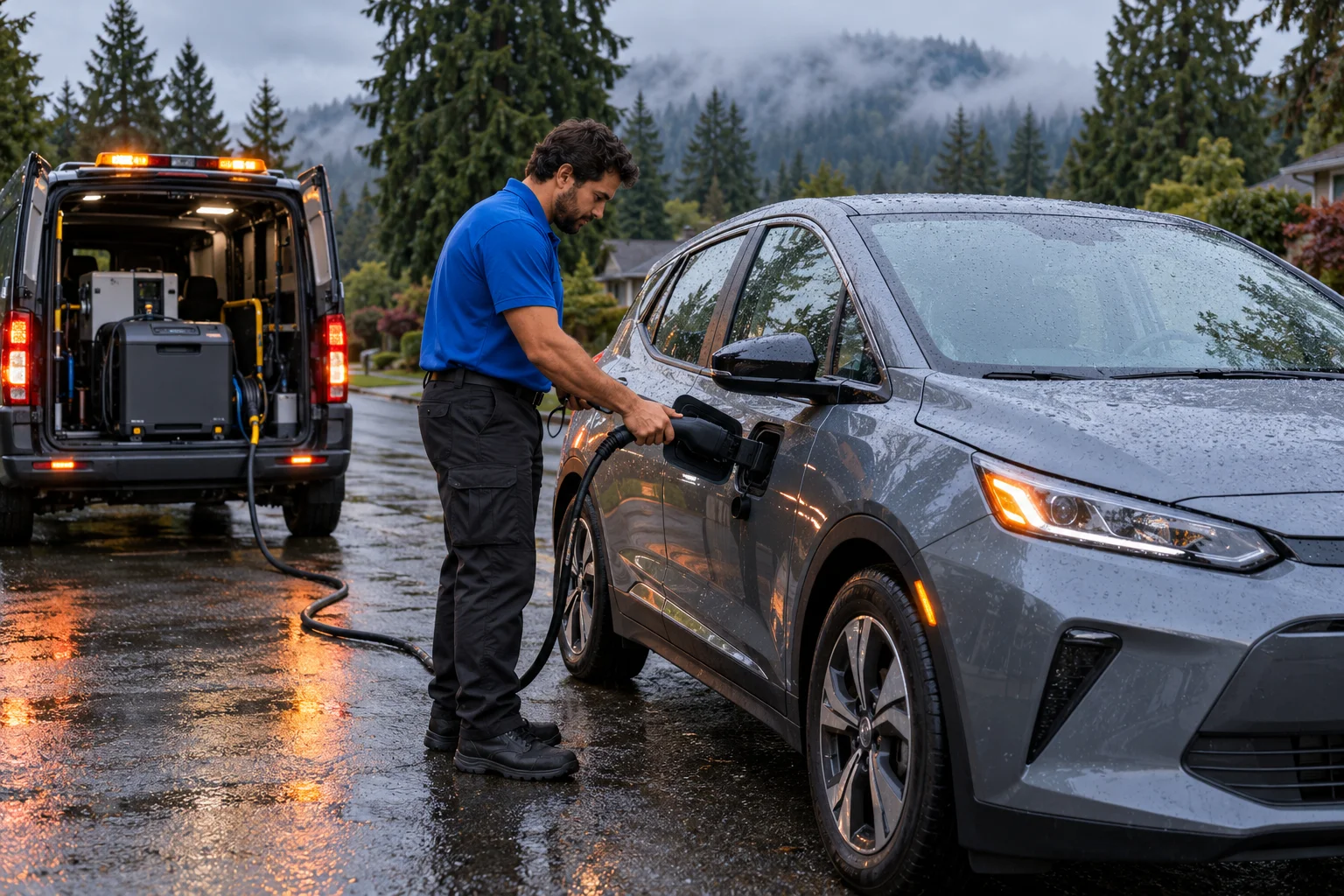
Mobile charging can make sense when the traction pack is empty and the vehicle is safely accessible. The rescue setup used by matched operators supplies 240V AC at 9.6 kW. It supports NACS and a CCS adapter for compatible vehicles.
A typical rescue connection lasts 15 to 30 minutes. That can add roughly 10 to 20 miles of range. This describes charging time and estimated range added. It isn’t an operator arrival promise or a guarantee that your EV will gain the same distance.
The goal is usually limited. Mobile charging may provide enough energy to reach a suitable charger or another safe destination. It isn’t intended to refill the entire traction battery beside the road.
Before choosing mobile EV charging, tell the operator your connector type. Level 2 AC charging commonly uses SAE J1772 or J3400, also called NACS. An adapter may be needed for a non-Tesla EV receiving AC power from a NACS source.
On-site charging isn’t the right answer for every Brier stall. Towing may fit better when the vehicle has collision damage, won’t accept power, displays a serious system warning, or can’t be reached by the charging equipment. It may also be the practical option when a short rescue charge won’t support the next safe leg.
If towing is recommended, confirm the destination with the towing provider. “Tow it toward Lynnwood” isn’t a complete instruction. Give the selected charger, repair facility, or other destination directly to that provider. Confirm that the destination can receive the vehicle before it moves.
Prices couldn’t be confirmed for Brier mobile charging or towing. Charge Pro SEA doesn’t set either amount. Ask the operator or towing provider for the current quote, included work, and any distance-related charges before authorizing service.
Our broader out-of-charge recovery service explains the rescue option. The final choice still depends on access, vehicle condition, connector compatibility, and the driver’s intended destination.
What to share when requesting an operator
Good information helps the matched operator understand the Brier situation before discussing service. Begin with your name, callback number, and exact location. A map pin is useful, but include a street or cross street too.
Next, describe the vehicle:
- Year, make, model, and trim
- Displayed battery percentage, if visible
- Charging connector or adapter available
- Dashboard warnings or error messages
- Whether the doors, screens, and controls respond
- Whether the vehicle can shift into neutral
- Any recent charging attempt and what happened
Then explain the surroundings. Say whether you’re on Brier Road, a neighborhood street, or near the boundary with Lynnwood or Mountlake Terrace. Mention a driveway, curb, parking area, gate, steep access point, or tightly parked cars. Don’t add a local road name unless you’re certain of it.
Tell the operator where the charging port is located. Note whether another vehicle or wall blocks that side. If the car is in a garage, provide the clearance and say whether the garage door opens. Tell the operator if the vehicle is unresponsive or can’t be repositioned.
Photos can clarify access and warning messages.
Ask what type of help the operator proposes. Confirm whether the plan involves a 12V jump, a load test, mobile Level 2 charging, battery replacement, or referral to a towing provider. Ask which connector or adapter will be used.
Get the operator’s quote before work begins. Charge Pro SEA is a referral service. It doesn’t perform the work, set prices, collect the operator’s payment, or provide a warranty. You contract with and pay the independent operator directly.
Our emergency EV roadside assistance page gives an overview of matched help. Your request should still include the Brier-specific location and access details. Those details distinguish a local neighborhood stop from a vehicle already moving toward I-5.
When to call us
Call when your EV is stranded in Brier with an empty pack, an unresponsive 12V system, or an unclear no-power condition. A local operator can assess whether mobile charging or 12V service fits, while a towing provider may be needed for other failures.
Call us at (206) 202-7018 and we’ll connect you with a local EV rescue operator.