You just landed at Sea-Tac, walked to the parking garage, and your EV will not wake up. Maybe the app is dead. Maybe the door handles do not present. The good news is that Sea-Tac’s garage EV stalls are real and well-maintained. The bad news is that week-parked cars on the dark long-term floors tend to develop a different problem while they are sitting there.
What Sea-Tac actually offers
Sea-Tac’s parking garage has 94 free Level 2 EV stalls across two main zones. Sixty-four stalls sit on Floor 7 Rows E and F, designated for general parking. Thirty more sit on Floor 4 Rows E and F, reserved for short-stay use. Two DC fast chargers sit in the Cell Phone Lot for vehicles that need a quick top-up before picking up a passenger.
Regular parking rates apply whether you are using the EV stalls or not, the charging itself is free, but the parking fee is not. Most EVs in the garage end up on the dark long-term floors, where lighting is intentionally limited for security. That is where the trouble starts.
What can go wrong on a long-term floor
A car that sat in the garage for a week or more while you were traveling can come back to a 12V battery that has quietly drained below the threshold needed to wake the car. The traction pack still shows full range, the door handles will not present, the key fob cannot reach the car, and the app may show the car as “offline.” This is not an out-of-charge problem. It is a 12V problem, and it is the most common failure mode at Sea-Tac.
The fix is a 12V jump at the labeled jump points on the car. For most modern EVs that means pulling a small panel in the front bumper area or using the frunk to reach the terminals. Once the 12V is back, the car boots normally and you can drive out of the garage.
If the issue is genuinely out of charge, the Sea-Tac stalls can top you up at Level 2 speed, which is enough range for the drive home but not a full charge. Pair the stall with a public DC fast charger in the area if you need more.
The honest limit of charging at the airport
Free Level 2 stalls sound ideal until you have used one once. They are slow. A typical Level 2 EVSE adds roughly 20 to 30 miles of range per hour, and Sea-Tac’s stalls deliver that consistently. For a week-parked car that needs to clear the I-5 corridor to Tacoma or Bellevue, that is enough. For a road-trip driver who needs to be back at 80 percent before heading up to Everett, that is not enough.
The two DC fast chargers in the Cell Phone Lot help, but they are sized for passenger pickups and short stays, not full session charges. Plan around them as a top-up, not a primary stop.
What to do when your EV will not wake in the Sea-Tac garage
If your car will not power on after a long trip, the 12V is the most likely culprit. Three things to try before calling for help:
- Press the physical key card or mechanical key against the B-pillar sensor. Some cars have a passive entry zone near the door handle that bypasses the fob battery.
- Look for the manual key blade inside the fob. Most modern EVs ship with one, even if the fob is the primary entry device.
- Check the car’s app for any error messages. A dead 12V usually shows as “offline” or “last seen” hours ago, not as a range warning.
If none of those work, the 12V is the failure and you need external power applied at the labeled jump points. Many Sea-Tac parking garages have first-call agreements with local tow operators, but a tow to a dealership costs both money and time you do not want to spend.
When to call mobile rescue at Sea-Tac
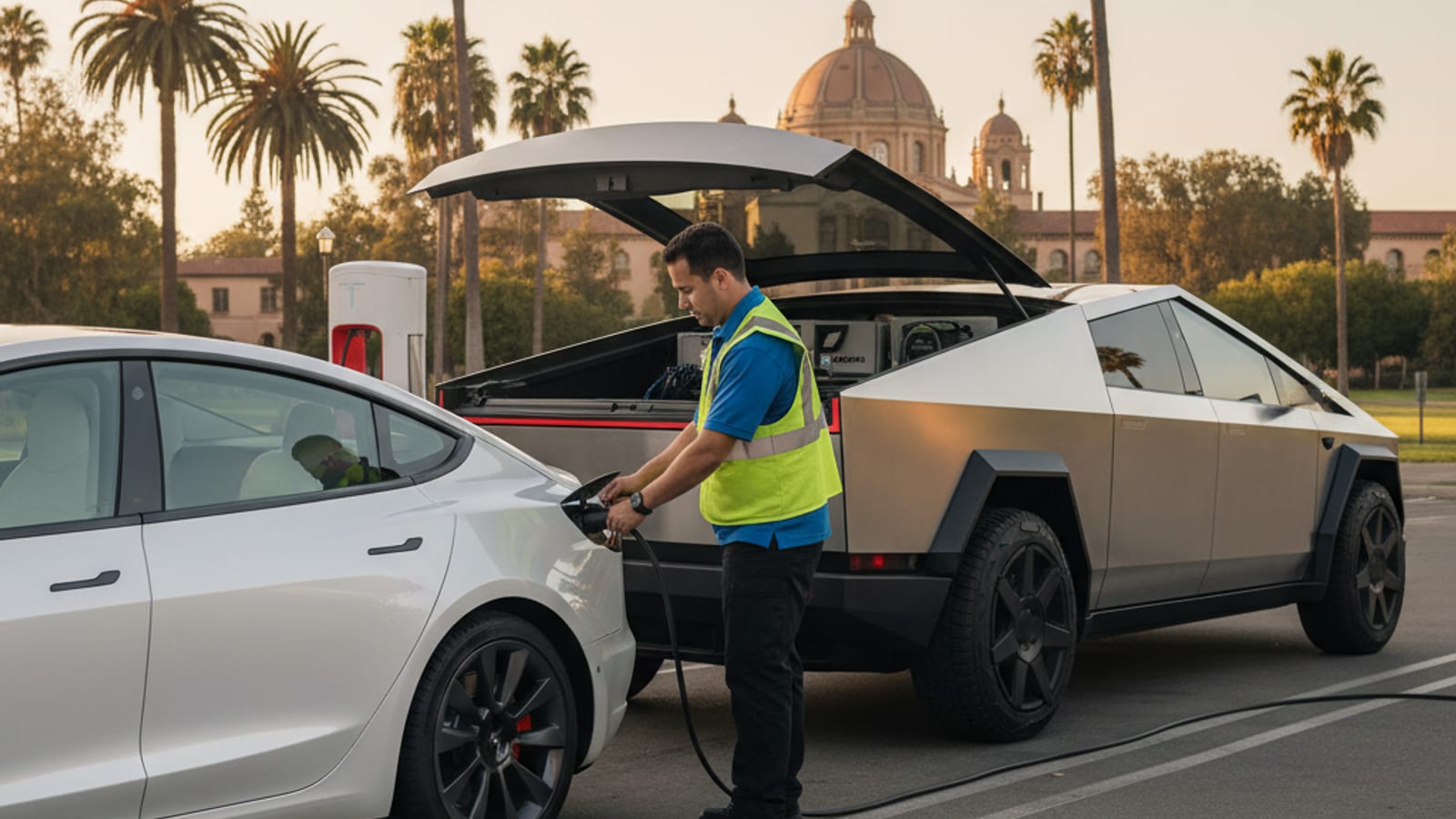
A mobile EV rescue operator with the right jump equipment can reach you in the Sea-Tac garage faster than a tow, and often cheaper. They bring the proper cables for the specific EV brand, apply external 12V power at the labeled terminals, and confirm the car boots before they leave.
If the issue is range, a mobile charge operator brings a Level 2 source to your stall and adds 10 to 20 miles of range on-site, enough to clear the I-5 corridor to a working public charger.
Our mobile EV charging and EV roadside assistance services cover Sea-Tac and the surrounding South King cities, including SeaTac city proper, Des Moines, Burien, Tukwila, and Federal Way.
Planning ahead if you fly out of Sea-Tac
Three small habits cut the chance of a dead 12V at the airport.
Top up before you go. A working home Level 2 charger topped off before the trip keeps the traction pack full, but more importantly, the car is awake and the 12V is being maintained by the EVSE. A car parked at 80 percent on Floor 4 with a working 12V will be ready when you land.
Set the charge limit to 80 or 90 percent for long-term parking. Sitting at 100 percent for a week is harder on the pack chemistry than sitting at 80 percent, and the 12V sees less cycling.
If your car supports sentry mode or camp mode, consider whether you really want it active for the whole trip. Sentry mode can pull the auxiliary battery down faster than you expect on a week-long sit, especially on the cooler floors.
When to call us
If your EV is dark in the Sea-Tac garage or sitting on a long-term floor that will not wake up, an operator can reach the airport garage and bring your car back online without a flatbed. The operator quotes you before starting.
Call (206) 202-7018 to reach a local operator.
Frequently asked questions
How many EV chargers does Sea-Tac have?
Sea-Tac’s parking garage has 94 free Level 2 EV stalls across Floor 7 Rows E and F (general parking) and Floor 4 Rows E and F (reserved). Two DC fast chargers sit in the Cell Phone Lot. Regular parking rates apply.
Is EV charging at Sea-Tac free?
The Level 2 stalls are free to use, but you still pay the regular parking fee for the time your car sits there.
Why does my EV not wake up after a week at Sea-Tac?
Almost always a dead 12V auxiliary battery, not an empty traction pack. The 12V runs the telematics, security, and keyless entry systems while the car sits. After a week or more on the dark long-term floors, it can drain below the threshold needed to wake the car.
Can a mobile operator reach me inside the Sea-Tac garage?
Yes. Operators routinely access Sea-Tac garage stalls with portable jump equipment and Level 2 charging sources. Confirm the stall number when you call.
What if my car is just low on charge, not dead?
The Sea-Tac Level 2 stalls add 20 to 30 miles of range per hour, which is enough for most South King commutes. For longer drives, follow up with a public DC fast charger nearby.
Call (206) 202-7018 to reach a local operator.