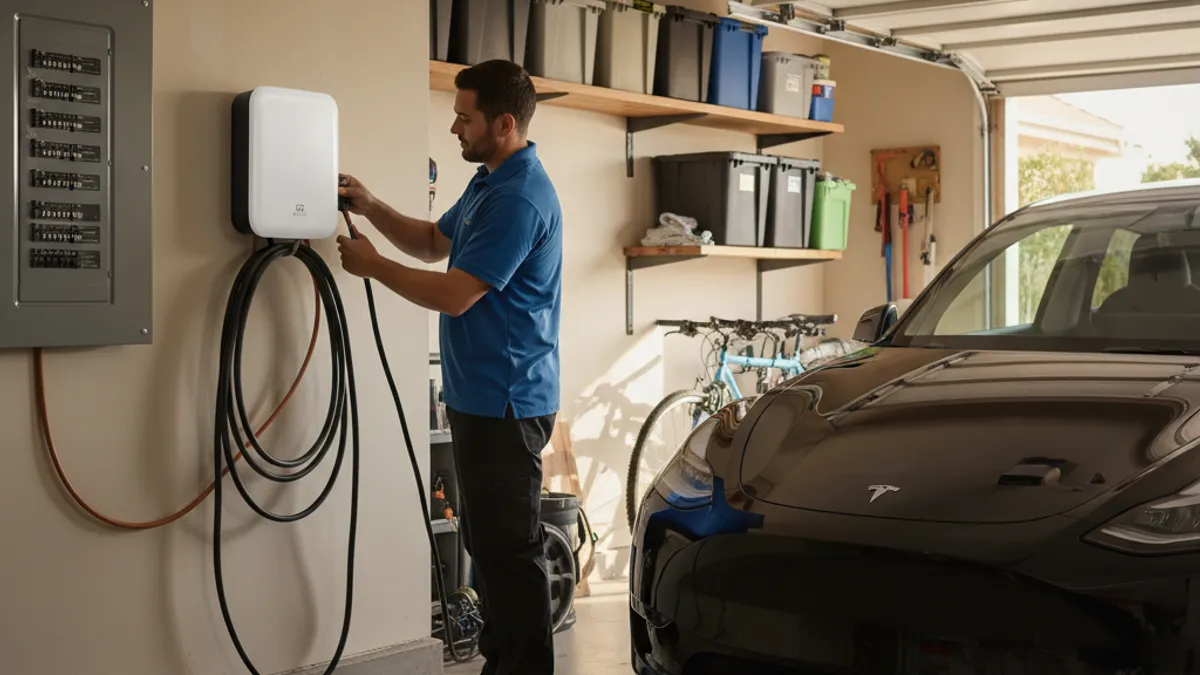
If you live in North Bend, Snoqualmie, Fall City, or Preston and you just bought an EV, you have probably searched some version of “EV charger installation near me” and gotten a wall of ads. The valley has a different install reality than Bellevue or Seattle. Older homes, smaller panels, longer permit timelines, and the constant question of whether the home charger is going to work before the next I-90 climb all change what you need.
We are a mobile EV charging and roadside rescue service, not an installer. So here is the straight version of what a home Level 2 install involves in the valley, what to ask before hiring anyone, and how to keep your EV charged while you wait for the work to get done.
What “EV charger installation” really means in the valley
When people search for a charger install, they usually picture an electrician bolting a box to the garage wall. The box is the easy part. The real work is the circuit behind it.
A Level 2 home charger runs on 240V, the same kind of circuit a dryer or oven uses. To feed it, an electrician adds a dedicated breaker to your electrical panel and runs new wire from the panel to wherever you park. How hard that is depends almost entirely on three things: your panel’s spare capacity, the distance from panel to parking spot, and whether your jurisdiction wants a permit pulled first.
In newer subdivisions near Snoqualmie Ridge, panels are often 200 amps with room to spare. In older North Bend and Fall City homes, you find 100-amp or 125-amp panels that are already close to full. That is the single biggest cost driver out here, and it is why two neighbors can get wildly different quotes for the same charger.
The panel question: why some valley quotes run higher
If your panel is full, the electrician has a few options, and they are not all cheap.
A load calculation comes first. Code requires the installer to add up your home’s existing electrical demand and confirm there is headroom for a 240V charger pulling 40 to 48 amps. If the math does not work, you are looking at one of these:
- A load management device that throttles the charger when the house is drawing a lot of power. This is often the cheapest fix and avoids a panel upgrade entirely.
- A panel upgrade from 100 or 125 amps to 200 amps. This is the expensive path and triggers its own permit plus coordination with the utility.
- A circuit-sharing setup that splits an existing high-draw circuit, which works in some homes and not others.
Older North Bend homes and rural Fall City properties are the ones most likely to need a panel upgrade. Snoqualmie Ridge and the Issaquah Highlands side of the valley are a mixed bag, with newer subdivisions usually fine and older central neighborhoods more likely to need work. If a quote comes in low and the installer never asked about your panel age or did a load calculation, that is a red flag.
Tanner Electric versus PSE: why the utility matters here
Most of the Puget Sound eastside runs on PSE, with its Up and Go Electric and Flex EV rate plans. The Snoqualmie Valley, by contrast, is mostly served by Tanner Electric, a smaller cooperative that covers rural stretches including Fall City, North Bend, and out toward Carnation. Tanner does not run the same EV-specific rate programs that PSE does, which changes when cheap overnight charging actually kicks in. If your installer assumes PSE off-peak windows without checking, your overnight schedule may not save what you expect.
If your home is on the PSE side of the valley, you can use the Flex EV schedule to drop charging into the cheapest hours. If you are on Tanner, ask Tanner directly about current time-of-use options, because the offer is different and not all installers know that.
Permits and inspection: the part that adds time
Most King County jurisdictions require an electrical permit for a Level 2 charger install, and the valley is no exception. Snoqualmie and North Bend run through the City building departments. Unincorporated areas, including parts of Fall City and Carnation, permit through King County. Washington State has pushed cities to streamline EV charger permitting, and many now offer same-day or over-the-counter approval for a straightforward residential install. A panel upgrade is a bigger permit and takes longer.
A reputable installer pulls the permit for you and schedules the inspection. If someone offers to skip the permit to save you money, do not. An unpermitted 240V circuit can void your homeowner’s insurance after an electrical fire, and it becomes a disclosure headache when you sell.
Budget for the timeline, not just the price. A simple install with panel headroom can happen within a week of the quote. A panel upgrade stretches to a month or more, especially during summer when installers are slammed.
What to ask before you hire an installer
Use this as your screening checklist when you call around:
- Will you do a load calculation, and can I see it in writing?
- Is my panel large enough, or am I looking at a panel upgrade?
- Is the electrical permit included in your price, and who schedules the inspection?
- What charger amperage are you running the circuit for, 40 or 48 amps?
- How far is the wire run from my panel to where I park, and is that priced in?
- Which utility serves the home, and how does that affect my off-peak charging plan?
An installer who answers all six clearly is worth more than one who just quotes a low number for the box on the wall. The cheap quote that skips the load calc is the one that turns into a change order halfway through the job.
How to keep your EV charged before the install is done
Here is the gap nobody warns you about. You bought an EV, you are waiting on an install, and you still need to drive. If your quote turned into a panel upgrade, that wait can be weeks.
You have a few options. Public charging works but eats time, and valley chargers can be sparse once you get past North Bend toward Snoqualmie Pass. A standard wall outlet trickles in only a few miles of range per hour, which barely keeps up with a daily commute.
This is where we come in. We deliver a Level 2 charge directly to your driveway anywhere in the valley, including North Bend, Snoqualmie, Fall City, and Preston. The operator vehicle carries a 240V outlet with the connectors you need, so we can charge a Tesla, a Hyundai Ioniq 5, a Ford Lightning, or just about any EV on the spot. It is a practical bridge while your home install is in the permit queue or waiting on a panel upgrade.
If you misjudge your range and run low before the home charger is live, our mobile EV charging service is also the call. Pricing varies by what the operator brings and how far they drive, so ask before you commit.
When a home charger fails after install
Installs do not always hold. Breakers trip, GFCI faults pop, and chargers throw error codes, sometimes weeks after the electrician leaves. If your brand-new home charger quits and you wake up to a dead EV, that is a roadside problem, not just an electrical one.
The short answer: if you are stranded, we can get enough range into your car to get you moving, then you sort out the charger warranty on your own clock. The I-90 climb toward Snoqualmie Pass is one of the metro’s worst stretches to be low on range, especially in winter when cold soaks the pack. A mobile charge beats a tow out of the valley.
Frequently asked questions
How much does EV charger installation cost in the Snoqualmie Valley?
A straightforward install with panel headroom is typically a few hundred to around a thousand dollars for labor and the circuit, plus the charger hardware. If your home needs a panel upgrade, common in older North Bend and Fall City homes, the total climbs well past that. Always get a load calculation before accepting a quote.
Do I need a permit to install an EV charger in North Bend or Snoqualmie?
Yes. Both cities require an electrical permit for a 240V Level 2 install, and so does unincorporated King County for areas like Fall City. A good installer pulls the permit and schedules the inspection for you.
Why is my install quote higher than my neighbor’s?
The most common reason in the valley is panel capacity. If your panel is older or near full, the installer may need to add a load management device or upgrade the panel, both of which add cost. Wire run distance from the panel to your parking spot also matters.
Can I charge my EV before the installer finishes?
Yes. A standard 120V outlet adds a few miles of range per hour, which is slow but works for light driving. For a real charge, we deliver Level 2 to your driveway anywhere in the valley while you wait on the install.
Is overnight charging cheaper on Tanner Electric?
Tanner does not run the same EV rate plans that PSE does. Confirm directly with Tanner what off-peak options are currently available before you plan your schedule around them.
The bottom line for valley drivers
Getting a Level 2 charger installed in North Bend, Snoqualmie, Fall City, or Preston is usually worth it, but the panel and permit reality here means you should plan for more than just the box on the wall. Get two quotes, insist on a load calculation, confirm the permit is included, and confirm which utility serves the home before you plan around an off-peak schedule.
While you wait on the install, or if you ever run low before it is live, we bring the charge to you anywhere in the valley. Call (206) 202-7018 to reach a local operator.