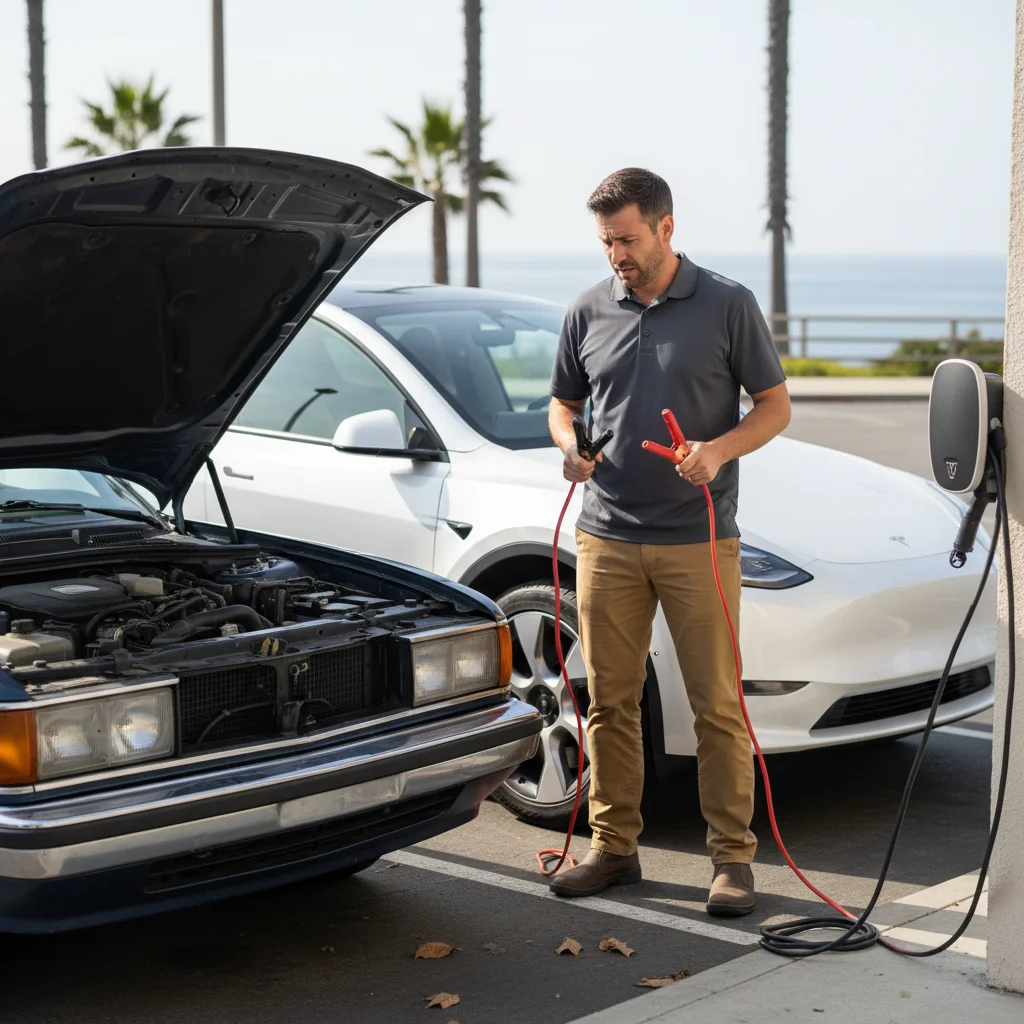
You walk out of a Bellevue Whole Foods and see a neighbor with their hood up, hazard lights blinking, looking defeated. Your first instinct as a helpful Seattle-area driver is to offer a jump. Your Model Y is fully charged. You have jumper cables in the frunk. It seems like the right thing to do. But can a Tesla jump-start another car?
The short answer is no, and it isn’t a small caveat.
The short answer and why the question comes up so often
Let’s be direct. No, you should never use your Tesla to jump-start another vehicle, especially a conventional gas car. The risk of causing expensive damage to your own vehicle is simply too high.
The question comes up so often because, for decades, jump-starting a car was a common act of automotive kindness. It was a simple procedure with two gas cars and a set of cables. Since Teslas have a 12-volt battery, just like an internal combustion engine vehicle, it is logical to assume they can perform the same function. Drivers see the familiar positive and negative terminals under the frunk’s access panel and think it is good to go.
The role and design of the 12V battery in a Tesla are fundamentally different from the one in a gas car. While your Tesla’s 12V battery can die and can receive a jump start from an external power source, it is not designed to give one. Trying to force it into that role is a gamble against your car’s complex and sensitive electronics.
Why the Tesla 12V system is not built for this
To understand why using your Tesla as a donor vehicle is a bad idea, you need to know what its 12V battery actually does. In a gas car, the 12V battery is a brute-force powerhouse. Its main job is to deliver a massive jolt of electricity, hundreds of amps, to turn the starter motor and crank a heavy engine. These are typically heavy lead-acid batteries built for high-amperage output.
A Tesla’s 12V system is much more delicate. It is a low-capacity battery, whether it is the older lead-acid type or the newer lithium-ion version. Its job is not to crank an engine but to act as a low-voltage gateway. It powers the computers, the touchscreen, the door locks, the interior lights, and, most critically, it closes the contactors that connect the main high-voltage battery pack to the drive unit.
The 12V battery is constantly being topped off by the main pack through a DC-to-DC converter. This system is designed for a consistent, low-draw environment. When you try to use a Tesla to jump a gas car, you are asking this low-capacity system to suddenly discharge a huge amount of current. This can cause several catastrophic failures:
- The DC-to-DC converter can be damaged. This sensitive piece of equipment that recharges the 12V battery is not designed to handle a sudden, massive power surge in reverse. Repairing it can be costly.
- The 12V battery can be permanently damaged by the extreme current draw.
- The vehicle computers can be damaged. The voltage drop and potential for electrical spikes can cause faults across the modules that control everything in your Tesla.
- Your warranty can be voided. Damage caused by improper use, like attempting to jump-start another vehicle, is typically not covered. You could face a repair bill in the thousands of dollars.
Essentially, you would be connecting a sophisticated piece of electronics to a brute-force mechanical system, and the electronics are almost certain to lose.
What Tesla’s manual actually says
You do not have to take any blog’s word for it. Tesla is very clear on this subject in its official owner’s manuals. While the manuals provide detailed instructions on how to receive a jump start when your 12V battery is dead, they explicitly forbid using the car as a power source for another.
Across different models like the Model 3, Model Y, Model S, and Model X, the language is consistent and unambiguous. A typical manual will state something like: “NOTICE: Do not jump-start another vehicle with your Tesla. Doing so can result in damage.”
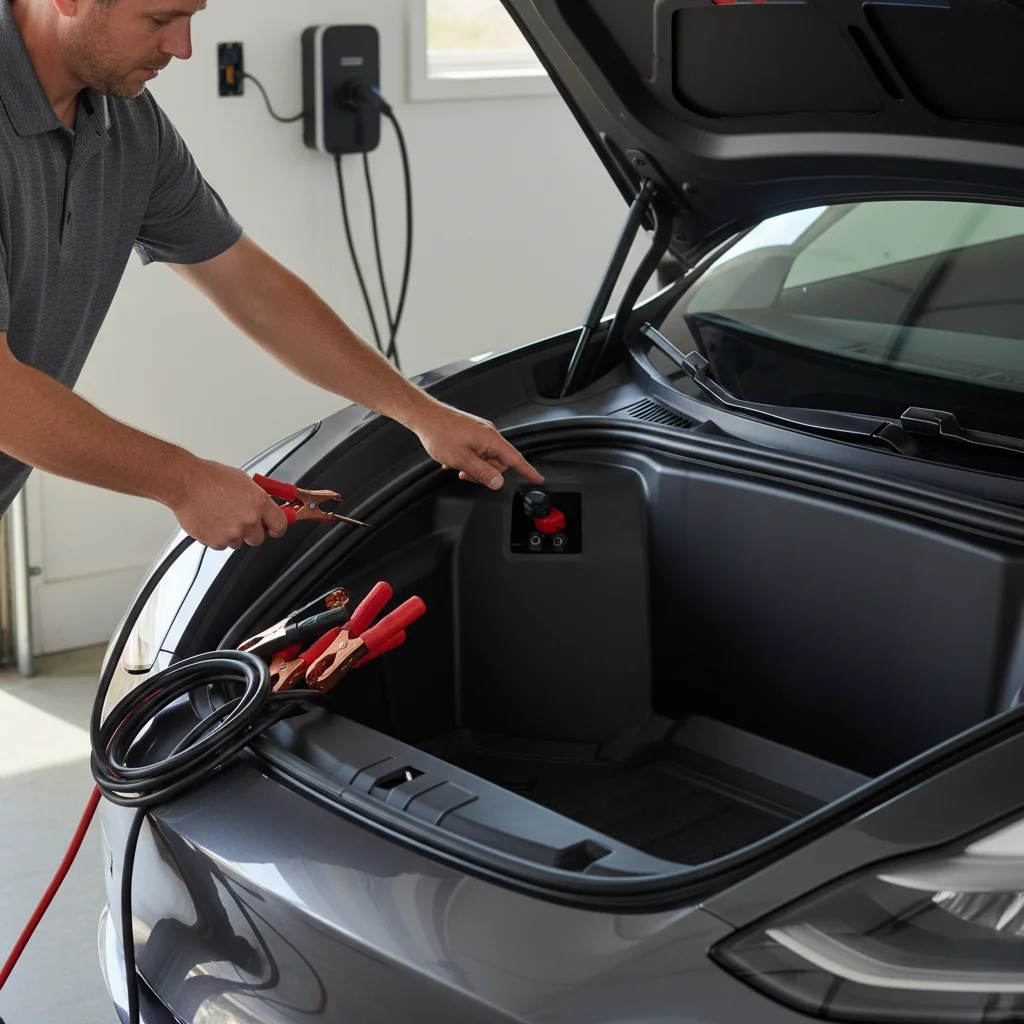
This warning is not legal boilerplate. It is a direct reflection of the vehicle’s electrical architecture. The engineers who designed the car know the precise limitations of the 12V system. They included jump posts for one reason only: to allow an external source to safely re-energize the low-voltage system so the car can wake up and access its main battery. These terminals are an inbound-only connection for power.
Ignoring this direct instruction from the manufacturer is a significant risk. Even if you have seen a video online of someone who claims to have done it successfully, you are only seeing the one time it did not immediately fail. You are not seeing the potential long-term damage or the people who ended up with a bricked car and a hefty service bill.
Safer alternatives if you want to help a stranded driver
Just because you cannot use your Tesla to jump a car does not mean you cannot be a good Samaritan. You can still provide meaningful help without putting your own vehicle at risk. Here are the best and safest ways to assist a stranded driver in the Seattle metro.
The single best tool you can carry is a portable lithium-ion jump starter pack. These compact devices are essentially powerful battery packs with their own mini jumper cables attached. They are specifically designed to deliver the high-amperage jolt needed to start a gas car and are completely self-contained. You can keep one in your frunk or sub-trunk, and it will be ready when needed. They are affordable, safe, and incredibly effective. Instead of connecting your car to theirs, you simply connect the portable pack to their battery and start their car.
If you do not have a portable jumper, the next best thing is to help the driver get professional assistance. You can help them use their phone to call a roadside service. In a Bellevue parking lot or on the shoulder of I-405, the matched operator the referral line sends out carries the right gear for either a gas car or an EV.
In some situations, the most valuable thing you can offer is a ride. If they are in an unsafe location, like the shoulder of the I-90 floating bridge or a stalled spot on SR 520, or if they need to get to a service station or pick up a family member, a safe ride in your Tesla is a huge help that costs you nothing and risks nothing.
When to call for help
While you cannot give a jump, your own Tesla can sometimes need one. The 12V battery in a Tesla can and does fail. When it does, your entire car can seem dead. You might not be able to open the doors, the screen will be black, and the car will be completely unresponsive. Often, you will get a warning on your screen or app beforehand, like “12V Battery Needs Service.”
If you find yourself in this situation, you need a jump from an external power source. While the procedure is possible to do yourself, it can be tricky, and doing it incorrectly can still cause damage.
This is where a professional EV roadside service comes in. A specialized service understands the unique needs of a Tesla. They have the right equipment to provide a clean, stable 12V source to safely wake up your car without risking its sensitive electronics. Our Tesla 12V battery jump service connects you with an operator who does exactly that, across King, Pierce, and Snohomish counties.
When to call us
If your Tesla is dead or won’t wake in a parking structure in Bellevue, a Kirkland driveway, or anywhere else in the Puget Sound region, the referral line connects you with a licensed, independent local operator. The operator brings the right power and the right tools to your location.
Call (206) 202-7018 and we will connect you with a local EV rescue operator.