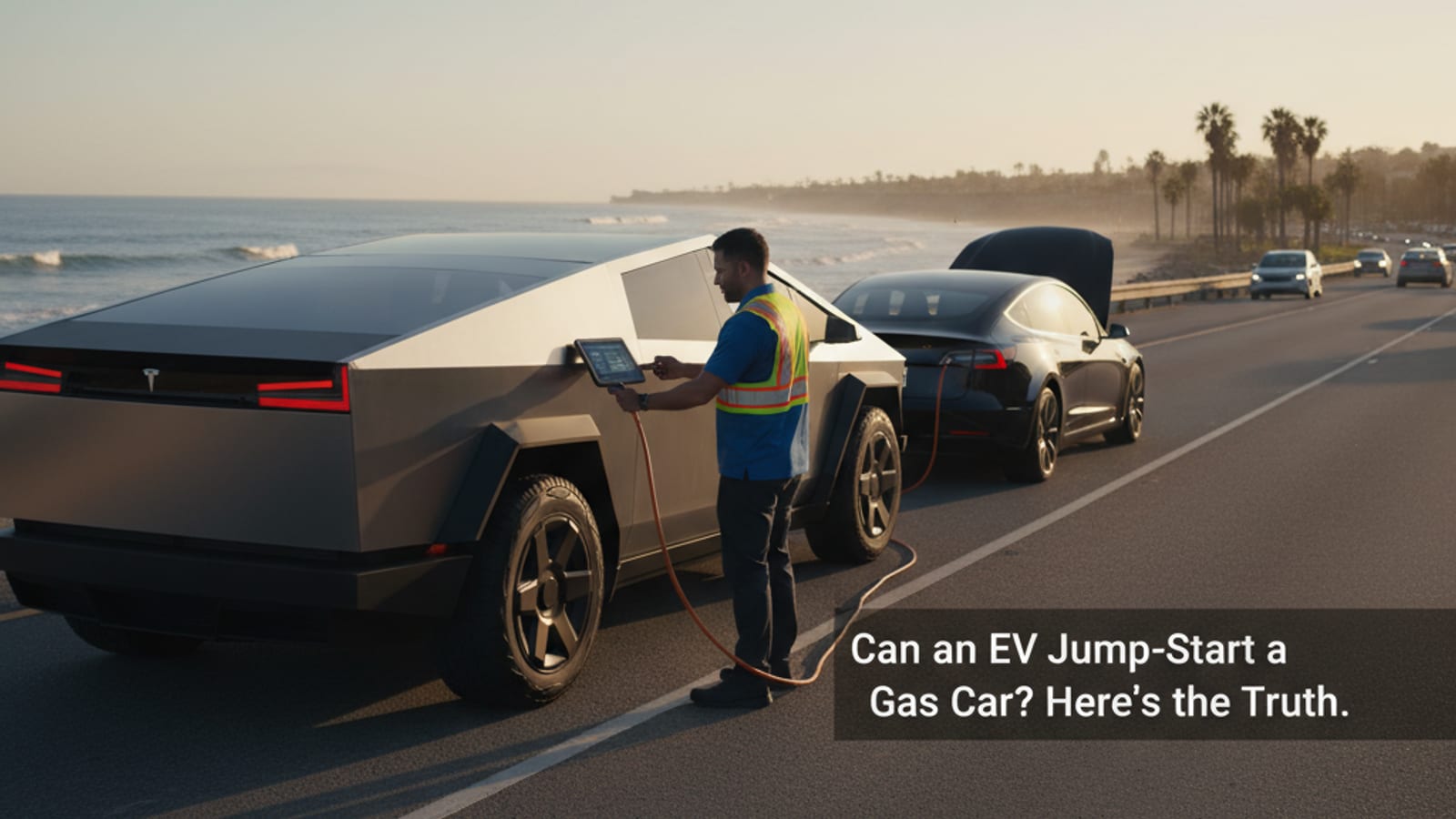
A common roadside scene: a friend’s gas car will not start, the battery is dead, and you are there in your electric vehicle. The immediate thought is, can my EV lend a hand. It is a fair question, and the answer is more nuanced than a simple yes or no. Most EVs can technically jump-start a gas car, but doing it well means understanding what you are actually using and where the risk sits.
The 12V system is what does the work
At the heart of this question lies a common misunderstanding about how electric vehicles operate. Unlike the large, high-voltage battery that powers an EV’s motor, every electric vehicle also has a 12V auxiliary battery. This smaller battery is functionally very similar to the lead-acid battery in a traditional gas car. Its primary role is not to move the car but to power all the low-voltage systems, headlights, wipers, infotainment, power windows, central locking, and most critically, the car’s computers and relays that boot the vehicle.
In a gas car, the 12V battery provides the initial surge of power to crank the engine, and then the alternator recharges it. In an EV, the 12V battery does not crank an engine. Instead, it powers the control systems that prepare the high-voltage battery to send power to the motor. The EV’s main pack, through a DC-DC converter, then recharges the 12V battery while the car is on or charging.
Around the metro, where Tesla density is high in Bellevue, Kirkland, and Redmond, EV owners are familiar with the 12V’s quirks. The battery’s importance is often overlooked until it fails. A dead 12V in an EV can render the vehicle completely immobile even with a full main pack, which is the common service call for our Tesla 12V battery jump team.
The mechanics of a jump start
When you jump-start a gas car, you are not directly powering its engine. You are providing enough temporary voltage and current to its dead 12V battery so its starter motor can crank the engine over. Once the engine starts, the gas car’s alternator takes over, recharging its own 12V and powering the electrical system. The key here is the starter motor’s initial power draw, often several hundred amps for a brief moment.
A donor vehicle’s 12V battery provides this surge. It needs to be healthy enough to handle the sudden drain without suffering damage. The jumper cables create a direct electrical connection, allowing current to flow from the charged 12V to the discharged one. Proper connection is important: positive to positive, negative to a ground point on the dead car’s engine block away from the battery. Incorrect connections can cause sparks, damage electronics, or even battery explosions.
Can an EV jump-start a gas car? The direct answer
Yes, an EV can technically jump-start a gas car, but it comes with caveats. The jump-starting capability relies solely on the EV’s 12V auxiliary battery, not its massive high-voltage traction pack.
Most EVs use a standard 12V lead-acid battery similar in size to those in compact gas cars. Some newer EVs, including many Teslas, have transitioned to lighter lithium-ion 12V batteries. While lithium 12V batteries offer advantages in lifespan and weight, their characteristics for jump-starting are different. They may not handle the sustained high current draw of a gas car’s starter motor as gracefully as a traditional lead-acid without internal protection circuits tripping.
The primary concerns are:
- An EV’s 12V is typically designed for less strenuous demands than a gas car’s starting battery. It powers accessories and control systems, not a large starter motor. Attempting to jump-start a gas car can put excessive load on the EV’s 12V, potentially draining it completely or causing internal damage.
- EVs are packed with complex electronics and battery management systems. A sudden, high current draw or voltage spike from an improper jump-start attempt could damage the EV’s low-voltage circuitry or its DC-DC converter, leading to costly repairs.
- If your EV’s 12V is depleted or damaged during the jump, you might find yourself with two immobile vehicles instead of one. Imagine being stranded at a Mukilteo ferry holding lane after helping a friend, with both cars unable to move.
Risks and precautions when considering an EV jump
The decision to use your EV to jump-start a gas car should not be taken lightly. The risks often outweigh the benefits, especially when safer alternatives exist.
Potential risks include over-drawing your EV’s small 12V, voltage spikes that damage the EV’s electronics, and stranding your own car in the process. Tesla, for instance, generally advises against using their vehicles to jump-start other cars. Always check the manufacturer’s published guidance for your specific EV before attempting it.
A safer play in the wet
Months of rain across the metro freeze cables and dampen connection points at the worst possible moment. If you are considering lending your EV to a stranded neighbor, do a quick check first: confirm your 12V’s resting voltage is healthy, inspect your jumper cables for corrosion, and verify both cars are off before connecting. Polarity mistakes in low light, in the rain, are how people damage both vehicles at once.
If your own EV ends up with a depleted 12V from helping someone else, that is the moment to call for a mobile jump rather than trying to nurse both cars back to health. Our EV roadside assistance team can roll out, wake your car, and quote the work before it starts. Call (206) 202-7018 to reach a local operator who will talk through what your EV needs before sending anyone out.