Searches for “battery backup Monroe” usually mean one of two things: a wall-mounted home battery that keeps the lights on during a windstorm, or a way to put miles back into an EV whose traction pack is empty. Both involve batteries and backup power, and both belong to different specialists. This guide keeps them separate so you reach the right one.
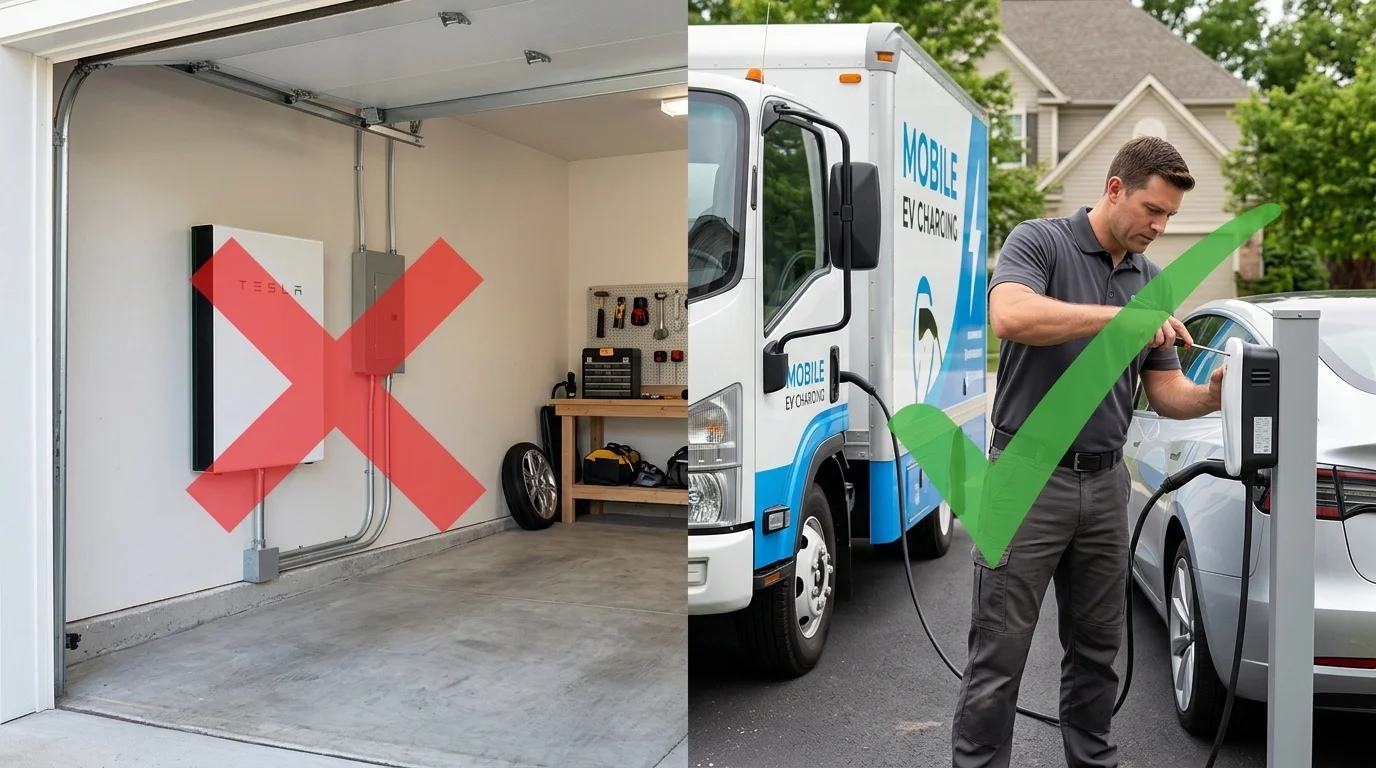
Two different battery backup problems
Home battery backup means a stationary storage system, often tied to rooftop solar, that keeps selected circuits running when SnoPUD or the grid goes dark. Most Monroe homes that add storage are on the US-2 corridor or in the woods east of the city, where tree-fall windstorms and winter icing knock out power for hours at a time. The hardware is large, permits are required, and a licensed electrician installs it.
EV battery backup is a different problem. The traction pack in your car is empty, or the 12V battery that boots the computers has died, and the vehicle is stranded. The fix is energy delivered to the car, not energy stored at the house. Mobile EV charging is the roadside service that puts usable miles back into the vehicle so the driver can reach a fixed charger or home.
Charge Pro SEA does not sell, install, or service home stationary batteries. We connect stranded EV drivers across the Puget Sound region with licensed, independent local operators who run mobile charging trucks.
What a home battery backup actually does
A typical home storage install pairs lithium iron phosphate or NMC cells with an inverter and the home’s electrical panel. During normal hours the battery charges from the grid or from solar. When the grid drops, the inverter switches the home to battery power, often within a few hundred milliseconds, and selected circuits stay live until either the battery drains or the grid returns.
For a typical Monroe single-family home that means the fridge, some lights, internet equipment, a well pump if there is one, and a few outlets. Whole-home backup with HVAC and electric range is a larger system with a higher sustained output. The product line ranges from a single wall-mounted unit to a stacked array with its own subpanel.
The hardware and permitting are not DIY. Snohomish County PUD customers may qualify for a residential battery rebate, but the work still needs a licensed electrical contractor, a county permit, and an interconnection agreement with the utility. SnoPUD publishes program rules that change over time, so check the current status before contracting.
What happens to an EV when the house battery runs the house
The house battery does not feed the car. A homeowner who lost grid power overnight may wake up to a house that is still lit and a car that is still dead. The EV has its own traction battery, and it needs a charger, either the home Level 2 unit or a mobile truck, to refill.
A common Monroe scenario: the windstorm takes the grid down at 11 p.m. The house battery covers the essentials. By morning, the EV sits at 8 percent because nobody remembered to plug it in before the storm. The Level 2 charger needs the grid to run, and SnoPUD’s Flex EV rate schedules around evening hours anyway. Now the homeowner has two backup problems, not one, and the second one is mobile.
This is where mobile EV charging differs from home storage. The mobile operator brings a portable Level 2 or DC source in a truck, connects to the vehicle’s charging port at the home or wherever the car sits, and adds enough energy to reach the next fixed charger. The service is a referral, not a sale: Charge Pro SEA matches the driver with a licensed independent local operator; the operator quotes the job and bills the customer directly.
Why an EV rescue operator shows up for “battery backup Monroe” searches
Search engines do not separate home storage from EV charging when the words match. “Battery” and “backup” both describe both problems. So a Monroe driver whose EV is dead after a power outage may find a home-storage installer, a portable EV charger retailer, and a mobile EV rescue brand in the same results page. Only the mobile rescue brand actually puts energy into a stranded car at the address.
The way to tell which service you need is to ask one question first: is the problem at the house or at the car? If the lights work and the car does not, the answer is mobile EV charging. If the lights do not work and the car is fine, the answer is a licensed electrical contractor for the home battery.
Charge Pro SEA’s role is the second case. We refer stranded drivers to operators across Snohomish County, including Monroe, Sultan, Gold Bar, and the surrounding US-2 corridor. The matched operator confirms the connector type, the available power, and the access conditions, then performs the work or declines if the situation does not fit mobile service.
When mobile charging fits and when it does not
Mobile charging fits when the vehicle can safely accept compatible power at its location. The driver provides the vehicle details, the connector type, the displayed warnings, and the remaining charge. The matched operator decides whether a Level 2 portable unit will add useful miles or whether the situation calls for transport.
Mobile charging does not fit when the vehicle is in an unsafe position, when the traction pack is damaged, or when the failure mode is not energy-related. A damaged pack needs a service center. A vehicle wedged against a barrier on US-2 needs a wrecker. A 12V battery that died overnight may only need a portable jump, which our Tesla 12V battery jump service covers for Tesla models and our non-Tesla EV rescue covers for the rest.
For a side-by-side look at the two backup paths, our mobile EV charging versus home battery backup post walks through the choice a homeowner is actually making.
When to call us
If the EV is the problem and the house is fine, call (206) 202-7018 to reach a local EV rescue operator. Charge Pro SEA connects drivers across the Puget Sound region, including Snohomish County and the US-2 corridor, with licensed independent local operators.