Many Puget Sound EV owners hear “battery backup” and “mobile charging” mentioned in the same breath, but they are different solutions for different problems. Understanding the difference helps you know who to call when your EV needs power and where the line falls between rescue and home energy.
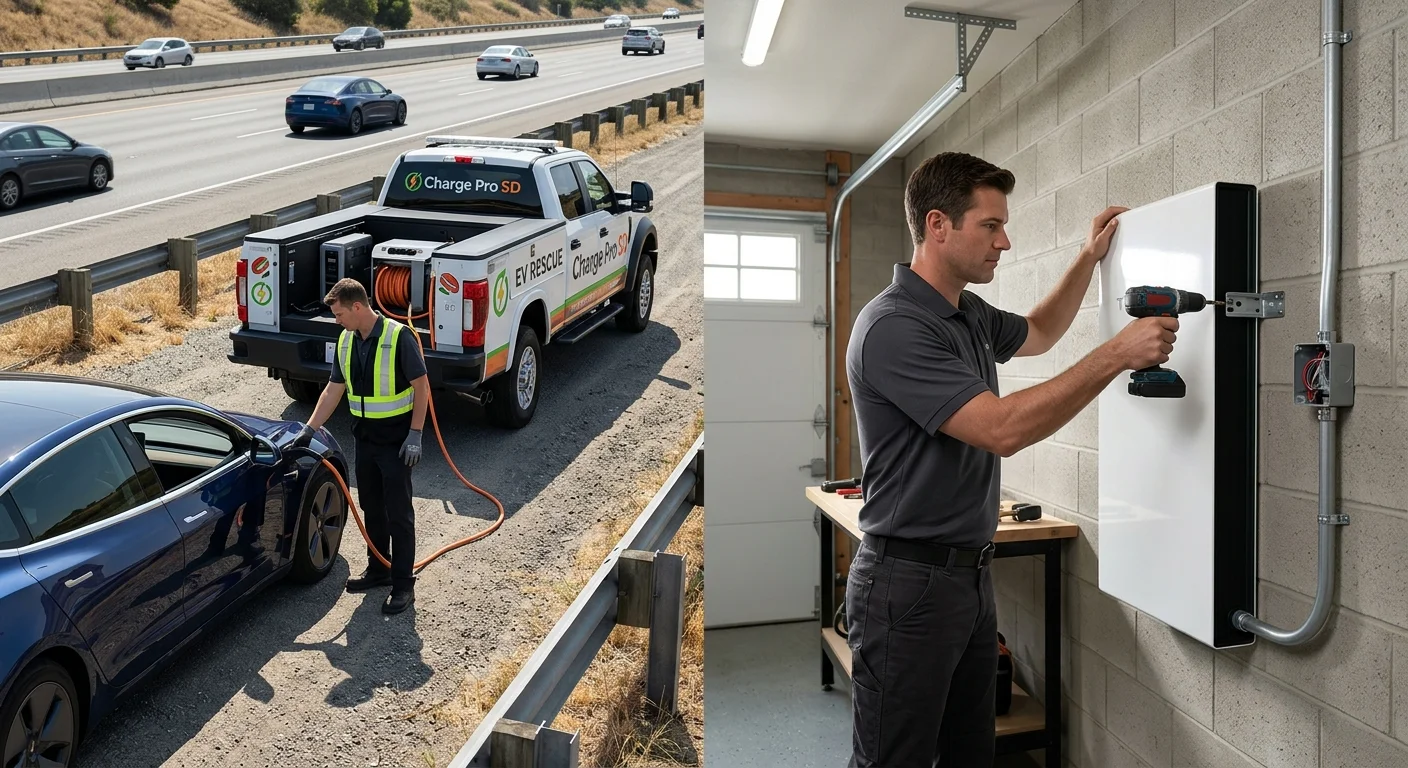
What is mobile EV charging?
Mobile EV charging is an emergency roadside service designed to get your electric vehicle moving again when its battery runs critically low or completely dead while you are on the road. Think of it as the modern version of a gas can delivery, but instead a specialized vehicle brings a charge directly to your EV. If you are driving along I-5 near Shoreline or crossing the I-90 floating bridge and your range estimate plummets, this is the service that gets you home.
Charge Pro SEA provides this lifeline across the metro. Operators drive vehicles carrying portable EV chargers that deliver enough energy to your car to reach the nearest charging station or your home. We are here for those unexpected moments: a miscalculated route, a forgotten charge overnight, or a range estimate that did not hold up. We offer mobile EV charging and full EV roadside assistance for all EV makes and models, including Teslas, Fords, Hyundais, and more. Our focus is immediate, on-site power delivery to minimize your downtime and get you safely back on your way.
What is home battery backup?
Home battery backup refers to an energy storage system installed at your residence. Tesla Powerwall is the most widely known example, but many other brands offer similar setups. These systems consist of large, wall-mounted batteries that store electricity, often generated from rooftop solar panels or drawn from the grid during off-peak hours. Their primary purpose is to provide power to your home during electricity outages.
When the grid goes down because of a wet-season windstorm, a planned outage, or a feeder failure, the home battery backup system automatically takes over. It keeps your lights on, your refrigerator running, and can even charge your EV if it is parked in your garage. This type of system is a long-term investment in home energy independence and resilience. It is designed to keep your household powered and comfortable when the utility cannot.
Why they are not the same thing
The core difference between mobile EV charging and home battery backup comes down to location and purpose. Mobile EV charging is an emergency service for vehicles stranded away from home due to a low battery. Its purpose is immediate, temporary vehicle mobility. Home battery backup is a fixed installation at your home to keep your residence powered, regardless of grid availability. Its purpose is long-term home energy security.
You would not call a mobile EV charging service if your house lost power, just as you would not expect your home battery to come rescue your EV on the shoulder of SR 167. These are distinct services provided by different types of specialists. Charge Pro SEA provides the former: rapid, on-demand power delivery to your stranded EV across the metro. Companies that install home battery backup systems are typically licensed electricians or solar contractors. They specialize in complex electrical installations, often involving solar panel integration and permit acquisition. They are home energy experts, not roadside rescuers.
When you need mobile rescue: stranded on the road
You need mobile EV rescue when your electric vehicle runs out of charge or has a critical battery issue that leaves it immobile away from a charging station. This could happen unexpectedly in many ways across the metro. Perhaps you misjudged the last charging opportunity on a long run up to Stevens Pass on US 2, finding yourself with zero range indicators on a snow-covered stretch. Or maybe you had a busy day in Bellevue, made several unexpected detours, and your battery would not make the rest of the way home to Edmonds.
These scenarios require immediate, on-site assistance. Waiting for a tow truck is a lengthy process, and it often just moves your dead EV to another location without addressing the core problem of no charge. Charge Pro SEA brings power directly to you, whether you are on a busy I-405 commute, in a Southcenter parking lot, or a quiet residential street in Kirkland. We provide enough charge to get you safely to the nearest public charging station or your destination, avoiding the hassle and risk of being stranded.
When you need a home battery: surviving an outage
A home battery backup system becomes essential when the power grid fails and you want to maintain electricity for your residence. The Puget Sound sees windstorms every fall that can knock out power for hours or days, particularly in the more wooded neighborhoods of Bellevue, Mercer Island, and the Eastside plateau. Outages disrupt daily life and cost money in spoiled food or lost productivity.
Installing a home battery provides peace of mind. It allows your essential appliances to keep running, your refrigerator, lights, internet, and even the ability to charge your EV if it is plugged in at home. This type of system contributes to greater energy resilience for your household. Utilities in the metro, including PSE and Seattle City Light, run separate residential EV rebate programs that often stack with a home battery investment. If uninterrupted power at your residence is a priority, a home battery backup system is the solution.
What wet-season outages actually do to EV charging
A wet-season windstorm that takes out grid power does more than darken a kitchen. It also takes down any Level 2 charger that runs off the home’s main panel, including EVSE in attached garages. Drivers who rely on home charging wake up to a dark garage and a battery that did not top up overnight. A backup home battery can carry the charger for a stretch. A mobile charging call cannot help in that scenario, since the operator’s truck needs road access but the EV needs grid power to accept a charge at home.
The reverse is also true. A driver whose EV runs low on the road cannot wait for a home battery to do anything. Mobile charging is the only answer that puts power in the traction pack while you are stranded on I-5.
Charge Pro SEA is rescue, not installation
To be clear, Charge Pro SEA is your partner for emergency EV power and roadside assistance throughout the metro. Our mission is to quickly and safely get you back on the road when your EV is out of charge or experiencing a low-power issue. The operator arrives with the specialized equipment and expertise to deliver a charge directly to your vehicle, anywhere you are stranded. We are an emergency mobile service.
What we do not do is install, service, or sell home battery backup systems, solar panels, or fixed EV charging stations for residential or commercial properties. That work requires different licenses, different equipment, and different expertise. If you are looking to fortify your home against power outages or enhance your energy independence with a battery backup system, you will need to consult with a qualified electrician or solar installer in the metro. If your EV is sitting dead on the side of the road, however, Charge Pro SEA is exactly who to call for prompt, professional mobile EV charging assistance.
When to call us
Call Charge Pro SEA whenever your electric vehicle is stranded on the road in the metro due to a dead or critically low battery. Operators are ready to provide fast, reliable roadside rescue. Call (206) 202-7018 and we will connect you with a local operator who quotes you before starting.