Rivian highway assist is the brand’s driver assistance feature. It is not the same as roadside help when the truck runs out of charge. The two are different products with different response models. Knowing the difference saves time when a Rivian is stranded in the Puget Sound.
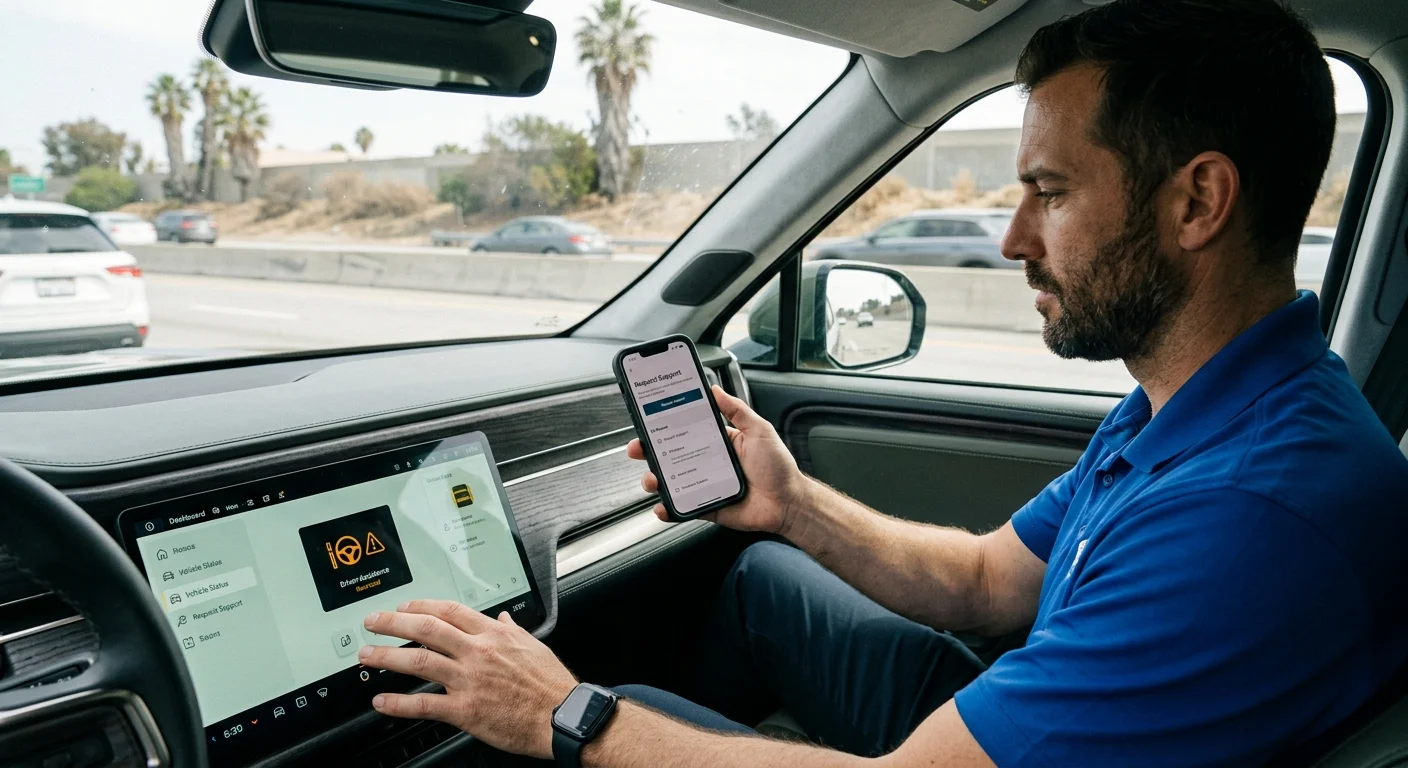
What Rivian highway assist does
Highway assist is a level-2 driver assistance feature on the R1T and R1S. It combines adaptive cruise control, lane centering, and automatic lane changes. The driver keeps their hands on the wheel and their eyes on the road. The system reads the lane markings and the cars ahead and adjusts speed and position accordingly.
Highway assist does not charge the truck. It does not summon help when the truck is stranded. It is a convenience feature for highway driving, not a roadside product.
What Rivian roadside assistance does
Rivian roadside is a national program that dispatches help for flat tires, lockouts, and out-of-charge situations. The dispatch line routes through a contracted service that may or may not have an EV-specific truck in the metro.
A Rivian that runs out of charge in Bellevue, Seattle, or on US-2 toward Stevens Pass may get a flatbed as the default response. The flatbed tows the truck to a working charger or a service center. The driver still needs a charge at the destination.
A Rivian that wakes up with a dead 12V in an apartment garage may get a battery boost. The boost is not a 240V Level 2 source, and it does not solve an empty pack.
What Rivian roadside does not cover
Rivian’s program is national. The local question is who can put 240V on the truck when dispatch sends a tow. The answer in this metro is an independent operator who carries native NACS for Teslas, CCS, and J1772 adapters for the rest of the fleet.
A mobile operator in the Puget Sound can add 10 to 20 miles of range in 15 to 30 minutes of Level 2 charging. That is enough to reach a working charger, the nearest driveway, or a safe parking lot. It is not a full pack.
Why a local mobile operator is the right call
The metro’s mix of independent operators handles the cases Rivian’s program does not. A Rivian that runs out of charge on I-5, I-405, or a state route needs a 240V Level 2 source, not a flatbed. Mobile rescue at the shoulder is faster and cheaper.
Mobile EV charging at the curb is the standard path. The operator quotes before starting and bills the driver directly. Charge Pro SEA connects you with a local operator who knows the metro.
When to call
Call (206) 202-7018 when your Rivian cannot reach a charger in the Puget Sound region. Charge Pro SEA connects you with a local operator who quotes before starting and bills you directly.