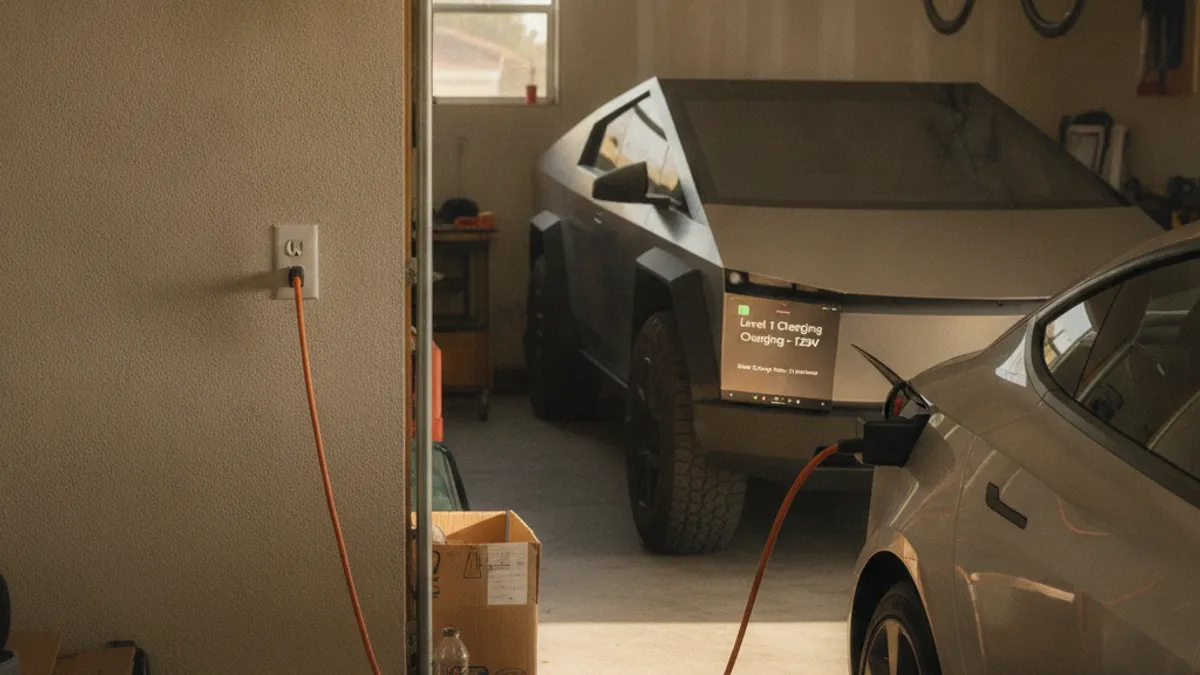
A Level 1 charger is not a separate product you buy. It is the basic cord that ships in the trunk with almost every new EV, and it plugs straight into a standard 120V household outlet. It is the slowest way to charge, adding roughly 3 to 5 miles of range per hour, and for most metro drivers with a real daily commute, it cannot keep up on its own.
How Level 1 charging actually works
Every EV comes with a portable charging cable that plugs into a regular household outlet, the same kind you would use for a lamp or a phone charger. No installation, no electrician, no permit. You plug it in, and the car slowly draws power overnight. It works because it is simple, but “simple” and “fast” are not the same thing here.
Because a standard outlet only delivers around 120 volts at a limited amperage, the charging rate tops out at roughly 3 to 5 miles of range added per hour. Starting from near empty, a full charge on Level 1 alone can take two to three full days of continuous plugging in.
What comes in the box, and what does not
The cable itself typically has interchangeable adapters, one end for the car’s charge port and a household plug on the other, sometimes with a second adapter for a 240V dryer-style outlet if your car supports it. That second option is closer to a slow Level 2 setup than true Level 1, and it is worth checking your owner’s manual to see which adapters shipped with your specific car. What does not come standard is any kind of hardwired installation. Level 1 is deliberately a plug-and-go setup, which is exactly why it needs no electrician and no permit, and exactly why it is capped at the speed a normal household circuit can safely deliver.
When Level 1 is genuinely enough
Level 1 is not useless. It works fine for drivers who put on fewer than 30 to 40 miles a day and have a full overnight window to recover that range, which describes a fair number of metro commuters with short in-town drives. It is also the default setup for plug-in hybrids, which have much smaller batteries than a full EV and do not need fast charging to top off.
The Puget Sound apartment problem
The math falls apart quickly for anyone in an older apartment building without an assigned parking outlet. King County has roughly 46.6 percent pre-1980 housing, Pierce 43.0 percent, Snohomish 36.0 percent. In specific cities the figure is much higher: Burien 68.6 percent, SeaTac 63.9 percent, Edmonds 63.3 percent, Tacoma 64.8 percent.
A typical pre-1980 building along Burien’s Ambaum Boulevard, Edmonds’ 76th Avenue, or Tacoma’s 6th Avenue has no outlet at any parking stall. The Level 1 cord cannot be used because there is no outlet to plug into. The owner does not even have the slow Level 1 path as a fallback.
This is the no-home-plug problem, and it is the dominant EV charging gap in the metro. Roughly two-thirds of renters in Burien, SeaTac, Edmonds, and Tacoma live without a 120V parking outlet, which means they live entirely on public charging. A driver in one of those buildings who arrives home at 8 percent battery on a Wednesday evening with the nearest Level 2 stall occupied has lost the day’s margin.
Apartment dwellers who do have a shared outlet in the lot face a second version of the same problem. The outlet, if it exists, is shared with the building’s exterior lighting circuit or a neighboring stall. Plugging in a 120V Level 1 cord at 16 amps alongside an outdoor light circuit on a cold winter night can trip the breaker at 2 a.m. The driver wakes up to a battery that did not top up.
Why most owners upgrade to Level 2 anyway
The math falls apart quickly for anyone with a longer commute, multiple daily errands, or an unpredictable schedule. Someone driving from Federal Way to a job in Bellevue, or commuting up the I-405 corridor from Renton, can easily use more range in a day than a Level 1 outlet replaces overnight. Miss one night of charging, or take an unplanned trip, and you are behind with no fast way to catch up.
That is why the large majority of full-time EV owners eventually install a Level 2 charger, a 240V circuit similar to what a dryer or oven runs on, which adds roughly 20 to 44 miles of range per hour depending on the car and the circuit. It turns overnight charging from a marginal top-off into a genuine full recharge. Installing one requires a licensed electrician, and the panel work involved can be substantial in older homes. In the metro, PSE, Seattle City Light, Tacoma Power, and SnoPUD each run their own residential EV rebate programs, which often stack with a Level 2 install.
Using Level 1 charging safely
A few practical habits matter more with Level 1 than with a properly installed Level 2 circuit. Plug directly into a wall outlet rather than an extension cord or a power strip, since a long cord run at this amperage can overheat over hours of continuous use. Make sure the outlet is on its own dedicated circuit if you are charging every night, since sharing it with other appliances on the same circuit can trip a breaker mid-charge. Older homes across the metro, especially those with outlets that predate modern grounding standards, should have an electrician confirm the outlet is properly grounded and GFCI-protected before you rely on it nightly. This is a low-cost check that prevents a much bigger problem down the line.
What to do when Level 1 leaves you short
If you are relying on a wall outlet and it simply cannot keep up, whether that is an unexpected extra trip or a Level 2 install that has not happened yet, running out of range mid-day is a real risk. Apartment renters who have no home plug at all are already there.
Charge Pro SEA brings a mobile Level 2 charger directly to you anywhere in the metro, adding enough range on-site to reach the nearest Supercharger or get you home, without waiting on a tow. Our mobile EV charging service exists for exactly this gap between what your current setup provides and what you actually need that day. For Burien, Edmonds, Tacoma, and SeaTac renters in particular, a planned on-site mobile charge at your parking lot removes the dependence on a public stall that might be occupied.
Frequently asked questions
How many miles per hour does a Level 1 charger add?
Roughly 3 to 5 miles of range per hour, depending on the vehicle. It is the slowest charging option and typically takes two to three days to fill a nearly empty battery.
Is a Level 1 charger enough for daily driving?
For drivers with short commutes under 30 to 40 miles a day and a full overnight charging window, yes. For longer commutes, unpredictable schedules, or apartment dwellers without a parking outlet, it usually falls short.
What is the difference between Level 1 and Level 2 charging?
Level 1 uses a standard 120V household outlet and needs no installation. Level 2 uses a 240V circuit, similar to a dryer outlet, and charges roughly four to ten times faster, but requires a licensed electrician to install.
Do I need to buy a Level 1 charger separately?
No. The portable Level 1 cable comes standard with nearly every new EV. You are only buying additional equipment if you decide to upgrade to a Level 2 home charger.
If a slow charge left you stranded before your next trip, call (206) 202-7018 to reach a local operator.