Tesla roadside assistance is a dispatch program, not a Tesla-branded charge truck sitting on call. You tap the car, Tesla triages the request, and a contractor often does the work on the shoulder. Charge Pro SEA is not Tesla, does not hold Tesla’s contract, and does not send a truck of its own. It refers stranded drivers to licensed local operators when Tesla will not refill the high-voltage pack.
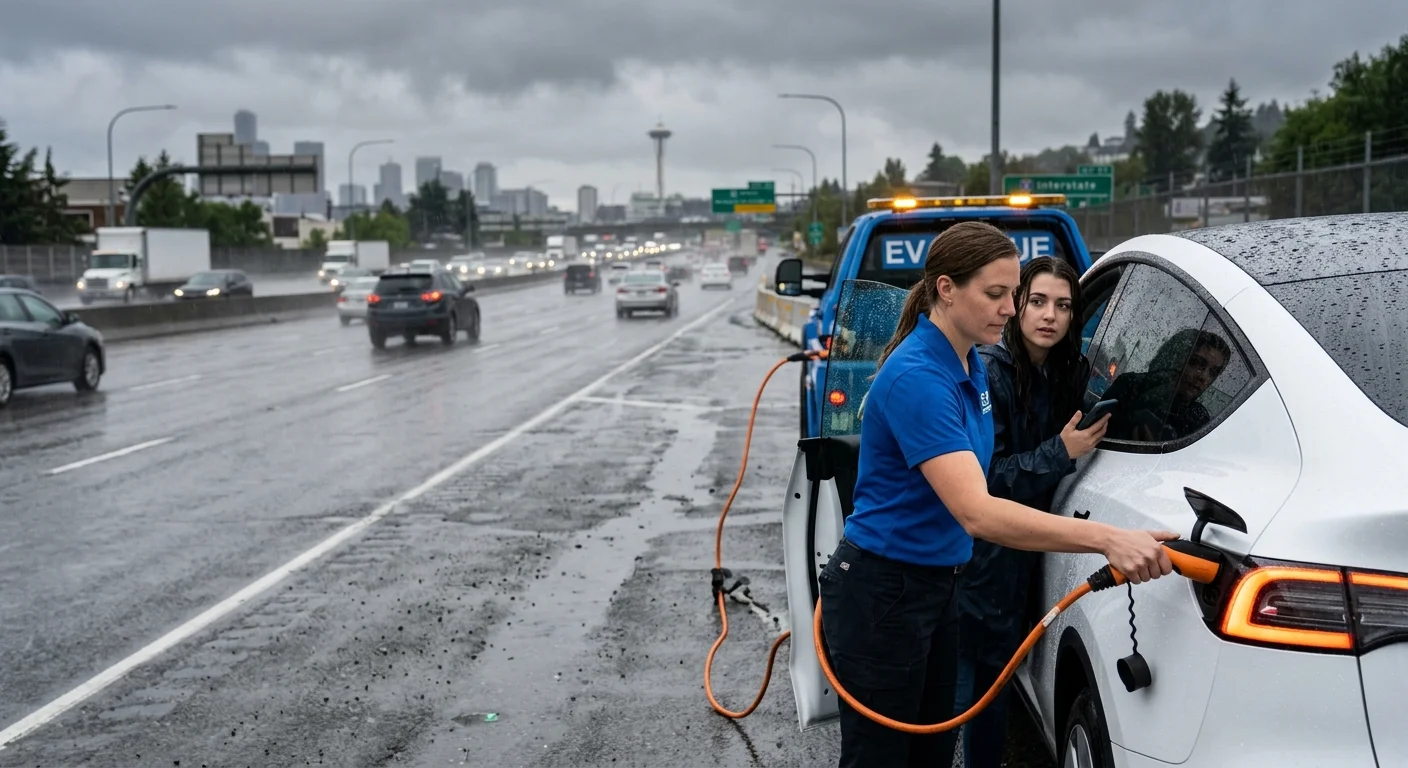
What Tesla roadside is built to handle
Tesla does have emergency roadside assistance. You request it in the Tesla app, not by hoping a Supercharger appears on I-5. The program is built for classic roadside events: a tow, a 12-volt no-start, a lockout, and a flat tire. Tesla Mobile Service is a different track. That one is a repair visit, often at home or work, not a shoulder rescue.
That split matters on a wet Puget Sound night. A Model Y that will not wake up is often a low-voltage battery, not an empty drive pack. The computers and contactors need that small battery before the pack can even connect. Roadside is the path Tesla points you toward for that kind of stall. A scheduled Mobile Service tech is the path for a warranty repair once you are already somewhere safe.
What Tesla roadside is not built to do is refill the high-voltage pack on the spot. Tesla’s current official roadside materials describe tow, 12-volt, lockout, and tire help. They do not present the program as a mobile Level 2 or DC charge. Confirm the live menu in the Tesla app and on Tesla.com before you assume a pack refill is on the list. Tesla changes those screens. A blog should not invent the current line items.
Included versus billed is the other trap. Searchers ask whether Teslas get free roadside. A complimentary window has existed for many new cars, and Tesla Insurance can change what you pay. The exact year, mile, or fee rule could not be confirmed from Tesla’s public pages at the time this was written. Open the Tesla app on the car that is stuck. That screen is the authority, not a remembered brochure. For a deeper map of what the program lists, see what Tesla roadside assistance covers.
A flat tire follows the same pattern. Tesla can dispatch tire help. What the contractor is allowed to do on a Seattle shoulder, and whether a repair, a spare, or a tow is the outcome, is set by Tesla’s current rules and the truck that shows up. Those limits were not a verified figure we could publish. Check the app, then decide if you need a local match instead.
How a request moves from the app to a contractor
You start in the car, not on a hold queue you found on a forum. In the Tesla app, you open the roadside request, confirm the problem, and send your location. The car already knows the VIN. Tesla already has the account. That is why the app is the clean path. Tesla’s own phone line exists, but Tesla does not keep a single public number that we could verify as stable. Use the app first.
Tesla then triages. The request is not a promise that a Tesla employee will walk up with a badge. In a lot of Puget Sound calls, Tesla routes the job to a third-party roadside contractor. That contractor is the one who finds you on the I-5 shoulder, in a downtown garage, or on the I-90 climb toward the pass. Tesla is the dispatcher. The truck on scene is often someone else’s.
Keep the car as visible and as far right as you can. Hazards on. If you are on a state highway and the stop is unsafe, dial 911. WSDOT’s Incident Response Team handles incidents on state highways, from flat tires and running out of gas to major collisions. Teams are on call around the clock and patrol major corridors during peak hours. WSDOT’s published materials do not mention electric vehicles, out-of-charge stalls, or EV charging. IRT can make the scene safer. It is not a mobile charger.
Washington also puts a duty on the driver. RCW 46.61.560 generally bars stopping on the roadway outside incorporated cities and towns, with an exception when the vehicle is so disabled that stopping is unavoidable. RCW 46.61.590 then requires the driver to arrange prompt removal. A Tesla sitting on a mountain-pass shoulder is not a camping spot while you wait for a perfect truck. You need a path that actually clears the lane.
Tesla does not publish a fixed wait we could verify. Anyone quoting “N minutes” for Tesla roadside is guessing. Traffic on I-5 through Seattle, a blocked downtown garage, or a wet night on I-90 will change the clock. Tesla also does not publish a contractor identity we can name. You will know more once the app shows a truck assigned.
What usually arrives, and what does not
What usually arrives is a conventional roadside unit. A wrecker for a tow. A tire truck if that is the ticket. Someone who can work a 12-volt no-start or a lockout, if Tesla assigned that job. What does not arrive is a Supercharger on wheels. The contractor is there to move the car, wake the 12-volt, or deal with a tire. The contractor is not there to fill the drive pack.
That is why “how good is Tesla roadside” is the wrong question if the pack is empty. The program can be fine at towing a Model 3 to a service center. It can still leave you stuck if what you needed was range to the next charger. Quality, in that moment, is whether the truck that shows up can do the job you actually have.
Downtown Seattle parking garages add a second mismatch. A low-clearance wrecker, a tight ramp, and a Tesla that will not roll on its own are a bad combination. The contractor may not be able to reach the stall. You may still need a local operator who can charge on site, or a tow planned around the garage’s height and access rules. Tesla’s dispatch screen will not know the garage manager’s after-hours policy.
Wet nights are the 12-volt pattern. Rain, short trips, and cabin heat load the small battery. The car looks dead. The pack may still hold tens of miles. A Tesla roadside 12-volt visit can be the right ticket if that is the failure. If the screen already says the high-voltage pack is empty, a 12-volt jump will not invent range.
A tow is the other common arrival. Tesla roadside can send the car to Tesla Service. That helps when the car needs a shop. It is a slow, expensive-feeling path when all you needed was enough charge to get off I-5 and to a Supercharger. Confirm destination rules in the app. Mile caps, included tows, and extra-zone fees could not be verified here. Tesla sets those, and they move.
When a local mobile charge is the better next call
Call a local mobile charge when the high-voltage pack is the problem. Tesla roadside will not refill that pack as a standard roadside act. A matched operator can. Charge Pro SEA is a referral service. It connects you with licensed, independent local EV charging professionals. The operator quotes and bills you directly. The brand sets no price and promises no arrival window.
A typical rescue charge, from the brand’s published rescue story, puts about 10 to 20 miles of range back in 15 to 30 minutes of Level 2 charging. That is charging time on the cable, not a promise about when anyone shows up. Ten to twenty miles is often enough to leave an I-5 shoulder, clear a downtown block, or reach a Supercharger instead of riding a wrecker across town.
That is the handoff this page exists for. If Tesla’s app offers a tow and you only need range, skip the long shop trip. Ask for a Tesla roadside rescue match, or a straight mobile EV charging visit. The operator brings charging equipment to the car. You stay with the Tesla. You do not wait on Tesla to invent a service it does not sell.
Use Tesla roadside when the job is a tire, a lockout, a 12-volt wake-up, or a tow Tesla will actually cover. Use a local charge when the car is out of pack, the Supercharger is a few miles away, or the contractor on the app cannot reach you. A dead Tesla in a Southcenter garage, a stall on SR 99, and an empty pack east of North Bend on I-90 are all pack problems first.
Do not mix the two in your head. Tesla Mobile Service is still a repair visit. Tesla roadside is still dispatch. A local mobile charge is a third path: range on site, billed by the operator, with no Tesla contract attached. If Tesla declines the pack refill, that third path is the one that gets the car moving.
How Puget Sound geography changes the outcome
This region is dense with Teslas, and it is not one road. Washington had 299,705 registered EVs in the state file updated 2026-09-15, and Tesla accounted for 122,981 of them, about 41 percent. King County alone had 144,257 EVs, 63,017 of them Teslas, about 44 percent. Seattle had 45,469 registered EVs. The Washington DOL EV population data is the source. A Tesla roadside playbook written for an empty desert interstate will not read the same here.
I-5 through Seattle and South King County is stop-and-go, wet, and shoulder-poor. A disabled Tesla there is a traffic hazard fast. WSDOT IRT can buffer the scene if you dial 911. IRT still will not charge the pack. RCW 46.61.590 still wants the car moved. A local charge that restores 10 to 20 miles can be the difference between rolling to a charger and waiting on a wrecker in the rain.
I-90 toward Snoqualmie Pass is a different failure. Grade, cold, and traction rules stack. Across 30-plus EV models, Recurrent Auto found EVs keep about 78 percent of range at 32F, a loss of about 22 percent. AAA testing at 20F found temperature alone cut range 10 to 12 percent, and cabin heat pushed the loss toward 40 percent. An Eastside commute that looked fine at noon can strand a Tesla after dark. Tesla roadside may offer a tow back west. It still will not refill the pack on the shoulder.
Downtown garages and ferry lines add access, not miles. A contractor who cannot enter the garage cannot complete Tesla’s ticket. A stall in line for Mukilteo is not a highway tow. Local operators who already work those sites know the ramps and the waiting lots. Tesla’s national dispatch map does not.
Eastside, South King, Pierce, and the pass corridors also do not share the same charger density. Bellevue and Redmond have more public options than Gold Bar. A Tesla that dies in Kirkland may be three miles from a Supercharger. A Tesla that dies on US 2 is not. Geography decides whether Tesla’s tow is a short hop or an all-evening project. Geography is why a local charge is often the better next call once Tesla will not put energy in the pack.
When to call us
Call when Tesla roadside will not refill the high-voltage pack, or when the contractor on the app cannot reach the car. A stall on an I-5 shoulder, in a downtown garage, or on the I-90 climb is a local operator job if all you need is range. Call us at (206) 202-7018 and we’ll connect you with a local EV rescue operator.