The same EV problem can land at two very different doors. A car that runs out of charge on I-5 needs a mobile rescue with a 240V Level 2 source. A car that refuses to charge on a working Level 2 post needs a shop diagnosis. Mixing them up costs time and money.
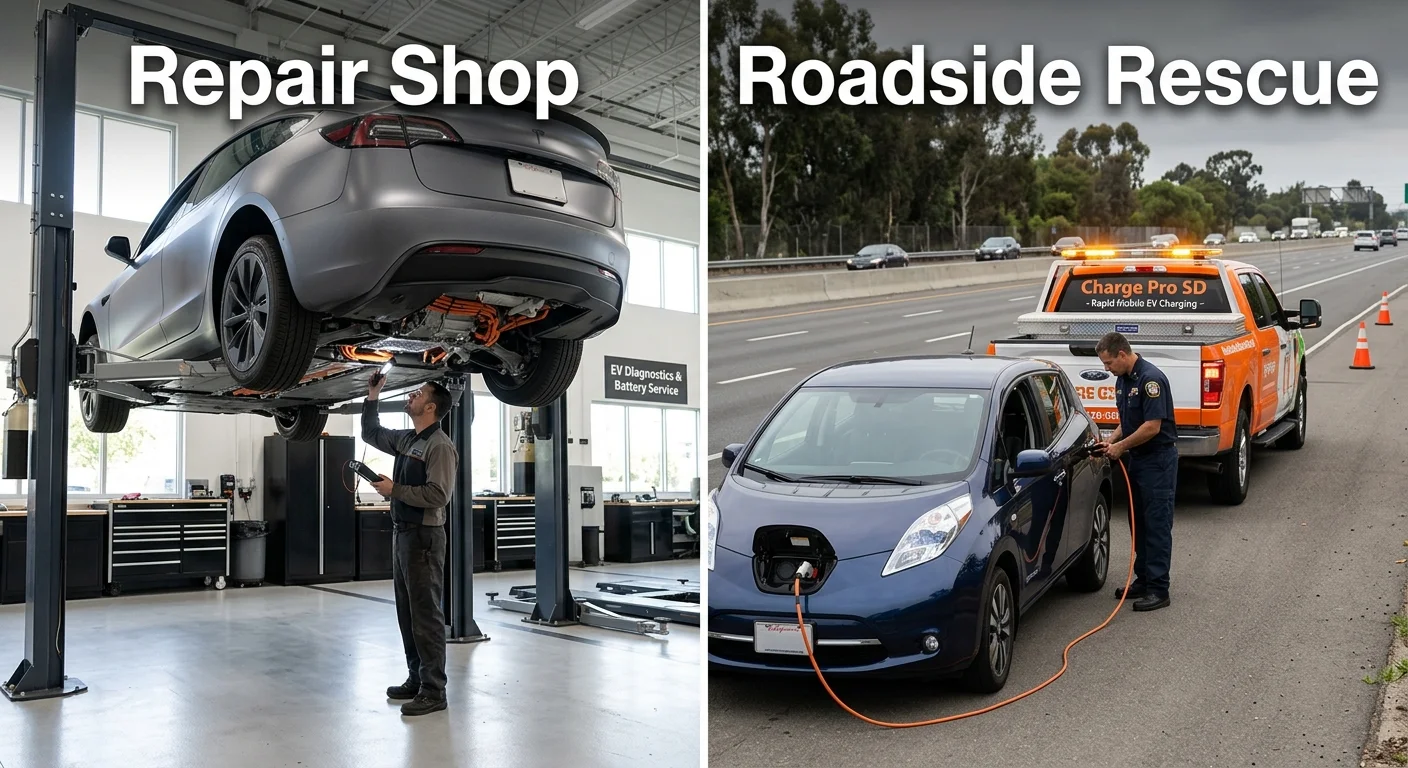
What rescue handles
Mobile rescue handles the moment the car cannot continue. Out of charge on a shoulder, dead 12V in an airport garage, a stuck charge cable at a public post, a flat tire on a pass climb. The operator brings a 240V Level 2 source, a 12V jump pack, a basic tire kit, and the cabling to release a stuck handle.
A successful rescue returns the car to a state where the driver can continue. That means enough range to reach a working charger, a healthy 12V to start the car, or a released cable so the driver can move on. Fifteen to thirty minutes of Level 2 charging typically adds 10 to 20 miles of range, which is the typical recovery window.
Mobile EV charging is the most common rescue service in the metro. The operator quotes before starting and bills the driver directly. Charge Pro SEA connects you with a local operator who knows the corridor.
What repair handles
A shop handles the diagnosis that a rescue operator cannot complete on the shoulder. A car that refuses to charge on a working Level 2 post may have a faulty onboard charger, a wiring issue, or a battery management fault. A car that throws persistent error codes after a successful charge needs a scan tool and a trained technician. A car with a traction battery warning light needs factory diagnostics.
Repair work happens at a licensed shop with diagnostic equipment, parts inventory, and a bay. The repair estimate, parts lead time, and labor rates are between the driver and the shop. Mobile rescue does not replace a shop visit when the problem is not range-related.
The middle case
A few problems sit between rescue and repair. A 12V that dies repeatedly after a successful charge usually points to a parasitic draw or a battery management fault. The rescue operator jumps the car, and the driver should drive it to a shop for diagnosis. A car that charges to 80 percent and stops may have a thermal management issue, which is a repair case. A car that throws a low-voltage warning but starts after a jump is sometimes a borderline 12V that needs replacement soon.
Drivers in the Puget Sound should keep the name of a local independent EV shop handy for the cases that mobile rescue cannot solve. The Tesla Service Centers in the metro handle warranty work, but they are often booked out. A trusted independent shop gives the driver an option when the dealer is full.
Common rescue calls that look like repair
A driver who wakes up to a dead 12V on a Tesla almost always sees the touchscreen stay dark. The fix is a 12V jump, not a service center visit. The rescue operator carries a portable jump pack designed for EVs and can restore the car on the spot.
A driver who plugs in at a public post and gets a red fault light often has a wet connector or a software glitch. The rescue operator cleans and dries the port, then verifies a successful handshake with another cable. If the handshake fails on multiple cables, the problem is the car, and the next stop is a shop.
A driver whose charge port is stuck in cold weather often just needs a manual release. The rescue operator carries the tools and knows the per-model release procedure. That is a rescue call, not a repair.
Common repair cases that masquerade as rescue
A car that throws a high-voltage warning light after a charge needs a factory scan. No mobile operator carries the diagnostic equipment for that. The driver should arrange a flatbed to a licensed shop.
A car that loses range dramatically over weeks is not a roadside problem. That is a battery health question that belongs to a shop with the right test gear.
A car with a damaged charge port from a collision is a body shop and electrical diagnostic case, not a rescue call.
When to call which
Call rescue when the car is stopped and the driver cannot continue safely. Call a shop when the car runs but throws a warning. The two are not interchangeable. Mixing them up costs time and money.
When to call
Call (206) 202-7018 when your EV is stopped and you need a mobile operator in the Puget Sound region. Charge Pro SEA connects you with a local operator who quotes before starting and bills you directly.