EV charging levels describe how an electric vehicle receives power. Level 1 and Level 2 use AC electricity, while DC fast charging supplies far more power. For a stranded driver in the Puget Sound, the connector, battery state, location, and available equipment determine whether charging or transport makes sense.
What each charging level means
A Level 1 charger for an EV uses 120V AC power. That is the voltage supplied by a standard household outlet. The verified specifications list a 1.9 kW power output and an SAE J1772 connector.
Level 1 adds approximately five miles of range per charging hour. Eight hours can provide roughly 40 miles for a midsize EV. Those figures are useful for planning, but they are not promises for every vehicle. Battery capacity, state, and temperature affect actual results.
Level 2 uses 240V in residential settings or 208V in commercial settings. Its verified power range is 2.9 to 19.2 kW. The Department of Energy figures list 7.2 kW as the residential standard and about 25 miles of added range per charging hour. Connectors include J1772 and J3400, also known as NACS, for Tesla vehicles.
DC fast charging is the category many drivers associate with the term Level 3. Verified equipment can deliver up to 500 kW. It may add approximately 100 to more than 200 miles in 30 minutes. Supported connectors include CCS, CHAdeMO, and J3400.
Those are maximum or approximate capabilities, not guaranteed results. The vehicle controls how much power it accepts. Battery capacity, state of charge, and ambient temperature also matter.
Which charging options can help on the road
Charging speed matters only after finding a safe, compatible power source. A standard outlet does not become a practical roadside solution merely because Level 1 equipment is in the vehicle.
Level 1 may fit when the vehicle is parked somewhere appropriate and a suitable dedicated circuit is available. Its slower charging rate can still provide enough energy for a short next step. The driver should check the vehicle manual and confirm that the outlet and charging equipment are appropriate. Do not treat an unfamiliar outlet as approved simply because the plug fits.
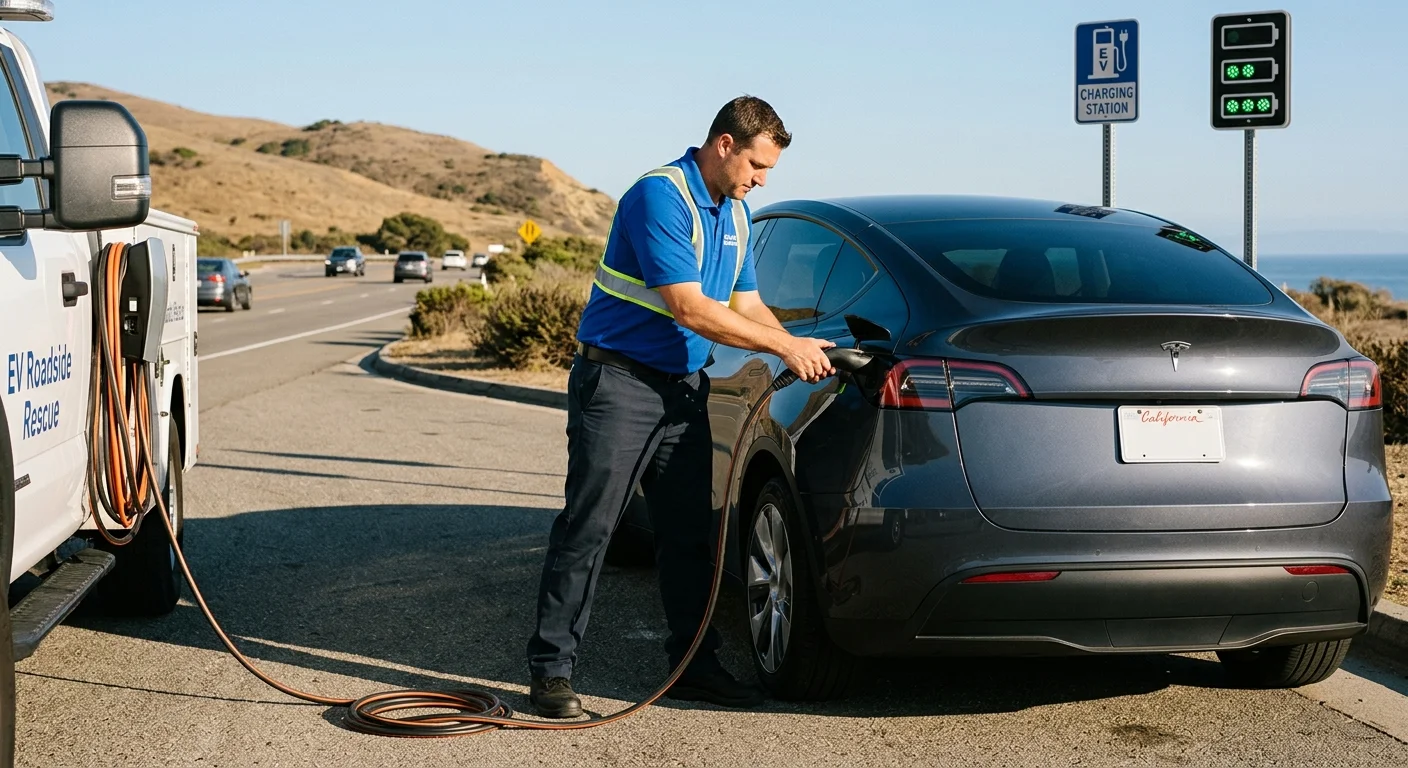
Level 2 can add range faster, but it needs compatible equipment and electrical service. A mobile operator may have equipment that works with some vehicles. The operator must confirm the available charging method, connector, and expected output before beginning. In the metro, a Level 2 mobile stop adds 10 to 20 miles in roughly 15 to 30 minutes, enough to clear most range emergencies and reach a real station.
DC fast charging usually serves commercial or public infrastructure. Its high maximum output does not mean that power can be brought to every roadside location. A stranded vehicle may also be unable to reach a fixed fast-charging station without help.
Your first decision is whether the vehicle needs energy or another form of recovery. Check the dashboard message and the vehicle manual. A depleted traction battery points toward charging or out-of-charge recovery. A vehicle that will not accept a charge may need a different response.
Why the vehicle and connector still matter
The charging level does not confirm compatibility by itself. The plug, charging equipment, and vehicle charging system must work together.
J1772 is associated with Level 1 and Level 2 AC charging. J3400 is used by Tesla vehicles and also appears in the DC fast-charging connector list. CCS combines AC charging hardware with additional contacts for DC charging. CHAdeMO is another DC fast-charging connector.
A connector that looks familiar still needs confirmation. Adapters and vehicle support vary, so check the owner’s manual. The charging provider should also verify its equipment against the vehicle’s make, model, and charge port.
Roadside assistance for EV charging therefore starts with clear information. Tell the operator which vehicle you have and what the dashboard displays. Describe the charge-port type if you know it. Explain whether the traction battery reached an indicated empty state or the vehicle stopped responding differently.
Location changes the practical decision too. A vehicle in a Bellevue parking garage presents different access conditions from one stopped near I-405, I-5, or US-2. Drivers around Seattle, Bellevue, Kirkland, and Everett may also be different distances from compatible public charging.
No verified universal range figure applies to every mobile session or vehicle. Use the operator’s equipment details and your vehicle manual instead. Our Puget Sound EV charging guide can help you consider local charging before the battery reaches empty.
When mobile charging may fit
Mobile charging may fit when the traction battery is depleted and the vehicle can accept the operator’s equipment. The vehicle also needs to be accessible from a suitable working position. The matched operator should confirm both points before service.
The practical goal is not always a full battery. It may be enough usable energy to reach a compatible charging location. Still, there is no approved universal figure for how much range a roadside session will add. The answer depends on charging power, battery state, vehicle acceptance rate, and temperature.
Give the operator specific details when requesting mobile EV charging. Include the make, model, displayed battery state, connector type, and exact location. Mention parking structures, access restrictions, or an unsafe traffic position. Those details help the operator decide whether its equipment can fit the scene.
Mobile charging may make more sense in a parking area than beside moving traffic. If the vehicle creates an immediate road hazard, contact the appropriate emergency authority and follow official instructions. Do not stand in traffic or attempt to move charging equipment across active lanes.
We connect stranded drivers with licensed, independent local operators serving the metro. The customer contracts with and pays the operator directly.
Ask the operator to confirm its charging method, compatibility, scope, and price before authorizing service. We do not set operator prices or give warranties. Any terms for the work come from the independent operator.
When the vehicle may need transport
Transport may be the better option when compatible mobile charging is not available. It may also fit when the charge port will not accept the available connector or the vehicle does not begin charging. Those symptoms do not prove a specific fault, so check the vehicle manual and avoid guessing.
A high-power charging specification cannot solve every roadside problem. DC fast equipment may support up to 500 kW, but that is a maximum equipment capability. Actual charging still depends on the vehicle’s acceptance rate, battery state, and available infrastructure.
Transport may also be considered when the vehicle cannot be reached safely by charging equipment. Road shoulders, restricted garages, and blocked charge ports can change what is practical. The independent operator should evaluate the situation and explain the available options.
Do not improvise a towing or loading method from another vehicle’s instructions. EV transport procedures can depend on the specific model. Use the manufacturer’s manual and confirm the method with the operator responsible for moving the vehicle.
Our out-of-charge recovery service connects metro drivers with independent local operators. The operator determines whether charging, recovery, or transport fits the vehicle and location.
If a specific charging or transport requirement cannot be confirmed, say so during the service request. Ask the operator to verify it against the vehicle documentation. That is safer than treating a general charging-level chart as model-specific guidance.
Call (206) 202-7018 to reach a local operator who can sort out whether charging, recovery, or transport fits your situation.