When Sammamish homeowners type “battery backup” into a search bar, they usually mean one of two things, and mixing them up wastes time. Either they want the house to keep lights on during a winter storm outage, or they want the EV to keep moving when its own batteries run low. The words overlap. The fix for each does not.
The Plateau holds some of the densest EV ownership on the Eastside. Sammamish shows about 8,129 registered EVs, and many driveways hold two. The home is also a place where long power outages from windstorms or wet snow are common enough that battery backup has become a real consideration for the house.
What most Sammamish homeowners actually mean
“battery backup sammamish” usually means one of three things:
- A whole-home or partial-home battery that powers circuits during a PSE outage. Tesla Powerwall, Enphase Encharge, and Generac PWRcell are the common picks.
- A Level 2 home charger installed on the existing electrical panel. Most Sammamish homes were built in the 1990s through the 2010s, and many already have the panel headroom for a 40 or 48 amp circuit.
- Mobile EV charging when the car’s traction pack goes flat and there is no working charger nearby.
These are three different jobs. Each one is owned by a different trade.
The home backup battery, who installs it
A whole-home or partial-home battery is a fixed electrical installation. It is wired into your service panel and may interact with a rooftop solar system. In Sammamish, the utility for almost every address is Puget Sound Energy, and PSE’s Up & Go Electric program is the active residential rate and incentive framework for managed EV charging, with separate pathways for storage.
This work is licensed. The Washington State Department of Labor and Industries issues the electrical contractor license (the equivalent of California’s C-10). Verify any contractor’s license at lni.wa.gov before signing a contract. Charge Pro SEA does not install home batteries. We connect stranded EV drivers with licensed, independent local EV rescue operators.
If your goal is home resilience, your next call is to a Washington-licensed electrical contractor who can size the system, pull the permit, and coordinate any required utility approval.
The Level 2 home charger, who installs that
A Level 2 charger runs on a 240V circuit. Most Sammamish homes can host one without a panel upgrade, but only a licensed electrician can run the load calculation and confirm. The electrician pulls the permit, installs the breaker and the cable run, and arranges inspection through the City of Sammamish.
PSE’s Flex EV rate rewards customers who schedule home charging off-peak, and the Up & Go Electric program has offered bill credits for managed charging. Confirm the current program status directly with PSE before counting any credit in your budget.
The federal tax credit that covered part of home EV charger installation costs expired for installations completed after a federal deadline in 2025. State and utility incentives in Washington change, so ask your electrician what is active at your address right now.
Mobile EV charging, who does that
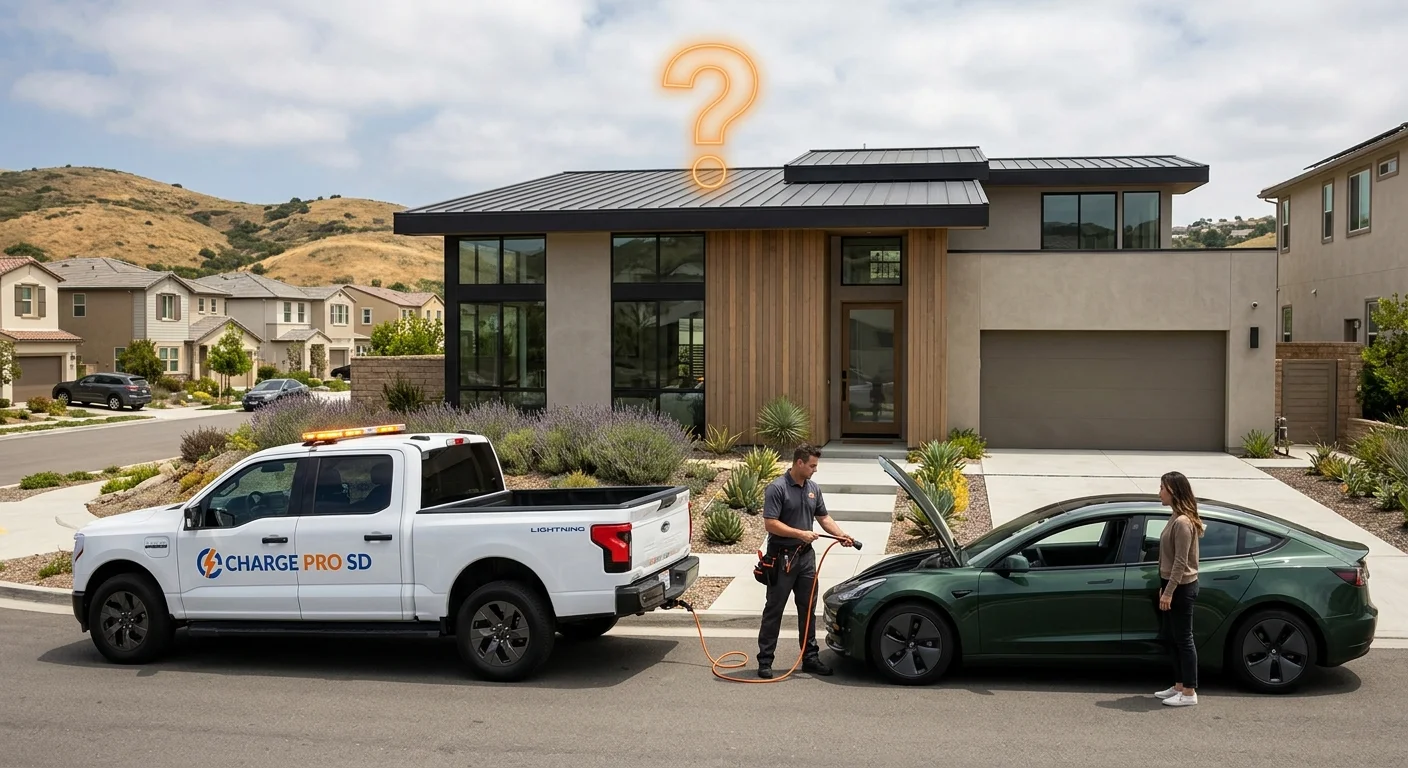
If the question is really about your car being dead, then you are looking for a different service. Mobile EV charging brings a portable 240V source to where your car sits and adds enough range to drive to a working charger or home. This is not a home battery and not a home charger install. It is a roadside service.
Sammamish terrain makes this different from a flat suburb. The Plateau’s elevation, plus the climb up from I-90 and the Eastside arterials, can drain a pack faster than navigation expects, especially in cold weather. A driver who started the day with a partial charge and ran the heat on a 35F morning can find the readout at zero in the Timberline or Soaring Eagle area without warning.
For those cases, our mobile EV charging service connects you with an operator who knows the Sammamish plateau and the access streets off 228th Ave SE and SE 4th St.
When both systems fail at the same time
The worst case is the one worth planning for: a power outage at home that strands an EV that does not have enough charge to reach a working public station. This happens in Sammamish more than the numbers suggest because most public Level 2 stations are also on the grid that just dropped. DC fast charging sites with battery buffering are rarer.
If you find yourself in this position, the order matters:
- Confirm the outage scope. PSE’s outage map shows whether the area is hours or days.
- Decide whether to wait it out at home or drive to a working station. If the second, do it before the pack drops further.
- If the pack is already too low to reach a station safely, call for mobile EV charging. The operator will reach you faster than a flatbed.
- Once the home battery is in and the car is topped up, run the home charger off the home battery only if your electrician set the panel up to island the charger circuit. Most setups will not.
For a deeper look at how this plays out across the Eastside, our EV roadside guide for Redmond covers the same problem in a different city. The Sammamish scenario adds elevation and longer feeder-road access.
What we do and what we don’t
Charge Pro SEA does not install home batteries, Level 2 chargers, or any fixed electrical work. We connect stranded EV drivers in Sammamish and the rest of the Puget Sound region with licensed, independent local operators who run mobile EV charging trucks. The customer contracts and pays the operator directly. Confirm pricing, scope, and equipment before any work starts.
If your priority is keeping the house lit during a storm, talk to a Washington-licensed electrical contractor. If your priority is keeping the EV charged enough to drive, our referral line is the right call.
If your EV is out of charge or stuck in Sammamish, call (206) 202-7018 to reach a local operator.